Rockefeller University Hospital
1198 York Avenue | also 590 East 68th Street | Lenox Hill | built 1940
Open on the map11 entries

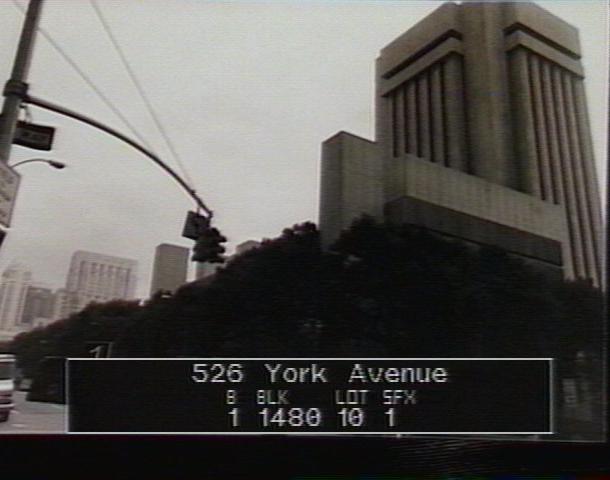
The city photographed every building for its tax records around 1940 and again in the 1980s. NYC Municipal Archives.
Written with AI from the source each entry cites, then fact-checked.
- 1910
The Rockefeller Institute Hospital opens for clinical research
The Rockefeller Institute Hospital opened in 1910 as the first center for clinical research in the United States, a place where scientists could connect laboratory work with the care of patients at the bedside. The institute itself became The Rockefeller University in 1965.
Source: rockefeller.edu
- 1913
Rufus Cole brings Oswald Avery to the hospital to make and test a pneumonia serum
After Rufus Cole became director of the hospital in 1908, he set its main goal as a therapeutic serum for lobar pneumonia. One of Oswald Avery's research papers caught his attention, and he offered Avery a position in 1913. On joining the hospital staff, Avery was given the job of processing the serum and measuring how well it worked against pneumococcus.
Source: profiles.nlm.nih.gov
- 1937
Thomas Rivers succeeds Rufus Cole as director of the Rockefeller hospital
Rufus Cole, the first director of the hospital that opened in 1910 as America's first facility for clinical research, retired in 1937. He was succeeded by Thomas Milton Rivers. Rivers also directed the institute's virology laboratory, where he worked to establish virology as a field apart from bacteriology.
“The Rockefeller Hospital's first director Rufus Cole retired in 1937 and was succeeded by Thomas Milton Rivers.”
Source: Wikipedia
- 1940
By 1940, hospital-trained doctors fill nearly half of the top academic medicine posts
The hospital opened in 1910 with laboratories of its own, so physicians could pursue research on the diseases they treated on its wards. According to the hospital's own history, by 1940 close to half of the leading academic internal-medicine posts across the United States were occupied by alumni who had trained there in clinical investigation.
Source: centennial.rucares.org
- 1944
Oswald Avery's team shows that genes are made of DNA
Working at the Rockefeller Hospital, Oswald Avery, Colin MacLeod and Maclyn McCarty studied how one type of pneumococcus bacterium could transform into another. Their 1944 paper in the Journal of Experimental Medicine showed that the substance causing this permanent, inherited change was DNA, a result that opened the era of molecular biology.
Source: centennial.rucares.org
- 1950
A new wing modernizes the Rockefeller Institute Hospital
The hospital gains a new wing and a full modernization of its original 1910 building, finished in 1951. Five research groups move into the renovated space, studying respiratory disease, rheumatic fever, cardiovascular disease, endocrine disorders, and chronic liver disease.
Source: digitalcommons.rockefeller.edu
- 1965
The Rockefeller Institute Hospital is renamed Rockefeller University Hospital
Under Detlev Bronk the Rockefeller Institute began awarding PhD degrees in 1954 and grew into a university. In 1965 the institute took the name The Rockefeller University, and its hospital, the country's first dedicated to clinical research, became Rockefeller University Hospital. The name has stayed since.
Source: Wikipedia
- 2001
Obese women check in for a leptin study on the hospital wards
On May 8, 2001, the hospital announced a study of about 20 weeks led by Sagit Zolotov in Jeffrey Friedman's Laboratory of Molecular Genetics. It sought obese women aged 20 to 40 with body mass indexes between 29 and 40. Participants stayed in the hospital for the first nine weeks on a supervised low-calorie diet and received either leptin or a placebo, testing whether replacing the hormone that falls during dieting would help.
Source: rockefeller.edu
- 2006
The NIH awards Rockefeller a Clinical and Translational Science Award
Until 1963 the hospital was supported entirely by institutional funds, and from then until 2006 it also drew on the National Institutes of Health's General Clinical Research Center program. In September 2006 the NIH awarded the university a Clinical and Translational Science Award, a new grant that replaced that earlier arrangement.
Source: centennial.rucares.org
- 2009
A plaque in the hospital lobby marks the 1944 discovery that DNA carries heredity
On February 10, 2009, colleagues, family members and admirers filled the first-floor lobby of the hospital to unveil a plaque honoring Oswald Avery, Colin MacLeod and Maclyn McCarty, who showed in 1944 that DNA is the molecule that carries genetic information. It was the first event in a series celebrating the hospital's coming centennial, and it placed the discovery at the building where the team worked.
Source: rockefeller.edu
- 2019
A law firm's report finds a hospital doctor sexually abused child patients for decades
In May 2019 the hospital made public a 27-page report by the firm Debevoise & Plimpton on Dr. Reginald Archibald, who worked there from 1946 to 1982. It described repeated misconduct toward children and found that his prestigious reputation contributed to the lack of action on complaints. The review began after a former patient's complaint in March 2018, and over 900 people contacted the investigators. The hospital apologized and said it would provide funds for counseling.
Source: gothamist.com
Further reading
- Rockefeller UniversityWikipedia
Nearby
- Founder's Hall, Rockefeller University1216 York Avenue | 4 entries
- Memorial Sloan Kettering Cancer Center1275 York Avenue | 14 entries
- Schwarzman Animal Medical Center510 East 62nd Street | 7 entries
- Church of St. John Nepomucene411 East 66th Street | 2 entries
- Weill Cornell Medical College1300 York Avenue | 13 entries
- Mount Vernon Hotel Museum421 East 61st Street | 12 entries