Abyssinian Baptist Church
132 West 138th Street | Harlem | built 1922
Open on the map12 entries

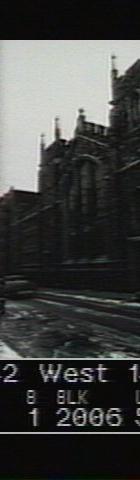
The city photographed every building for its tax records around 1940 and again in the 1980s. NYC Municipal Archives.
Written with AI from the source each entry cites, then fact-checked.
- 1808
Black worshippers walk out of First Baptist Church to found Abyssinian
Ethiopian seamen and Black congregants walked out of First Baptist Church on Gold Street after being forced into segregated seating, founding their own congregation in June 1808. They named it Abyssinian, the ancient name for Ethiopia. The church met in several downtown locations, including 166 Waverly Place, before its 1902 move to West 40th Street and its eventual relocation to Harlem.
Source: Daytonian in Manhattan
- 1922
Crowds pack West 138th Street for the Abyssinian cornerstone ceremony
On June 25, 1922, the cornerstone for the church and its community house was laid in a ceremony run by the Black Masonic Grand Lodge of New York State. The Times reported that the whole block was packed, with rooftops and fire escapes full of onlookers. Pastor Adam Clayton Powell Sr. called the project the most serious effort by Black people in the North to improve their condition through a church, welfare center and school.
Source: Daytonian in Manhattan
- 1923
Abyssinian Baptist completes its Gothic church on West 138th Street
The congregation traces its founding to 1808, when Ethiopian seamen and free Black worshippers walked out of the First Baptist Church rather than accept segregated seating. Under pastor Adam Clayton Powell Sr., who arrived in 1908, it moved uptown and built this Gothic and Tudor Revival church in 1922 and 1923, designed by Charles W. Bolton & Son. By 1930 it counted about 13,000 members. The city made it a landmark on July 13, 1993.
Source: Wikipedia
- 1930
Dietrich Bonhoeffer teaches Sunday school at Abyssinian Baptist
While studying at Union Theological Seminary, the German theologian Dietrich Bonhoeffer taught Sunday school at Abyssinian Baptist Church in 1930, the same year the congregation's membership reached roughly 13,000, making it the largest African American church in New York City. His time in Harlem shaped his later opposition to Nazism.
Source: Wikipedia
- 1933
Harlemites crowd 138th Street outside Abyssinian to protest a death on Welfare Island
On September 22, 1933, throngs filled West 138th Street in front of the church to protest the death of a young Black North Carolinian on Welfare Island, which the Daily Worker called a murder by prison officials. White members of the Young Communist League joined them. When a 19-year-old participant intervened as a policeman struck a Black woman, he was beaten badly. The episode hardened the congregation's resolve for equal rights.
Source: Daytonian in Manhattan
- 1937
Adam Clayton Powell Jr. succeeds his father as pastor
Adam Clayton Powell Jr. took over the Abyssinian pulpit from his father in 1937, after years of leading rent strikes and job campaigns in Depression-era Harlem. In 1941 he became the first Black member of the New York City Council, and in 1944 he was elected the first Black congressman from New York State, serving from 1945 to 1971.
Source: Wikipedia
- 1943
David Baldwin, stepfather of James Baldwin, has his funeral at Abyssinian in the wake of the 1943 Harlem riot
David Baldwin, a preacher and the stepfather of the writer James Baldwin, was mourned at Abyssinian just as the 1943 Harlem riot was fading. James Baldwin later wrote about attending his father's funeral in Notes of a Native Son, the 1955 essay that is considered his most famous.
“The funeral of David Baldwin, preacher and step-father of author James Baldwin, took place in the Abyssinian Baptist Church, during the wake of the 1943 Harlem riot.”
Source: Wikipedia
- 1948
Nat King Cole marries Maria Ellington at Abyssinian
On Easter Sunday, March 28, 1948, singer Nat King Cole married Maria Ellington at Abyssinian Baptist Church. The ceremony was performed by the church's pastor, Congressman Adam Clayton Powell Jr.
Source: Wikipedia
- 1953
Mayor Impellitteri and thousands of parishioners mourn Adam Clayton Powell Sr.
The Rev. Adam Clayton Powell Sr., Abyssinian's pastor from 1908 and a founder of the National Urban League, died on June 12, 1953. His funeral at the church on June 16 was the grandest the congregation had seen. Mayor Impellitteri and the police commissioner joined several thousand parishioners, and Powell's secretary read condolences from the White House, Cabinet members and congressional leaders.
Source: Daytonian in Manhattan
- 1972
More than 2,000 pack Abyssinian and thousands more fill the street for Adam Clayton Powell Jr.
Adam Clayton Powell Jr., the church's pastor and Harlem's congressman, died on April 4, 1972, and his funeral was held at Abyssinian on April 9. The Times reported more than 2,000 mourners inside and many thousands more outside. Mayor John Lindsay praised his style and compassion, and Samuel Proctor said Powell gave Black Americans hope when churches, hotels and unions were still segregated. Proctor took the pulpit three months later.
Source: Daytonian in Manhattan
- 1984
Count Basie's funeral draws jazz royalty to Abyssinian
Bandleader Count Basie's funeral was held at Abyssinian Baptist Church on April 30, 1984, drawing fellow jazz musicians including Dizzy Gillespie, Cab Calloway and Sarah Vaughan among the mourners. Newspapers described crowds overflowing from the sanctuary onto West 138th Street in the rain, waiting for a last look as Basie's coffin was carried out.
Source: Daytonian in Manhattan
- 1993
The Landmarks Commission designates the Abyssinian church and community house
On July 13, 1993, the city designated the Abyssinian Baptist Church at 136-142 West 138th Street and its community house at 132-134 as landmarks. The report called it the second oldest of Manhattan's African-American churches, and noted that under the younger Powell the membership grew past 10,000, among the largest Protestant congregations in the world. The Rev. Calvin Butts then led the church, with economic development in Harlem as a priority.
Further reading
- Abyssinian Baptist ChurchWikipedia
- The Abyssinian Baptist Church - 132 West 138th StreetDaytonian in Manhattan
Nearby
- Mother A.M.E. Zion Church140 West 137th Street | 3 entries
- James Weldon Johnson Residence187 West 135th Street | 2 entries
- Will Marion Cook House221 West 138th Street | 2 entries
- Countee Cullen Library104 West 136th Street | 3 entries
- Schomburg Center for Research in Black Culture515 Lenox Avenue | 12 entries
- Harlem YMCA180 West 135th Street | 10 entries