American Surety Building
100 Broadway | Financial District | built 1896
Open on the map11 entries

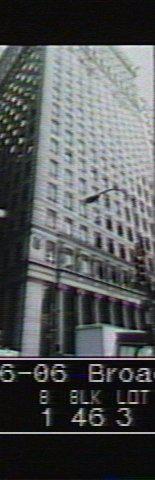
The city photographed every building for its tax records around 1940 and again in the 1980s. NYC Municipal Archives.
Written with AI from the source each entry cites, then fact-checked.
- 1894
American Surety announces a 20-story tower on the old Continental Life site, with Bruce Price as architect
In February 1894 the American Surety Company, which was renting space at 160 Broadway, said it had bought the former Continental Life Insurance site at Broadway and Pine Street. It planned a twenty-story tower to Bruce Price's designs. The New York Times said the tower would cast a shadow over the Pine Street insurance buildings, its only rival being the Manhattan Life Building, then under construction.
- 1896
John Jacob Astor threatens a 22-story neighbor, and the company leases the Schermerhorn Building for 99 years
Bruce Price's cornice projected several feet beyond the building, and Astor, who owned the adjacent Schermerhorn Building, sued. When talks stalled in May 1896, he had plans filed for a 22-story building that would cut off light and air to the new tower's south and east sides. The company answered with a 99-year lease on the Schermerhorn Building at $75,000 a year, plus all taxes and carrying charges.
- 1896
The American Surety Building rises as an early steel-framed skyscraper
Architect Bruce Price's design for the American Surety Company's new Broadway headquarters won a nine-entrant competition that also drew McKim, Mead & White and George B. Post. Completed in 1896, the 21-story granite tower was the first New York skyscraper built with a full steel skeleton and, at 308 feet, the city's second-tallest building at the time.
Source: Wikipedia
- 1901
A fire damages the Weather Bureau's quarters, with the air shaft beside the Schermerhorn Building implicated
The Weather Bureau was an early tenant, moving from the Manhattan Life Building and putting a 100-foot steel pole on the roof. As built, an air shaft ran between the tower and the Schermerhorn Building, and that shaft was tied to a 1901 blaze that left the bureau's offices damaged.
Source: Wikipedia
- 1919
American Surety buys the Schermerhorn Building from the Astor estate for $1.5 million
Having leased the Schermerhorn Building after Astor's challenge, American Surety had already connected it to the tower at the basement and first-story levels. In 1919, expecting a postwar building boom in Lower Manhattan, the company bought the older building from the Astor Estate for $1.5 million. Plans for the L-shaped annex followed in May 1920.
- 1922
Herman Lee Meader designs a widening annex
After buying the neighboring Schermerhorn Building, the American Surety Company hired architect Herman Lee Meader to supervise an annex, finished in 1922, that widened the tower by 40 feet on both Broadway and Pine Street and added a two-story penthouse. Meader kept Bruce Price's original facade design, though the expansion removed its gilded parapet and some sculpted figures.
Source: Wikipedia
- 1952
The Bank of Tokyo takes its first space in the building
The Bank of Tokyo first took offices here in 1952. Over the following decade it expanded into the banking room and several floors, becoming one of the larger tenants of the mid-20th century. It later hired Kajima International to refurbish the lowest thirteen stories, which the bank used.
“Bank of Tokyo first took space in the building in 1952 and expanded to the banking room and several floors over the next decade…”
Source: Wikipedia
- 1975
Critic Ada Louise Huxtable calls 100 Broadway an undesignated 'sleeper landmark'
After the 1975 modernization project, the critic Ada Louise Huxtable called 100 Broadway one of New York's sleeper landmarks, undesignated at the time. She described it as an outstandingly fine early skyscraper and said the city had many more such overlooked landmarks than anyone realized.
Source: Wikipedia
- 1975
The Bank of Tokyo installs a Noguchi sculpture, then removes it
The Bank of Tokyo had the building's lowest thirteen floors refurbished by Kajima International for $11 million, finished in 1975, and a 17-foot-long aluminum sculpture by Isamu Noguchi was placed in the lobby. The bank removed the sculpture in 1980 without telling the artist.
Source: Wikipedia
- 1997
The Landmarks Preservation Commission designates the building after three hearings
On June 24, 1997 the Landmarks Preservation Commission designated the American Surety Company Building a landmark. It had held hearings on September 19 and December 12, 1995 and January 30, 1996. Nineteen witnesses spoke for designation, among them Councilmember Kathryn Freed and representatives of Borough President Ruth Messinger, and no one opposed it.
- 2003
Borders opens a bookstore to replace its store lost on 9/11
Borders opened a 35,000-square-foot bookstore in the American Surety Building's base in 2003 to replace its branch destroyed in the World Trade Center during the September 11 attacks two years earlier. The new store was cited as one of several commercial openings that helped Lower Manhattan's retail economy recover after the attacks.
Source: Wikipedia
Further reading
- American Surety BuildingWikipedia
Nearby
- Bankers Trust Company Building14 Wall Street | 9 entries
- Equitable Building120 Broadway | 13 entries
- Irving Trust Building1 Wall Street | 12 entries
- Trinity Church75 Broadway | 19 entries
- Trinity Building111 Broadway | 5 entries
- Federal Hall National Memorial26 Wall Street | 13 entries