Church of St. Joseph of the Holy Family
140 Morningside Avenue | Morningside Heights | built 1860
Open on the map7 entries

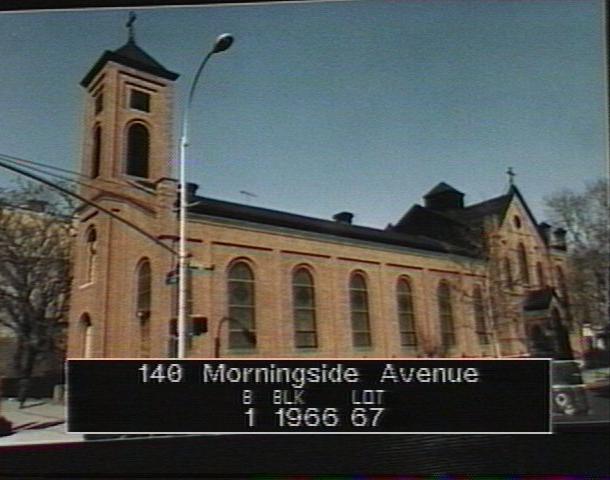
The city photographed every building for its tax records around 1940 and again in the 1980s. NYC Municipal Archives.
Written with AI from the source each entry cites, then fact-checked.
- 1860
German Catholics of Manhattanville dedicate St. Joseph's church
On August 28, 1859, German Catholics from Manhattanville met and agreed to buy four lots at the corner of Ninth (now Morningside) Avenue and 125th Street, and services began in the Sacred Heart academy chapel. Work on the brick church began with a cornerstone on May 18, 1860, and Vicar General William Starrs dedicated it on September 5, 1860. It cost roughly $15,000 and held 600 people.
- 1865
Anthony Kesseler becomes pastor of a church in financial trouble
By 1865 the young parish was in financial difficulty, and on the fifth anniversary of its dedication, Archbishop McCloskey named the newly ordained Anthony Kesseler as pastor. Born in the Rhineland in 1840 and brought to the United States in 1851, he served until 1898. He was responsible for the church's 1871 and 1889-90 enlargements and for building the rectory in 1873-74.
“By 1865, the church was in financial difficulty and on September 5, 1865, the fifth anniversary of the church's dedication…”
- 1890
The Herter Brothers add a gabled wing after a plan for a new church is scaled back
In 1871 the architect Henry Engelbert lengthened the church by 15 feet. In 1888 Father Kesseler bought lots and a former Methodist church on West 126th Street, and in 1889 the parish hired the Herter Brothers to design a new St. Joseph's. Plans were cut back to an addition 44 feet wide and 48 feet deep, finished in 1890, which keeps the original round-arched brick design in a more elaborate, irregular form.
- 1898
Pastor Anthony Kesseler drowns at sea aboard the ship La Bourgogne
Father Anthony Kesseler, who had led the parish since 1865, drowned at sea on July 4, 1898, aboard the ship La Bourgogne. According to the church's own history, he was praised for remaining behind to give last rites to fellow passengers. A plaque honoring him hangs inside the church on the altar.
Source: stjosephsharlem.com
- 1925
Four to five thousand people attend Sunday mass and 1,300 children fill the school
After the subway opened along Broadway in 1904 and sparked an apartment-building boom in Manhattanville, the parish grew. By 1925 a Sunday mass at St. Joseph's drew as many as four to five thousand worshippers, and its school had 1,300 to 1,400 pupils.
“By 1925 four to five thousand attended mass at St. Joseph's on a Sunday and 1300 to 1400 children were enrolled in the school.”
- 1940
The parish turns to African-American and Latino newcomers as old parish families leave
During the 1940s African Americans arriving from the South and Puerto Ricans settled in Manhattanville, replacing many old families who left for the suburbs. In the 1950s Robert Moses's slum-clearance program displaced tenants for Morningside Gardens and the Manhattanville and Grant Houses. Even as its old membership shrank, St. Joseph's reached out to both groups with masses in English and Spanish, and its Gospel choir sings at Sunday mass.
- 2016
The Landmarks Commission designates the oldest church building in use north of 44th Street
The Landmarks Commission designated St. Joseph's on June 28, 2016, describing it as the church building that has been in use longest without a break anywhere north of 44th Street. The Archdiocese of New York, the owner, spoke against designation at a 2015 hearing, while seven speakers supported it. The commission read the round-arched 1860 design as Rundbogenstil, a German style that reflected the parish's first members.
Further reading
Nearby
- P.S. 157327 St Nicholas Avenue | 4 entries
- Faison Firehouse Theater6 Hancock Place | 4 entries
- Sydenham Hospital565 Manhattan Avenue | 6 entries
- Mink Building1361 Amsterdam Avenue | 4 entries
- St. Mary's Episcopal Church521 West 126th Street | 5 entries
- Apollo Theater253 West 125th Street | 13 entries