Sydenham Hospital
565 Manhattan Avenue | also 339 West 123rd Street, 2 Hancock Place | Morningside Heights | built 1925
Open on the map6 entries

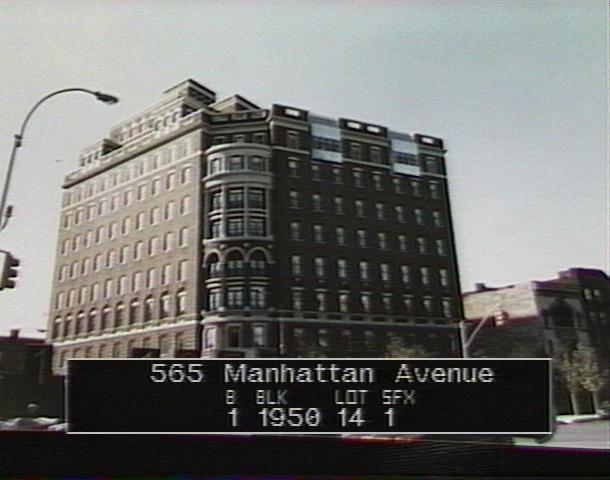
The city photographed every building for its tax records around 1940 and again in the 1980s. NYC Municipal Archives.
Written with AI from the source each entry cites, then fact-checked.
- 1944
Sydenham opens its medical staff to Black doctors, the first voluntary hospital to do so
Sydenham's trustees voted in December 1943 to accept Black physicians and added Black trustees. Two nurses and three other workers quit when the staff was told, but the white doctors stayed. Black doctors began work in February 1944 at what Time called the first U.S. voluntary hospital taking both white and Black physicians, and Black patients began entering the private rooms.
Source: Internet Archive
- 1944
Time reports Sydenham's mixed medical staff is succeeding 'beyond expectation'
In November 1944 Time reported that trustee Harry C. Oppenheimer had announced that the experiment had gone beyond expectation. Of some 300 staff doctors, 23 were Black, among them surgeon Peter Marshall Murray, who had many white patients. About 60 percent of the nurses were Black. Some Black backers worried that too high a share would turn Sydenham into a 'Negro hospital' and undo the experiment.
Source: Internet Archive
- 1949
New York City takes control of Sydenham Hospital
On March 3, 1949, the city took over Sydenham, which because of its small size had long faced more money trouble than most private hospitals, and made it part of the municipal hospital system. It was a new arrangement for municipal hospitals: the city let Sydenham's private doctors keep admitting their own patients there.
Source: Wikipedia
- 1958
W. C. Handy, the 'Father of the Blues', dies at Sydenham Hospital
The composer W. C. Handy died of bronchial pneumonia at Sydenham Hospital on March 28, 1958. More than 25,000 people attended his funeral at Abyssinian Baptist Church in Harlem, and over 150,000 gathered in the streets nearby to pay their respects. He was buried at Woodlawn Cemetery in the Bronx.
Source: Wikipedia
- 1971
Florence Gaynor, the first Black woman to run a major teaching hospital, takes charge of Sydenham
In 1971 Florence Gaynor was picked from a field of 20 candidates, all the others men, as executive director of Sydenham Hospital. That made her the first Black woman to lead a major teaching hospital in the United States. She had started in hospital administration at Lincoln Hospital, and the next year she moved to Martland Hospital in Newark.
“In 1971 she was selected from a field of 20 candidates, the rest of them men, to become the executive director of Sydenham Hospital…”
Source: Wikipedia
- 1980
Protesters storm Sydenham and occupy its offices for ten days over its closing
The Village Voice wrote in 1998 that when Mayor Ed Koch announced Sydenham's closing in 1980, angry protesters stormed the hospital and demonstrators held its offices for ten days. City officials, it said, learned never again to close a public hospital outright. Sydenham did close after much wrangling, and the federal government agreed to fund outpatient centers for the neighborhood.
Source: villagevoice.com
Further reading
- Sydenham HospitalWikipedia
Nearby
- Faison Firehouse Theater6 Hancock Place | 4 entries
- Church of St. Joseph of the Holy Family140 Morningside Avenue | 7 entries
- P.S. 157327 St Nicholas Avenue | 4 entries
- Apollo Theater253 West 125th Street | 13 entries
- Blumstein's Department Store230 West 125th Street | 4 entries
- Victoria Theater233 West 125th Street | 4 entries