The Normandy
140 Riverside Drive | also 348 West 87th Street, 353 West 86th Street | Upper West Side | built 1939
Open on the map9 entries

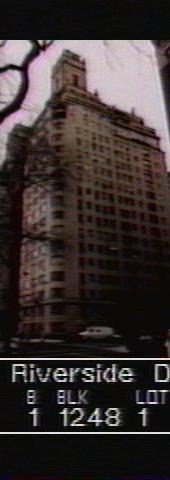
The city photographed every building for its tax records around 1940 and again in the 1980s. NYC Municipal Archives.
Written with AI from the source each entry cites, then fact-checked.
- 1910
Traffic engineer John A. Harriss buys a Riverside Drive house with a log cabin, chapel and ballroom
Twelve row houses went up on the Normandy's site in 1896, built by Henry Cook. Traffic engineer John A. Harriss bought the one at 140 Riverside Drive in 1910; it held a log cabin, a chapel and a ballroom. His firm, Rivercrest Realty, bought six neighboring houses in 1918 and the rest by 1921, planning an apartment building that never materialized. Metropolitan Life took over the properties in 1933.
“Traffic engineer John A. Harriss acquired the house at 140 Riverside Drive in 1910. This house had contained a log cabin, chapel, and ballroom.”
Source: Wikipedia
- 1938
Emery Roth and three builders buy the vacant Riverside Drive row houses
In 1938 Emery Roth formed a syndicate with the builders Samson Rosenblatt, Henry Kaufman and Herman Wacht to buy the largely vacant row houses on the blockfront. Rosenblatt had built the Graybar-Varick Building downtown. The brokers, Wood, Dolson & Company, called it the largest sale of vacant property for private-capital improvement in the city since the Depression began. The partners announced one of the largest apartment houses ever planned for Manhattan, with 1,080 rooms in 250 suites.
“Roth's syndicate included himself and three partners: Samson Rosenblatt, Henry Kaufman, and Herman Wacht.”
- 1938
The Buildings Department rejects Roth's plans, and a lost appeal pushes the design toward Moderne
Roth's original plans, filed on August 16, 1938, were rejected in late September. He appealed to the Board of Standards and Appeals in November and lost, so he had to redraw the balconies and roofline cornices with much smaller projections. The loss of a major overhanging cornice weakened the building's Italian Renaissance character and gave its Art Moderne qualities more weight.
- 1938
Emery Roth files plans for the Normandy on Riverside Drive
On August 25, 1938, Emery Roth & Sons file plans for an 18-story apartment house to replace eight mansions on the Riverside Drive blockfront between 86th and 87th Streets, with construction budgeted at $1.45 million. Roth, an officer of the company behind the project, says the building will be of its time without being modernistic. The result blends Italian Renaissance forms with Art Moderne rounded corners and a mosaic-tiled entrance.
Source: Daytonian in Manhattan
- 1939
Herman Wouk moves into the Normandy
Future novelist Herman Wouk moves into an apartment at the Normandy on December 1, 1939. He leaves to join the U.S. Naval Reserve after the attack on Pearl Harbor, years before he writes The Caine Mutiny, the novel that wins the Pulitzer Prize.
Source: Daytonian in Manhattan
- 1942
Gambler Morris 'Dimples' Wolensky, a Normandy resident, is shot dead at a bridge game
Morris Wolensky, known to gangland as Dimples, lived at the Normandy with his wife, the actress Marion Callahan, who had appeared in the 1934 film Murder at the Vanities. The district attorney's rackets bureau counted him and partner Tom Cuddy among three big gambling outfits of the Prohibition years. On August 3, 1942, gunman Max Fox followed him to a bridge club near Times Square and killed him and Robert B. Greene.
Source: Daytonian in Manhattan
- 1974
Sporting-goods magnate Herman Steinlauf dies after years in a Normandy apartment
Herman Steinlauf opened a record shop on Nassau Street in 1921 and switched to sporting goods three years later, building Herman's World of Sporting Goods into what was called the largest chain in the world. His wife Hannah died in May 1970, and he sold the chain to W. R. Grace & Co. within the year, staying on as chairman. He remained in his Normandy apartment until he died in January 1974.
Source: Daytonian in Manhattan
- 1985
Landmark designation halts a plan to replace the Normandy's windows
In fall 1985 the Normandy's board votes to replace the building's leaking casement windows, with attorney Mathilda Miller Cuneo casting the only vote against. She rallies sixteen residents to write to the Landmarks Preservation Commission. The commission holds a hearing on November 12, 1985, and designates the Normandy a landmark that same day, ending the replacement plan.
Source: Daytonian in Manhattan
- 1999
The Normandy's board pays $1.35 million for the air rights over a neighboring house
The owner of the House of Free Russia, a five-story house at 349 West 86th Street, announced plans to replace it with a 15-story condominium; many Normandy residents objected, and a board member said the tower would block views from over 100 apartments. A court found that the Normandy itself had broken a covenant against apartment houses on the neighbor's lot. In January 1999 the board bought the air rights over the site for $1.35 million, which kept the house from being expanded.
Source: Wikipedia
Further reading
- The NormandyWikipedia
- Emery Roth & Sons' 1939 Normandy Apartments - 140 Riverside DriveDaytonian in Manhattan
Nearby
- 345 West 88th Street1 entry
- The Red House350 West 85th Street | 2 entries
- Isaac L. Rice Mansion346 West 89th Street | 10 entries
- Soldiers' and Sailors' Monument171 Riverside Drive | 13 entries
- St. Ignatius of Antioch Church552 West End Avenue | 4 entries
- Church of St. Paul and St. Andrew263 West 86th Street | 8 entries