Isaac L. Rice Mansion
346 West 89th Street | Upper West Side | built 1915
Open on the map10 entries

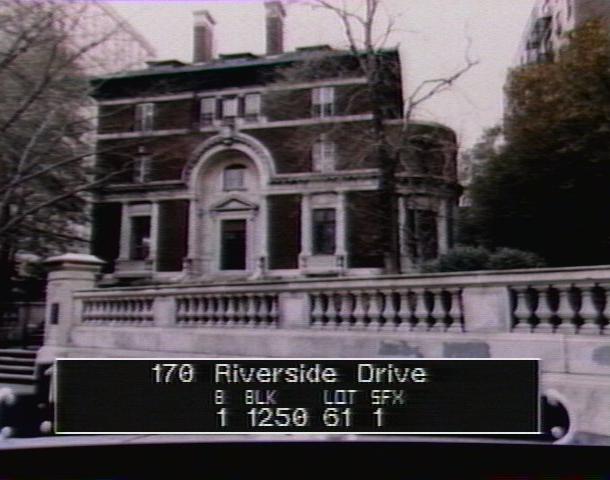
The city photographed every building for its tax records around 1940 and again in the 1980s. NYC Municipal Archives.
Written with AI from the source each entry cites, then fact-checked.
- 1900
Plans for the Rice mansion call for a French villa with a 96-foot observatory tower
In August 1900, plans for Isaac Rice's Riverside Drive house were submitted to the Department of Buildings. The New York Times then described a French villa design in brick and granite with marble trimming, and an observatory tower rising 96 feet above the curb. Rice had picked the theater architects Herts & Tallant after seeing their renovation of the Harmonie Club, of which he was a member.
Source: Daytonian in Manhattan
- 1903
Isaac Rice builds Villa Julia on Riverside Drive
Businessman Isaac L. Rice hired Herts & Tallant, architects known for Broadway theaters, to design a mansion at Riverside Drive and West 89th Street. Built between 1901 and 1903 for about $750,000, it mixes Colonial Revival, Georgian and Beaux-Arts styles. It was called Villa Julia in honor of his wife, Julia.
Source: Wikipedia
- 1905
Julia Barnett Rice launches her campaign against tugboat noise
In 1905, Julia Barnett Rice, who held a medical degree, rallied neighbors with petitions against the constant whistling of tugboats on the Hudson below her Riverside Drive home. By November 1906, unnecessary tooting had become a violation of the navigation laws. Within a month she had organized the Society for the Suppression of Unnecessary Noise.
Source: Daytonian in Manhattan
- 1906
A new maid jumps into the Hudson as police search the Rice house for a missing ring
In February 1906 Julia Rice hired Hortense Uzac, a girl newly arrived from France. Weeks later Julia Rice found a ring missing from her dresser, and while a detective questioned the servants one by one in the parlor, Uzac ran out of the house and jumped into the icy Hudson. She was pulled out and arrested for attempted suicide. Julia Rice said no accusation had been made against her, and the ring turned up in a search of the house.
Source: Daytonian in Manhattan
- 1907
Cigarette manufacturer Solomon Schinasi buys the Rice mansion
In December 1907, the Rices sold the mansion for $600,000 to cigarette manufacturer Solomon Schinasi. Schinasi hired architect C. P. H. Gilbert, who added a southeast extension and a semicircular bay in keeping with the original design. Schinasi died in the house in 1919.
Source: Daytonian in Manhattan
- 1912
C. P. H. Gilbert designs a new balustraded wall for the Schinasi house
The original brick-and-marble wall by Herts & Tallant extended beyond the property line, so it had to come down in 1912. C. P. H. Gilbert, who had already added to the house, was given the commission for the replacement, a marble wall with a balustrade, and he also narrowed the lower parts of the entrance steps. The balustrade echoes those of the Soldiers' and Sailors' Monument across the drive.
“Because the original brick and marble wall designed by Herts & Tallant had extended beyond the property line, it had to be taken down in 1912.”
- 1919
Cigarette manufacturer Solomon Schinasi dies at home of heart disease
Solomon Schinasi, the cigarette manufacturer who bought the house in 1907, died there on October 4, 1919, of heart disease. In 1927 his son Leon had a garage built and a third story added to the southern bay, in keeping with the original design. Leon's widow Ruby remained in the house after his death.
Source: Daytonian in Manhattan
- 1954
Yeshiva Chofetz Chaim buys the mansion from the Schinasi estate
Members of the Schinasi family occupied the house until about 1945, then it was leased to the Heckscher Foundation for Children. In 1954 the trustees of Leon Schinasi's estate sold it to the Yeshiva Chofetz Chaim. The Landmarks Preservation Commission's 1980 report says the house had served the school since.
- 1980
A preservation fight saves the Rice mansion from demolition
In 1979, Yeshiva Chofetz Chaim, which had owned the mansion since 1954, sought to sell it to a developer who would have replaced it with a high-rise tower. Neighbors formed the Citizens' Coalition to Preserve the Isaac L. Rice Mansion, and the city designated the house a landmark in February 1980. The Board of Estimate confirmed the designation by one vote that June, and the offer was withdrawn. Yeshiva Ketana took over the house in 1988.
Source: Wikipedia
- 1997
A fire damages the mansion's newly renovated roof
The roof caught fire in December 1997, soon after Yeshiva Ketana completed its renovation. The upper stories were badly damaged, and the roof work was delayed to the close of the school year. As a city landmark, the house drew outside help: the New York Landmarks Conservancy and other local groups paid for part of the restoration.
Source: Wikipedia
Further reading
- Isaac L. Rice MansionWikipedia
- The 1903 Isaac L. Rice Home -- 346 West 89th StreetDaytonian in Manhattan
Nearby
- 345 West 88th Street1 entry
- Soldiers' and Sailors' Monument171 Riverside Drive | 13 entries
- 601 West End Avenue3 entries
- The Normandy140 Riverside Drive | 9 entries
- Congregation B'nai Jeshurun257 West 88th Street | 11 entries
- St. Ignatius of Antioch Church552 West End Avenue | 4 entries