Soldiers' and Sailors' Monument
171 Riverside Drive | Upper West Side | built 1902
Open on the map13 entries

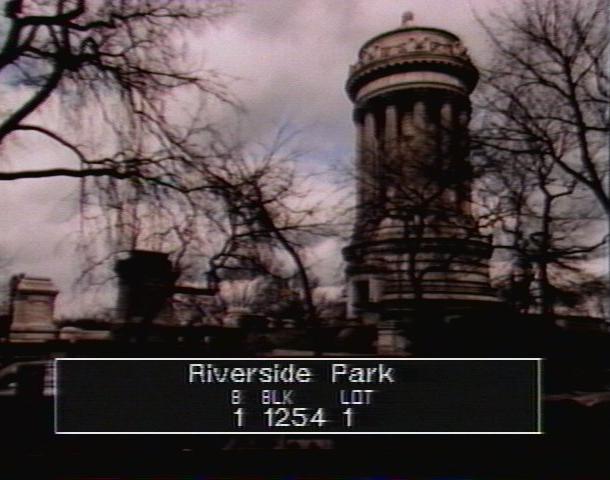
The city photographed every building for its tax records around 1940 and again in the 1980s. NYC Municipal Archives.
Written with AI from the source each entry cites, then fact-checked.
- 1893
A state commission is finally formed and given $250,000 for a Civil War monument
The legislature first authorized a soldiers' and sailors' monument in 1869, but nothing happened for 24 years. In 1893 a Board of Commissioners was created and allowed to spend $250,000. Its members were the mayor, comptroller, recorder, parks president, public works commissioner and the New York chairman of the Grand Army of the Republic.
- 1893
Architects win the monument competition with a "Temple of Fame"
Brothers Charles and Arthur Stoughton won a public design competition for the Civil War memorial with a circular colonnaded temple modeled on the ancient Choragic Monument of Lysicrates in Athens. Their design beat out other entries in the state-run competition years before ground was even broken.
Source: Wikipedia
- 1895
Rival uptown associations feud over where to put the war monument
After the state created a commission in 1893 to build a Civil War monument, the Upper East Side Association pushed for Fifth Avenue at 59th Street while the Upper West Side Association lobbied for Riverside Drive. The New York Times covered the rivalry for years; by 1899 the West Side won out, and the site later moved from a proposed spot at 83rd Street to its final ground at 89th Street.
Source: The Bowery Boys
- 1900
Governor Theodore Roosevelt lays the cornerstone at the 89th Street site
The monument had been planned for Mount Tom at West 83rd Street, but that site was dropped partly because tall apartment buildings opposite it on Riverside Drive were thought likely to dwarf it. The 89th Street site was chosen in 1900, and the cornerstone was laid there on December 15, 1900, with Governor Theodore Roosevelt officiating. Construction finished in 1902.
- 1902
Theodore Roosevelt dedicates the Soldiers' and Sailors' Monument
Designed by Stoughton & Stoughton with Paul E. M. Duboy to honor Union soldiers and sailors of the Civil War, the monument at Riverside Drive and 89th Street is about 100 feet tall and cost $300,000. Ground was broken on September 21, 1900, and it was dedicated on Memorial Day 1902 with President Theodore Roosevelt officiating.
Source: Wikipedia
- 1907
Mayor McClellan reports that marble slabs are falling from the monument
Only five years after the dedication, Mayor George B. McClellan Jr. reported that the monument needed repair. Three marble slabs had already come down and others were at risk, the building leaked badly, cement kept crumbling off the walls and ceiling, and many stones were chipped. He asked for $20,000 to fix it.
“…three had already fallen. The building badly leaked, cement was constantly falling from the walls and ceiling ... He requested $20,000 for the repair…”
Source: Wikipedia
- 1962
The city spends over $1 million restoring the deteriorating monument
Barely five years after the monument's 1902 dedication, Mayor George B. McClellan Jr. reported that marble slabs were falling and the structure was leaking, and he requested $20,000 for repairs. Further work followed in the 1930s, and by 1962 the city had spent more than $1 million replacing the roof and reinforcing the granite.
Source: Wikipedia
- 1976
The Landmarks Preservation Commission designates the monument, its terraces and steps a landmark
After a hearing on July 13, 1976, where no one spoke for or against designation and the Parks Department said it approved, the commission issued its report on September 14. The landmark covers the marble monument along with its terraces, balustrades, ornaments and the steps approaching it from the north and south. The report calls it a fitting tribute to the New York regiments of the Civil War.
- 2005
The Times finds skateboard-scarred paving, painted-over graffiti and a leaking, closed interior at the monument
In 2002 the Parks Department proposed a $1.2 million restoration of the monument's steps and sidewalks, but the project fell through when a private donor pulled out. The New York Times reported in July 2005 that paving stones, many damaged by skateboarding and soccer, needed replacing, graffiti was covered with tacky paint, and the leaking interior had long been closed to the public.
“The Parks Department had proposed a $1.2 million restoration in 2002 ... The effort failed when a private donor pulled out. In July 2005, the New York Times reported…”
Source: Wikipedia
- 2007
A $650,000 plaza redesign bogs down and a fence goes up around the crumbling steps
In 2007 Council member Gale Brewer committed $650,000 in city money to redesign the potholed plaza south of the monument, which holds three Civil War-era cannons. The effort bogged down in disagreement over the design and was never completed. In 2008 a fence went up to keep people off the entry stairs, which were in very poor condition.
Source: Wikipedia
- 2017
A failing retaining wall forces the monument to close
A 2017 inspection found the monument's retaining wall to be failing, and it was fenced off and closed to the public, with restoration estimated at $36.5 million. Mayor Eric Adams allocated $62 million for the work in fiscal year 2024, and drone surveys began that year. The monument has been a city landmark since 1976.
Source: Wikipedia
- 2019
A look inside the fenced-off monument finds the mortar largely gone and the floor mosaic like gravel
NY1 got a rare look inside the fenced-off monument in 2019. Riverside Park's administrator, John Herrold, said so much mortar between the marble blocks had disappeared that the building was held together mostly by gravity. Parks' Jonathan Kuhn said water was passing right through it, and the floor mosaic looked like gravel in spots. A 2017 study put repairs at more than $30 million, and the building has five spaces for sculptures that were never commissioned.
Source: ny1.com
- 2024
Drones survey the monument to launch a $62.3 million restoration
In March 2024 drones were permitted to fly around the monument's plaza on March 5 through 8 and again on March 12, gathering images and data for the engineers who would plan the repairs. The money had been placed in the city's fiscal 2024 budget after years of campaigning, including a 2022 petition by Council Member Gale Brewer. Parks expected the design to be done in June 2025 and construction to start in the summer of 2026.
Source: ilovetheupperwestside.com
Further reading
Nearby
- Isaac L. Rice Mansion346 West 89th Street | 10 entries
- 345 West 88th Street1 entry
- 601 West End Avenue3 entries
- The Normandy140 Riverside Drive | 9 entries
- Congregation B'nai Jeshurun257 West 88th Street | 11 entries
- St. Ignatius of Antioch Church552 West End Avenue | 4 entries