Bridge Cafe
16 1/2 Dover Street | also 279 Water Street | Financial District | built 1920
Open on the map5 entries

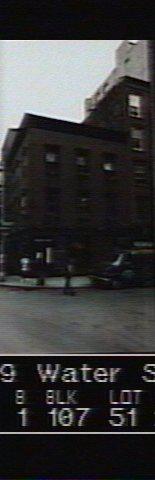
The city photographed every building for its tax records around 1940 and again in the 1980s. NYC Municipal Archives.
Written with AI from the source each entry cites, then fact-checked.
- 1794
Newell Narin leases a wooden corner building at Water and Dover Streets and opens a grocery
In 1794 Newell Narin leased from James Kip a two-and-a-half-story wood-frame building on the corner of Dover Street, at 279 Water Street. On the ground floor he ran a grocery and a wine and porter bottling business. Two years later Narin was sent to debtors' prison, and Kip leased the property to Peter Laing, a retired ship captain, who kept the grocery going with his wife, Janet, and later bought the building.
Source: Daytonian in Manhattan
- 1878
A raid backed by reformer Jerry Macauley sweeps through the saloon at 279 Water Street
By the 1860s the old ship captains' houses along Water Street had turned into saloons, gambling houses and brothels. On March 30, 1878, a raid pushed by Jerry Macauley, who preached against the neighborhood's vice from his Water Street Mission, included 279 Water Street, and nearly two dozen women ended up in the Tombs Police Court. Mary Reilley, called the proprietress by the New York Times, was held on $1,000 bail, and in April 1879 the District Attorney indicted the business as a disorderly house.
Source: Daytonian in Manhattan
- 1888
The old wooden building is converted to a three-family dwelling and gets its present roof
The Landmarks Preservation Commission calls 279 Water Street the only surviving wood-frame building in the South Street Seaport district, and thinks it was built around 1801. The landfill under Water Street was believed unable to carry brick, so lighter wooden structures were tolerated here into the 1940s. The building first belonged to a grocer and was used commercially up to 1888, when it became a three-family dwelling and its peaked roof was lowered; the exterior seen today dates entirely from that remodeling.
- 1921
John Pikel leases the store and basement as a restaurant that sells home-brewed beer
For years the corner had been a bar, run by Jeremiah J. Cronin and John Murphy from 1891 and by Peter J. Boyle from 1902 until Prohibition. In the early years of Prohibition, on September 27, 1921, John Pikel took a lease on the store and basement from Margaret C. Hyland. He ran it ostensibly as a restaurant, but customers came for the cider and for home-made beer brought in from Brooklyn by a bootlegger, Charlie Brennan.
Source: Daytonian in Manhattan
- 1979
Jack Weprin turns the old waterfront bar into the white-tablecloth Bridge Cafe
Through the 1970s the building held McCormick's Bar, popular with fishmongers from the nearby Fulton Fish Market. In 1979 Jack Weprin bought it and converted it into The Bridge Cafe, a white-tablecloth restaurant. Mayor Ed Koch regularly dined there while in office and called it his favorite restaurant. Hurricane Sandy flooded the building in 2012, and the restaurant closed.
Source: Wikipedia
Further reading
- Murder, Degraded Women, and a Grocery -- 279 Water StreetDaytonian in Manhattan
Nearby
- 277 Water Street2 entries
- Bridge Cafe building279 Water Street | 7 entries
- 275 Water Street1 entry
- Captain Joseph Rose House273 Water Street | 5 entries
- 252 Front Street2 entries
- 271 Water Street2 entries