Bridge Cafe building
279 Water Street | also 16 Dover Street | Financial District | built 1920
Open on the map7 entries

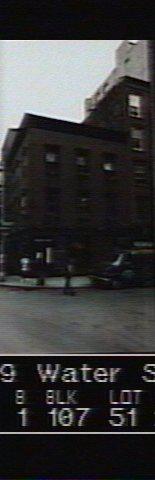
The city photographed every building for its tax records around 1940 and again in the 1980s. NYC Municipal Archives.
Written with AI from the source each entry cites, then fact-checked.
- 1794
Grocer Newell Narine leases a wooden building here and ends up in debtors' prison
In 1794 Newell Narine leased a wood-frame building at this corner from James Kip and ran a grocery and porter bottling business on the ground floor. Narine was sent to debtors' prison in 1796, after which Kip rented the property to Peter Laing, a retired ship captain, who kept the grocery going with his wife Janet and later bought the building.
Source: Daytonian in Manhattan
- 1862
Catharine Curran is lured into the bar here and dies after being forced to drink fuel and alcohol
According to press accounts, 28-year-old Catharine Curran, who had stalked her former lover James Winthrop for weeks, was lured into the saloon at 279 Water Street. Witnesses told the inquest that she was made to drink three quarts of a burning-fluid and alcohol mixture within an hour, and she died soon afterward.
Source: Daytonian in Manhattan
- 1878
Water Street Mission founder Jerry McAuley leads a raid that puts 22 women in the Tombs police court
The reformer Jerry McAuley, who preached against the saloons and brothels of Water Street from his mission, was behind a March 30, 1878 raid that included 279 Water Street. Twenty-two women appeared in the Tombs Police Court, and Mary Reilley, described as the proprietress, was held on $1,000 bail. The next year the district attorney indicted the place as a disorderly house.
Source: Daytonian in Manhattan
- 1888
Maurice Hyland enlarges the 1801 wooden building, the last of its kind in the seaport district
The landmark designation report identifies 279 Water Street as the only wood-frame building left in the South Street Seaport Historic District, built when landfill was thought too weak for brick. In 1888 Maurice Hyland raised the old two-and-a-half-story house, losing its steep roof, into the flat-topped three-story building of today, with new wooden facades by Kurtzer & Rohl.
Source: Wikipedia
- 1921
John Pikel leases the store during Prohibition, and patrons come for cider and Brooklyn beer
According to Daytonian in Manhattan, John Pikel leased the store and basement on September 27, 1921, the year after Prohibition began. He ran it nominally as a restaurant, but customers came for cider and for home-made beer brought over from Brooklyn by the bootlegger Charlie Brennan.
Source: Daytonian in Manhattan
- 1979
McCormick's fishmonger bar becomes the Bridge Cafe, a favorite restaurant of Mayor Ed Koch
Through the 1970s the corner was McCormick's Bar, popular with workers from the nearby Fulton Fish Market. In 1979 Jack Weprin bought it and made it the Bridge Cafe, a white-tablecloth restaurant. Mayor Edward I. Koch dined there regularly and called it his favorite, and New York magazine ranked it among the city's top five historic bars in 2005.
“Mayor Edward I. Koch regularly had dinner at Bridge Cafe and declared it to be his favorite restaurant.”
Source: Wikipedia
- 2012
Hurricane Sandy floods the Bridge Cafe, which stays closed, and Netflix later borrows its look
Sandy's floodwater inundated the building in 2012 and the Bridge Cafe has stayed closed since, ending its run as the city's oldest continuous business establishment. The property sold for $3.3 million in 2021. In 2024 the producers of Netflix's Black Rabbit found the empty cafe and used it as inspiration for the show's restaurant interiors.
Source: Wikipedia
Further reading
- Murder, Degraded Women, and a Grocery -- 279 Water StreetDaytonian in Manhattan
Nearby
- Bridge Cafe16 1/2 Dover Street | 5 entries
- 277 Water Street2 entries
- 275 Water Street1 entry
- Captain Joseph Rose House273 Water Street | 5 entries
- 271 Water Street2 entries
- 276 Water Street1 entry