Mark Hellinger Theatre (Times Square Church)
237 West 51st Street | also 217 West 51st Street | Times Square | built 1929
Open on the map14 entries

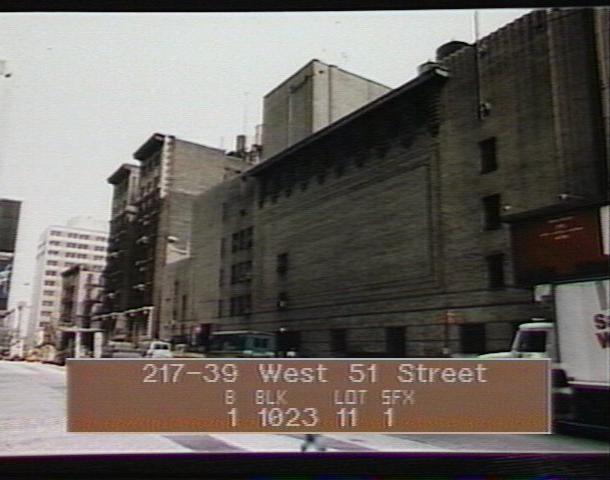
The city photographed every building for its tax records around 1940 and again in the 1980s. NYC Municipal Archives.
Written with AI from the source each entry cites, then fact-checked.
- 1925
Columnist Mark Hellinger, later the theater's namesake, becomes the first reporter to cover Broadway as news
Mark Hellinger (1903-1947), son of a Manhattan lawyer, left an advertising job to review plays and movies, later moving to the Daily News. By 1925 the landmark report credits him with changing how Broadway was covered: he was the first reporter to treat it as a news source, in a Sunday column of short vignettes called About Town. A reported 18 million readers followed him before he moved to Hollywood as a screenwriter and producer.
“By 1925, Hellinger had changed the way that the theater was covered by the media; he was the first reporter to cover Broadway as a news source.”
- 1929
Warner Brothers hires Thomas Lamb to build the Hollywood Theater as a rival to the Paramount and the Roxy
In 1929 Warner Brothers chose a lot on West 51st Street, between Broadway and Eighth Avenue, for a New York showcase for its sound films. It commissioned Thomas Lamb to design a movie palace of about 1,600 seats, with a stage for vaudeville acts, and named it the Hollywood. The lot had no Broadway frontage, so the studio arranged a passage through an adjoining building to give it an entrance from Broadway.
“Warner Brothers commissioned Lamb to design a movie palace, seating approximately 1600, with stage facilities for the live vaudeville acts…”
- 1930
Lamb gives the Hollywood a Baroque interior and a modernistic exterior echoing Saarinen's Helsinki station
Inside, Thomas Lamb's Hollywood was a plush Baroque movie palace of gilded plaster, statuary and murals. Outside, the landmark report says, he borrowed from early modern buildings instead. It names two likely sources: Eliel Saarinen's Helsinki railroad station, whose entrance is flanked by sculpted figures holding glass globes like the single figures here, and Frank Lloyd Wright's Unity Temple in Oak Park, Illinois.
“The elements of Lamb's design which appear to have been borrowed from it are the monumental paired sculptural figures, each holding a glass globe…”
- 1930
Warner Brothers opens the Hollywood Theatre with the musical film Hold Everything
The Hollywood opened on April 22, 1930, with the Technicolor musical Hold Everything, starring Winnie Lightner and Joe E. Brown. A Lindy's restaurant took one of the Broadway storefronts. For its first two years the house showed only films, and Lou Holtz's vaudeville revues, begun in February 1932, folded after about two months.
“The Warner Bros. Hollywood Theatre opened on April 22, 1930, with the Warner Technicolor musical film Hold Everything, starring Winnie Lightner and Joe E. Brown.”
Source: Wikipedia
- 1934
Warner Brothers reopens the Hollywood as a legitimate theater with the revue Calling All Stars
The theater opened in 1930 as a film house and added vaudeville in 1932. In 1934 Warner Brothers turned it into a stage theater, reopening it on December 13 with Calling All Stars, a revue whose cast included Martha Raye, Ella Logan and Judy Canova. In 1936 the main entrance was shifted off Broadway onto West 51st Street, and the house was renamed the Fifty-first Street Theater, a name it traded back and forth with Hollywood as it switched between film and stage.
“…they "reopened" it on December 13 with Calling All Stars, a revue with Martha Raye, Ella Logan and Judy Canova.”
- 1940
Laurence Olivier brings Romeo and Juliet to the house, billed as the 51st Street Theater
In 1940 Laurence Olivier's stage production of Romeo and Juliet opened here, with Vivien Leigh, Dame May Whitty, Edmond O'Brien and Cornell Wilde in the cast. The playhouse again carried the name 51st Street Theater, a title it had taken in 1936 when the entrance was moved from Broadway to West 51st Street.
“In 1940, with the opening of Laurence Oliver's stage production of Romeo and Juliet, the theater's name reverted to the "Fifty-first Street.”
- 1942
Casablanca premieres at the Hollywood as the house returns to films
After Banjo Eyes closed in the early 1940s the Hollywood went back to showing films full time. Casablanca premiered there in 1942, and the films shown in the mid-1940s included This Is the Army in 1943 and Night and Day in 1946. In August 1947 the name changed again, to the Warner Theatre, with the premiere of Life with Father.
Source: Wikipedia
- 1948
The theater returns to stage use and is renamed the Mark Hellinger for the late Broadway columnist
The house showed films through the war years and was called the Warner Brothers Theater for 1947. It then went back to legitimate stage use under a new name, the Mark Hellinger, honoring the Broadway columnist and film producer who had died in 1947. The landmark report dates the change to 1948 in one place and 1949 in another, and says the house has stayed a legitimate theater since.
- 1956
My Fair Lady, directed by Moss Hart with Julie Andrews and Rex Harrison, opens to unanimous acclaim
The landmark report calls Lerner and Loewe's My Fair Lady the Hellinger's greatest production. Directed by Moss Hart, it drew unanimous critical praise, with Julie Andrews and Rex Harrison leading the cast. It followed Guthrie McClintic's 1952 presentation of two Greek tragedies by the National Theater of Greece.
“Lerner & Loewe's My Fair Lady garnered unanimous critical acclaim and has remained one of the stage's most memorable musicals.”
- 1962
A court orders My Fair Lady to leave the Hellinger after Rodgers is refused the house for No Strings
Richard Rodgers and Samuel Taylor wanted the Hellinger for their musical No Strings, but the producer of My Fair Lady refused to move. In February 1962 the New York Supreme Court ruled that the show had to relocate. By then Rodgers and Taylor had booked another house, and The Sound of Music then transferred in from the Lunt-Fontanne to finish out its final seven months.
Source: Wikipedia
- 1971
Jesus Christ Superstar opens at the Hellinger and runs 720 performances
Andrew Lloyd Webber and Tim Rice's rock opera Jesus Christ Superstar opened on October 12, 1971, with Ben Vereen, Jeff Fenholt and Yvonne Elliman in the cast. It played 720 performances at the Hellinger, which had hosted Man of La Mancha from May 25, 1971, after its first run at the ANTA Washington Square Theater.
- 1979
Mickey Rooney and Ann Miller open the musical Sugar Babies
The Landmarks Preservation Commission designated the theater on January 5, 1988, after hearings in June and October 1982. Eighty-one witnesses spoke or submitted statements in favor; one spoke against, and the owner's representatives said they had not yet formed an opinion. The report describes the building as the only one of Midtown's grand movie palaces to survive intact.
- 1988
The Landmarks Commission designates the Mark Hellinger Theater after hearings that began in 1982
The Landmarks Preservation Commission designated the theater on January 5, 1988, after hearings in June and October 1982. Eighty-one witnesses spoke or submitted statements in favor; one spoke against, and the owner's representatives said they had no position yet. The report calls it the sole intact survivor of Manhattan's grand movie palaces in the Times Square area.
“Eighty-one witnesses spoke or had statements read into the record in favor of designation. One witness spoke in opposition to designation.”
- 1989
Pastor David Wilkerson's Times Square Church leases the theater and buys it in 1991
David Wilkerson founded Times Square Church in 1987 and held services at Town Hall and the Nederlander Theatre before finding a permanent home. The Nederlander Organization leased the Mark Hellinger to the congregation in February 1989, and the church bought the building in 1991; it was valued at between $15 million and $18 million. A church pastor said the landmarked theater would stay as it was, and the church still meets there.
Source: Wikipedia
Further reading
- Times Square ChurchWikipedia
Nearby
- Gallagher's Steakhouse228 West 52nd Street | 8 entries
- Neil Simon Theatre250 West 52nd Street | 12 entries
- Paramount Plaza1633 Broadway | 15 entries
- August Wilson Theatre245 West 52nd Street | 17 entries
- Broadway Theatre1681 Broadway | 5 entries
- Broadway Theatre230 West 53rd Street | 14 entries