5 Columbus Circle (United States Rubber Company Building)
1790 Broadway | also 5 Columbus Circle, 1784 Broadway | Midtown | built 1912
Open on the map8 entries

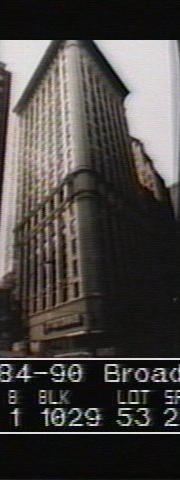
The city photographed every building for its tax records around 1940 and again in the 1980s. NYC Municipal Archives.
Written with AI from the source each entry cites, then fact-checked.
- 1892
Charles Flint merges nine rubber footwear makers to create the United States Rubber Company
The company that built this tower was formed in 1892 when financier Charles R. Flint persuaded nine rubber footwear manufacturers, including the firm holding Charles Goodyear's vulcanization license, to combine. It soon controlled about 70 percent of the country's rubber footwear trade. It adopted the Keds name for its footwear in 1917, the year its tires became U.S. Royal, and in 1967 unified its brands as Uniroyal.
“In 1892, Flint convinced nine companies involved in the manufacture of rubber footwear to merge, and thereby formed the United States Rubber Company.”
- 1911
U.S. Rubber leases the Broadway corner, later buying the land under its headquarters
In 1911 the company took a 21-year lease on the corner land from Mary Fitzgerald, who had begun buying lots on the block in 1876. U.S. Rubber was able to buy the land in 1932 and sold it to a holding company in 1940, though it stayed in the building until 1951. It then moved to a newer headquarters in Rockefeller Center.
- 1912
The tower rises on Automobile Row, a stretch of Broadway once home to horse and harness makers
Before about 1905 this part of Broadway belonged to horses and harness makers and was described as thoroughly lifeless. By 1907 the Times saw almost solid lines of motor-vehicle signs from Times Square to Sherman Square. B. F. Goodrich built a showroom next door at Broadway and 57th Street. The U.S. Rubber tower became the tallest building on the avenue north of Times Square.
- 1912
Carrere & Hastings give the building a thin marble skin over its steel frame
Thomas Hastings, who had used the term curtain wall by 1894, treated the facades as non-bearing veneer. Narrow continuous piers rise past the fourth through seventh floors and again from the ninth to the nineteenth, so the walls read as a thin skin over a steel cage. A rounded corner joins the Broadway and 58th Street fronts under a broad copper cornice, and for many years a large neon sign crowned the roof.
- 1912
Automobile engineers, tuberculosis fighters and a taxi operator rent offices in the new tower
Tenants were moving in by May 1, 1912. U.S. Rubber took the ground-floor showroom, the basements and ten upper floors, with its general offices on floors 15 to 17. Other floors were let to the Society of Automobile Engineers, the National Tuberculosis Association, the roller-bearing maker Timken and Keystone Transportation, which ran taxis.
Source: Wikipedia
- 1959
A bank hires Herbert Tannenbaum to remodel the first two floors in glass and gray marble
West Side Federal Savings Bank bought the building once U.S. Rubber moved out, hoping for a more modern look. It hired the architect Herbert Tannenbaum, who first added an awning over the Broadway entrance. At the bank's request, in 1959 he completely reconfigured the first two stories, covering them with glass and polished gray marble.
- 1967
The NAACP makes 1790 Broadway its headquarters for fifteen years
From 1967 to 1982 the National Association for the Advancement of Colored People had its headquarters in the building at 1790 Broadway. During the mid-twentieth century the U.S. State Department also leased several floors there.
“…the NAACP also had its headquarters in the building from 1967 to 1982…”
Source: Wikipedia
- 2000
The Landmarks Commission designates the former U.S. Rubber Building with the owner's support
The Commission designated the former United States Rubber Company Building on December 19, 2000, after an October hearing at which three speakers favored designation and none opposed. One of the three represented the owner and one the Historic Districts Council. The report called the tower one of the most prominent buildings of Automobile Row.
“There were three speakers in favor of designation including a representative of the owner and a representative from the Historic Districts Council.”
Further reading
- 5 Columbus CircleWikipedia
Nearby
- 240 Central Park South8 entries
- Museum of Arts and Design2 Columbus Circle | 8 entries
- 220 Central Park South16 entries
- Gainsborough Studios222 Central Park South | 8 entries
- Art Students League Building215 West 57th Street | 9 entries
- Argonaut Building224 West 57th Street | 7 entries