Gainsborough Studios
222 Central Park South | Midtown | built 1908
Open on the map8 entries

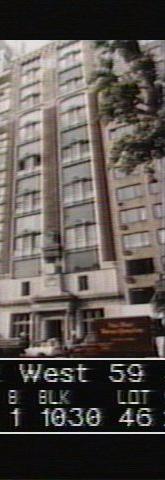
The city photographed every building for its tax records around 1940 and again in the 1980s. NYC Municipal Archives.
Written with AI from the source each entry cites, then fact-checked.
- 1907
Artists and a businessman form a corporation and break ground for cooperative studios on Central Park South
In 1907 the painters August Franzen, Elliott Daingerfield and Colin Campbell Cooper joined businessman Barron Collier in a corporation to build an artists' studio building facing Central Park, where the studios would always get northern light. The corporation bought the lot in April 1907 and, after an existing building was demolished, began construction on November 3. The Gainsborough Studios were completed on October 31, 1908.
“…purchased the lot on 59th Street in April 1907 and, after the demolition of an existing building, the studio building was begun November 3, 1907…”
- 1908
The Gainsborough is classed as a hotel to dodge the height limit on apartment buildings
Under the tenement law, an apartment building could be no taller than one and a half times the width of its street. To avoid that limit, the Gainsborough's backers had the building classified as a hotel, with a communal kitchen and dining room and only minimal kitchens in the apartments. Because only the park side got north light, just those rooms became double-height studios, giving each pair of floors two duplexes and four single apartments.
“…had its building classified as a hotel, with communal kitchen and dining room…”
- 1908
Konti's frieze, a Gainsborough bust and Moravian tiles dress the artists' building
Isidore Konti's terra-cotta frieze, A Festival Procession of the Arts, runs between the first and second floors, showing figures of all ages bringing gifts to an altar of the arts. A bust of Thomas Gainsborough sits above the entrance on a carved painter's palette, and from the sixth story up the facade is covered in colored tiles from Henry Mercer's Moravian Tile Works. A stone corbel of shells stands in place of a cornice, which might have cut the light.
Source: Daytonian in Manhattan
- 1908
Painter Elliott Daingerfield moves into the studios he helped found and stays until his death
Elliott Daingerfield, vice president of the Gainsborough corporation, kept his studio and living quarters in the building from its opening until his death in 1932. Born in West Virginia, he was known for poetic, mystical landscapes, and in 1902 he decorated the Lady Chapel of the West 46th Street Church of Mary the Virgin with murals. His work is held by the Metropolitan Museum of Art and the National Gallery of Art.
“From the Gainsborough studios' opening until his death in 1932, Daingerfield maintained his studio and living quarters there…”
- 1912
Stable fire behind the building shatters rear windows and sends artists to the elevators
On August 28, 1912, flames erupted at the Colorado Boarding and Livery Stables on West 58th Street, directly behind the building. A 12-foot alley separated the two, but the heat cracked the rear windows, and artist tenants woke to the crash of glass. Women pulled opera cloaks over their nightgowns and hurried to the elevators. The building was scorched but not seriously damaged.
Source: Daytonian in Manhattan
- 1924
Sculptor Helene White is padlocked into a first-floor studio for a weekend
In 1924 a minor scandal arose at the Gainsborough when the sculptor Helene M. R. White was padlocked in the first-floor studios of Consignment Arts, Inc. by the interior decorator Paul C. Leatherman. She was kept a prisoner there for an entire weekend. The studios were part of the building that artists had founded sixteen years earlier as a cooperative.
Source: Daytonian in Manhattan
- 1988
Residents restore the lobby and facade, and the city designates the building a landmark
By the 1950s the residents had come to dislike the Arts and Crafts look and hired designer Donald Deskey to redo the lobby, swapping the ornate iron doors for aluminum ones. In 1981 the corporation spent $100,000 to restore the lobby and recreate the doors from early photographs. A $1 million exterior restoration began in 1988 under resident architect Tod Williams, with new tiles made and the frieze and bust replicated. The Landmarks Preservation Commission designated the building that February.
Source: Daytonian in Manhattan
- 2025
Residents sue Vornado, saying construction of 220 Central Park South damaged their building
Residents of the Gainsborough Studios sued Vornado Realty Trust, developer of the neighboring 220 Central Park South, in 2025. They claimed that building the new tower had caused their building to sink and tilt eastward, damaging its roof, windows and mechanical systems. They said they had spent $3 million on repairs themselves.
Source: Wikipedia
Further reading
- Gainsborough Studios (Manhattan)Wikipedia
Nearby
- 220 Central Park South16 entries
- 240 Central Park South8 entries
- 5 Columbus Circle (United States Rubber Company Building)1790 Broadway | 8 entries
- Saint Thomas Choir School202 West 58th Street | 8 entries
- Art Students League Building215 West 57th Street | 9 entries
- Museum of Arts and Design2 Columbus Circle | 8 entries