Museum of Arts and Design
2 Columbus Circle | Midtown | built 1962
Open on the map8 entries

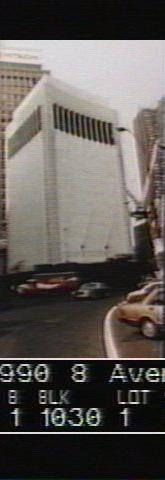
The city photographed every building for its tax records around 1940 and again in the 1980s. NYC Municipal Archives.
Written with AI from the source each entry cites, then fact-checked.
- 1958
Huntington Hartford hires Edward Durell Stone, who drops the first scheme of concrete cylinders
Huntington Hartford first worked with Hanford Yang, an MIT architecture student whose design used two interlocked concrete cylinders. In May 1958 Hartford brought in Edward Durell Stone instead, because Yang was not licensed in New York. Stone filled the whole block with a building of reinforced-concrete walls clad in white Vermont marble, with small windows only at one corner and open loggias at the base and top. He meant it to suit the neoclassical 5 Columbus Circle across the way.
Source: Wikipedia
- 1959
The Museum of Modern Art sues over the name Gallery of Modern Art
In early 1959 the Museum of Modern Art asked a court to stop Hartford from calling his museum the Gallery of Modern Art, though he was allowed to keep the name. Stone filed building plans that April while the dispute continued. A last tenant, a shoe-store owner, then fought eviction until the Court of Appeals refused his case in February 1960, which pushed the opening back by a year.
Source: Wikipedia
- 1964
Huntington Hartford opens the Gallery of Modern Art
A&P heir Huntington Hartford hired architect Edward Durell Stone to design a marble-clad tower at Columbus Circle for his personal art collection, meant as an alternative to prevailing modern taste. The Gallery of Modern Art opened to the public on March 21, 1964, displaying paintings by artists including Rembrandt, Monet, Manet, and Turner alongside a large Salvador Dalí mural made for the museum.
Source: Wikipedia
- 1969
Fairleigh Dickinson University takes over and renames the museum the New York Cultural Center
With the Gallery of Modern Art losing money, Hartford gave the building to Fairleigh Dickinson University in July 1969. It became the New York Cultural Center, and Donald H. Karshan was named its first director in January 1970. The center mounted about 150 shows in five years, plus film retrospectives, organ recitals and experimental theater in its basement auditorium. The university stopped operating it, and it closed on September 14, 1975.
Source: Wikipedia
- 1980
The city accepts 2 Columbus Circle as a gift from Gulf and Western, for cultural use only
Gulf and Western bought the empty building and gave it to the city, with a clause that it be used only for cultural purposes for thirty years. The Board of Estimate accepted the gift in February 1980, and Mayor Ed Koch dedicated the Department of Cultural Affairs offices there that November. The Convention and Visitors Bureau staffed a booth in the lobby, and a City Gallery for exhibitions opened on the second floor in April 1981.
Source: Wikipedia
- 2005
The Museum of Arts and Design completes its $17 million purchase after courts reject preservationists
The city agreed in 2002 to sell the building to the American Craft Museum, later renamed the Museum of Arts and Design, which hired Brad Cloepfil to replace Stone's marble skin. Landmark West and others filed lawsuit after lawsuit, the Landmarks Preservation Commission declined to hold a hearing, and in June 2005 the World Monuments Fund put the building on its list of the 100 most endangered places in the world. State courts sided with the museum, which closed on the purchase in October 2005.
Source: Wikipedia
- 2008
The Museum of Arts and Design reopens behind a stripped-down facade
Architect Brad Cloepfil removed Stone's marble facade and reclad the building in terra-cotta and glass panels, a redesign that preservation groups sued unsuccessfully to block. The Museum of Arts and Design opened in the renovated building on September 27, 2008, after years of construction and litigation.
Source: Wikipedia
- 2009
Robert, a restaurant on the ninth floor, opens as the museum draws 500,000 visitors
The ninth-floor restaurant opened in December 2009 and was named for event planner Robert Isabell, who had helped develop it before his death that summer. The museum drew 500,000 visitors in 2009 alone, well above its forecast of 300,000. By 2019 the restaurant and gift shop together earned $1.8 million a year, more than the museum raised through memberships.
Source: Wikipedia
Further reading
- 2 Columbus CircleWikipedia
- 2 Columbus CirclePlace Matters
- A brownstone encased in concrete on 64th StreetEphemeral New York
Nearby
- 240 Central Park South8 entries
- 5 Columbus Circle (United States Rubber Company Building)1790 Broadway | 8 entries
- Deutsche Bank Center (Time Warner Center)1 Columbus Circle | 13 entries
- Central Park Place301 West 57th Street | 3 entries
- 220 Central Park South16 entries
- Gainsborough Studios222 Central Park South | 8 entries