New York Stock Exchange
18 Broad Street | also 2 Broad Street, 8 New Street, 11 Wall Street | Financial District | built 1904
Open on the map13 entries

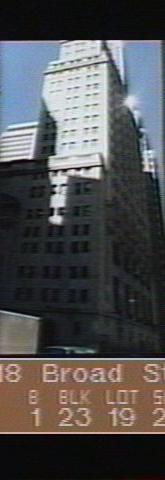
The city photographed every building for its tax records around 1940 and again in the 1980s. NYC Municipal Archives.
Written with AI from the source each entry cites, then fact-checked.
- 1865
The Stock Exchange moves into its Second Empire home on the Broad Street site
The Exchange took its present name in January 1863, bought land on Broad Street that October, and moved into the finished building in December 1865. That Second Empire building of 1863 to 1865 stood until George Post's replacement went up. Before that the brokers had moved from the Merchants' Exchange to the Cotton Exchange and Lord's Court Building.
- 1901
The exchange moves out and Post's cornerstone is laid
The old Broad Street building came down starting in May 1901, and the exchange's business shifted for a time to the Produce Exchange. Workers set the cornerstone of George B. Post's replacement on September 9, 1901, and the exchange took possession of the finished building on April 22, 1903. Post was selected through a competition among several of the city's best-known architects, whose program was drawn up with advice from Columbia professor William Ware and architect Charles W. Clinton.
- 1903
The New York Stock Exchange dedicates George B. Post's Broad Street building
Designed by George B. Post and built from 1901 to 1903, the exchange's marble building at 18 Broad Street was dedicated before more than 2,000 guests on April 23, 1903, and trading on the new floor began the next day. Its pediment sculpture, designed by John Quincy Adams Ward and Paul Wayland Bartlett, shows a central figure of Integrity flanked by figures of commerce and industry.
Source: Wikipedia
- 1909
J.Q.A. Ward's pediment shows 'Integrity Protecting the Works of Man'
Sculptor John Quincy Adams Ward designed the Broad Street pediment in 1903, but the marble figures were not carved until 1908 and 1909. Integrity stands at the center with two children, flanked on one side by a mechanic and helper and on the other by a farmer and his wife. The Landmarks Commission cites Wayne Craven as calling the iconography thoroughly American, since its subjects are the sources of the nation's prosperity.
“Ward's composition was designed in 1903 as the building was nearing completion, but the marble figures were not actually carved until 1908-09. They depict "Integrity Protecting the Works of Man.”
- 1914
The exchange shuts its trading floor for four months
When the outbreak of World War I sent investors rushing to convert securities into gold, the New York Stock Exchange closed its Broad Street trading floor for four months in 1914, the first extended shutdown in the exchange's history. Trading resumed cautiously as European markets remained frozen by the war.
Source: Wikipedia
- 1920
The Wall Street bombing kills 38 people outside the exchange
On September 16, 1920, a bomb exploded in the street outside the exchange, killing 38 people and injuring hundreds more. The attack came while the exchange was expanding: its annex at 11 Wall Street, designed by Trowbridge & Livingston, was finished in 1922, and the combined buildings were named a National Historic Landmark in 1978.
Source: Wikipedia
- 1929
The Great Crash of October 29 ends the 1920s speculative boom
In the 1920s the public flooded into the market and trading in common stocks soared. The Great Crash of October 29, 1929 ended that era abruptly and helped set off the Great Depression. Senate investigations of the Exchange in 1933 and 1934 led to laws placing all stock exchanges under heavy government control, though the commission notes that this did not reduce the Exchange's standing.
“The Great Crash on October 29, 1929, brought a dramatic end to this speculative period, helping to trigger the Great Depression.”
- 1933
The trading floor shuts for over a week after the Emergency Banking Act
In March 1933, in the depths of the Depression, the trading floor stayed closed for more than a week after Franklin Roosevelt signed the Emergency Banking Act into law. The shutdown followed the 1929 crash, when share prices on the exchange fell 23 percent in two days.
Source: Wikipedia
- 1936
Weathered marble pediment figures are replaced with metal ones, a change kept secret for 18 years
The Broad Street pediment, a commerce-and-industry scene designed by sculptors J.Q.A. Ward and Paul Bartlett, had deteriorated, and its marble figures were swapped out in 1936. Sheet metal coated with lead stood in for the stone, and the switch stayed secret for eighteen years.
Source: Wikipedia
- 1967
Abbie Hoffman and fellow activists shower dollar bills onto the trading floor
Abbie Hoffman led a group of protesters into the visitors' gallery, where they threw handfuls of real and fake dollar bills down onto the traders below; accounts of the total range from $30 to $300. Afterward the exchange spent about $20,000 to enclose the gallery behind bulletproof glass.
Source: Wikipedia
- 1967
Muriel Siebert becomes the first woman to hold a seat on the exchange
Muriel Siebert founded her own research and brokerage firm in 1967 and applied for a seat on the New York Stock Exchange the same year. Nine of the first ten backers she approached to sponsor her turned her down. The exchange also required her to produce a bank letter offering a $300,000 loan toward the near-record $445,000 price. Elected on December 28, 1967, she joined 1,365 men as the first woman member.
“She joined the 1,365 male members of the exchange on December 28, 1967.”
Source: Wikipedia
- 1985
The city designates the exchange building a landmark
The federal government named the Broad Street exchange and its Wall Street annex National Historic Landmarks in 1978. New York City followed with its own landmark designation for 18 Broad Street on July 9, 1985, and in 2007 the building became a contributing property to the Wall Street Historic District.
Source: Wikipedia
- 1989
Arturo Di Modica drops Charging Bull in front of the Exchange as guerrilla art
Late on December 14, 1989, sculptor Arturo Di Modica trucked his bronze Charging Bull to Broad Street and set it down beneath the 60-foot Christmas tree in front of the exchange, as an uninvited gift to the city. Crowds gathered while he handed out fliers. Exchange officials phoned the police, who seized the statue the same day. It was reinstalled at Bowling Green on December 20.
Source: Wikipedia
Further reading
- New York Stock Exchange BuildingWikipedia
Nearby
- Irving Trust Building1 Wall Street | 12 entries
- Continental Bank Building30 Broad Street | 3 entries
- 23 Wall Street15 Broad Street | 11 entries
- Bankers Trust Company Building14 Wall Street | 9 entries
- Exchange Court Building52 Broadway | 3 entries
- Federal Hall National Memorial26 Wall Street | 13 entries