Federal Hall National Memorial
26 Wall Street | Financial District | built 1842
Open on the map13 entries

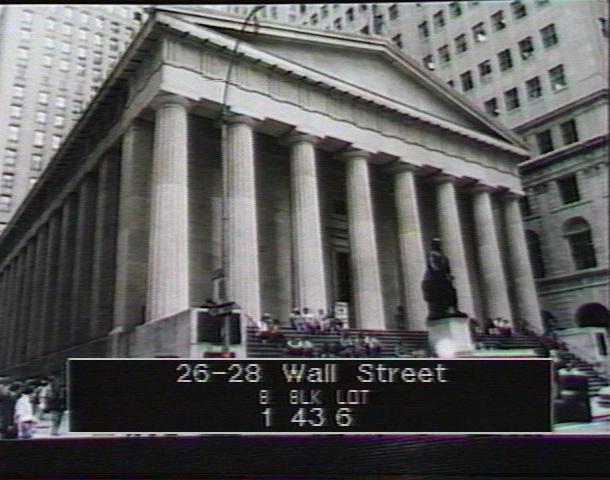
The city photographed every building for its tax records around 1940 and again in the 1980s. NYC Municipal Archives.
Written with AI from the source each entry cites, then fact-checked.
- 1735
Publisher John Peter Zenger is tried for libel on this site
An earlier city hall on this site held the 1735 libel trial of publisher John Peter Zenger, prosecuted for criticizing New York's colonial governor. His acquittal, argued on the grounds that true statements could not be libelous, became an early foundation for the American idea of press freedom later enshrined in the Bill of Rights.
Source: Wikipedia
- 1765
The Stamp Act Congress meets in the old City Hall on this site
An earlier building on this site, New York's second City Hall, was built between 1699 and 1703. In 1765 delegates from several colonies met there as the Stamp Act Congress to protest Parliament's new tax, arguing against taxation without representation. That building was later remodeled as Federal Hall and was torn down in 1812.
Source: Wikipedia
- 1787
The Continental Congress adopts the Northwest Ordinance at the old City Hall
After the Revolution, the Continental Congress held its sessions in New York's City Hall on this site. In 1787 it adopted the Northwest Ordinance there, which set out how new states would be created. The same building was later remodeled by Pierre L'Enfant for the new federal government.
“…the Continental Congress met at City Hall and, in 1787, adopted the Northwest Ordinance, establishing procedures for creating new states.”
Source: National Park Service
- 1789
George Washington takes the presidential oath on the balcony of Federal Hall
When New York was the first seat of government under the Constitution, Congress met in the old Federal Hall that stood on this site. George Washington took the oath of office as the first president on its balcony on April 30, 1789, and that September the Bill of Rights was proposed there. John Quincy Adams Ward's bronze statue of Washington, placed on the present building's steps in 1883, marks the event.
Source: Wikipedia
- 1789
Congress approves the Bill of Rights on this site
Meeting in the original Federal Hall that once stood here, the first United States Congress approved the Bill of Rights on September 25, 1789, along with the Judiciary Act establishing the federal court system. That building was demolished in 1812 after New York's new city hall opened elsewhere.
Source: Wikipedia
- 1812
The old Federal Hall is demolished after returning to city government use
After the capital moved to Philadelphia in 1790, the remodeled building went back to housing New York's city government. That arrangement lasted until 1812, when Federal Hall was demolished. The current marble building went up on the site and opened as a customs house in 1842.
Source: National Park Service
- 1842
The Greek Revival Custom House is completed on Wall Street
The present building was designed by Town and Davis, who won a competition in 1833, and was built from 1834 to 1842 as the United States Custom House at a cost of $928,312. Its Doric columns recall the Parthenon. It later served as the U.S. Subtreasury from 1862 to 1925, was made a national historic site in 1939, and opened to the public as a memorial in 1940.
Source: Wikipedia
- 1862
The building becomes the U.S. Sub-Treasury and fills its vaults with gold and silver
After customs operations moved to 55 Wall Street in 1862, the former Custom House became the United States Sub-Treasury. Millions of dollars in gold and silver were stored in its basement vaults. This lasted until 1920, when the Federal Reserve Bank took over from the Sub-Treasury system.
Source: National Park Service
- 1883
John Quincy Adams Ward's bronze Washington goes up on the Sub-Treasury steps
In 1883 a bronze George Washington by the sculptor John Quincy Adams Ward was set on the front steps of the Sub-Treasury. It stands at about the height of the old Federal Hall's balcony, where Washington took his oath, looking out over Broad Street.
“In 1883, John Quincy Adams Ward's bronze statue of George Washington was erected on the Subtreasury's ceremonial front steps.”
Source: Wikipedia
- 1924
Federal agents plan to store seized liquor in the Sub-Treasury vaults
In October 1924 federal officials said they would move Prohibition enforcement agents into the Sub-Treasury building and use the basement vaults to hold confiscated alcohol. The idea drew opposition from patriotic and historical societies, and the plan was canceled the following month. The government kept the building and used it as storage space and office space for other agencies.
Source: Wikipedia
- 1940
Federal Hall opens to the public as a national memorial
After decades as a Subtreasury holding federal gold and silver reserves, the 1842 Custom House building was designated the Federal Hall National Memorial in 1939 and opened to visitors on February 22, 1940. The National Park Service has operated the site as a public memorial ever since.
Source: Wikipedia
- 1965
The Landmarks Commission designates the Custom House after one witness speaks in favor
The Landmarks Preservation Commission held its hearing on October 19, 1965, and designated the building on December 21 of that year. One witness spoke in favor and none opposed. The commission praised its pure Greek temple form, with columned porticos at both ends, its masonry vaulted ceilings that gave fireproofing, and its place at the head of Broad Street as the site of Washington's first inauguration.
“One witness spoke in favor of designation. There were no speakers in opposition to designation.”
- 2002
Congress convenes in Federal Hall for the first time since 1790
On September 6, 2002, about 300 members of Congress traveled from Washington to Lower Manhattan and held a session in Federal Hall National Memorial, a gesture of support for the city after the attacks of the previous year. It was the first time Congress had met in New York City since 1790. The memorial had itself sheltered about 300 people on September 11, 2001, and then closed for a month over concerns about its cracked structure.
“…approximately 300 members of Congress traveled from Washington, D.C., to New York to convene in Federal Hall National Memorial as a symbolic show of support…”
Source: Wikipedia
Further reading
- Federal HallWikipedia
Nearby
- 40 Wall Street20 entries
- Bankers Trust Company Building14 Wall Street | 9 entries
- 23 Wall Street15 Broad Street | 11 entries
- 37 Wall Street (Trust Company of America Building)37 Wall Street | 7 entries
- New York Stock Exchange18 Broad Street | 13 entries
- American Surety Building100 Broadway | 11 entries