Bankers Trust Company Building
14 Wall Street | also 9 Pine Street | Financial District | built 1912
Open on the map9 entries

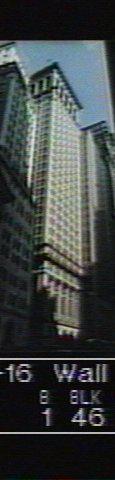
The city photographed every building for its tax records around 1940 and again in the 1980s. NYC Municipal Archives.
Written with AI from the source each entry cites, then fact-checked.
- 1909
Manhattan Trust pays a record $1.5 million for the Gillender Building, then resells it to Bankers Trust
In December 1909 the Manhattan Trust Company bought the Gillender Building at 16 Wall Street, an earlier tower on part of today's lot, for $1.5 million, the highest price yet paid for land in the city. It then resold the property to Bankers Trust for $1.25 million but kept long-term rights to the ground floor and other space. The New York Times reported that the two companies had colluded in the deal. Bankers Trust cleared the site the next year for its own headquarters.
“…the Manhattan Trust Company acquired the Gillender Building for $1.5 million (equivalent to $53,750,000 in 2025), then a record amount for land in New York City…”
Source: Wikipedia
- 1910
Workers begin demolishing the Gillender Building to clear the site
The 20-story, 300-foot Gillender Building was completed in 1897 for Helen L. Gillender Asinari. Manhattan Trust bought it in late 1909 and resold it to Bankers Trust, which wanted a taller building on the combined lot. Demolition began in April 1910, and The New York Times called it the first skyscraper torn down to make way for a taller one.
Source: Wikipedia
- 1912
A fire destroys Mercantile Trust's offices and forces Bankers Trust to redraw plans for its new tower
Bankers Trust had merged with the Mercantile Trust Company and expected to house some of its operations in the tower under construction. When fire gutted Mercantile's offices in January 1912, the bank had to rework its plans to fit Mercantile's staff. The blaze may also have revived talks with the Manhattan Trust Company: in February the bank announced it would absorb that firm, and the first two floors were redesigned as one joined space.
“Bankers Trust was forced to alter the plans for its new building to accommodate Mercantile Trust's staff and operations after Mercantile's offices were destroyed in a fire in January 1912…”
- 1912
Congress probes Bankers Trust's board, and J.P. Morgan & Co. cancels its move into the new tower
As the tower neared completion, a House subcommittee on banking learned that Bankers Trust was the country's second-largest trust company, with deposits above $168 million and a board holding 113 interlocking directorships. J.P. Morgan & Company had planned to move into the tower's thirty-first floor but cancelled, presumably to counter the bad press, and hired Trowbridge & Livingston to build the plain, unmarked 23 Wall Street instead. Congress passed the Federal Reserve Act in 1913.
- 1912
A parachutist jumps from the 32nd floor and lands on the roof of 26 Wall Street
In April 1912, a month before the building officially opened on May 1, a parachutist leapt from the 32nd floor of the new Bankers Trust tower at 14 Wall Street. The jumper landed on the roof of 26 Wall Street, the old Sub-Treasury building across Nassau Street. The bank's staff started moving in on May 20.
“In April 1912, a month before the building's opening, a parachutist jumped from the 32nd floor of 14 Wall Street, landing on the roof of 26 Wall Street…”
Source: Wikipedia
- 1912
Bankers Trust opens its 540-foot headquarters tower
Architects Trowbridge & Livingston designed the neoclassical tower at 14 Wall Street, topped by a seven-story pyramidal roof inspired by the Mausoleum at Halicarnassus. Bankers Trust used the basements and lower floors and rented out the rest, moving in on May 20, 1912. The 32nd floor was meant to be an apartment that J.P. Morgan had an option to occupy, but he chose not to.
Source: Wikipedia
- 1933
A 25-story Art Deco annex triples the building's rentable area
Shreve, Lamb & Harmon designed the annex, which wraps around the original tower on its western and northern sides. Bankers Trust razed the Astor, Hanover Bank and 7 Pine Street buildings to clear the site, and the project cost $5.5 million. The bank officially opened the annex on April 10, 1933.
Source: Wikipedia
- 1934
First National Bank wins $237,500 from Bankers Trust after annex blasting damaged its headquarters
When Bankers Trust cleared land for its annex in 1931, workers used dynamite and damaged two buildings near Wall Street and Broadway, including the First National Bank's headquarters. The bank sued Bankers Trust and the contractors for $881,500 in April 1932. After two years in court it was awarded $237,500 in January 1934, about a quarter of its demand, and Bankers Trust was released from any further liability.
Source: Wikipedia
- 1998
The Skyscraper Museum opens a show on the Empire State Building in the old Bankers Trust banking hall
In 1998 the Skyscraper Museum took over the Bankers Trust Building's Art Deco banking hall at 16 Wall Street. Its exhibition Building the Empire State ran from October 1998 through September 1999, followed by Big Buildings from October to December 1999. The museum then moved to a storefront at 110 Maiden Lane and later to its permanent home in Battery Park City.
Source: The Skyscraper Museum
Further reading
- 14 Wall StreetWikipedia
Nearby
- Federal Hall National Memorial26 Wall Street | 13 entries
- American Surety Building100 Broadway | 11 entries
- Equitable Building120 Broadway | 13 entries
- Irving Trust Building1 Wall Street | 12 entries
- New York Stock Exchange18 Broad Street | 13 entries
- 40 Wall Street20 entries