Alice Austen House (Clear Comfort)
2 Hylan Boulevard | Rosebank | built 1690
Open on the map8 entries

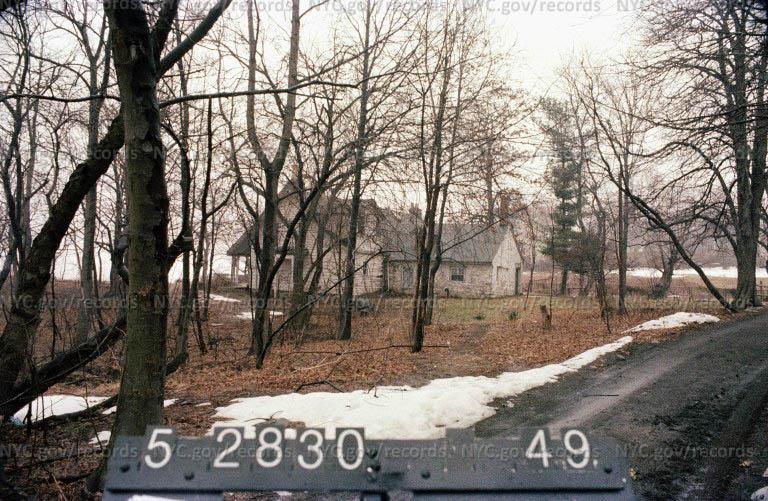
The city photographed every building for its tax records around 1940 and again in the 1980s. NYC Municipal Archives.
Written with AI from the source each entry cites, then fact-checked.
- 1698
The Johnson brothers buy the land around the future Austen cottage
The cottage started as a one-room Dutch Colonial house on the harbor shore near the Narrows. Its likely first occupants were the brothers Jacob, Lambert and John Woulter, or Johnson, who bought 120 acres from George Brown in 1698. Jacob's mother-in-law, Winifred King Benham, stood trial for witchcraft in Wallingford, Connecticut; after she was acquitted she may have come to live in the house.
Source: Wikipedia
- 1844
John Haggerty Austen buys the cottage and names it Clear Comfort
In 1844 John Haggerty Austen, grandfather of the photographer Alice Austen, bought the old Dutch house, gave it a new name and began remodeling it. It became Clear Comfort, the home where Alice spent most of her life and which is now a museum of her work.
Source: Wikipedia
- 1846
John Austen adds a wing that turns the farmhouse Gothic Revival
Two years after buying the L-shaped Dutch farmhouse, John Austen extended the frame wing northward with a new room, giving the house a T-shaped plan. Dormers were cut into the sweeping Dutch roof in the Gothic Revival style, and the architect James Renwick, a friend of the family, is credited with the look of the long wing facing the Narrows. The old stone kitchen behind still has its original bake oven.
“James Renwick, architect and friend of the Austen family, is credited with the Gothic REvival character of the long low wing…”
- 1866
Alice Austen, who will photograph her world from this house, is born
Elizabeth Alice Austen was born in 1866 into a wealthy New York family. One uncle, a sea captain, gave her a first camera when she was ten, and another, a chemistry professor, showed her how to develop glass plates. She went on to make close to 8,000 images, photographing beaches, sports and daily life around the family cottage.
Source: atlasobscura.com
- 1950
Alice Austen, ruined by the crash, leaves for the poorhouse
The 1929 stock market crash wiped out Alice Austen's inheritance, and she sold her possessions to get by. In 1950 she declared herself a pauper and moved to the Staten Island Farm Colony, the borough's poorhouse. Her photographs were rediscovered the next year through the Staten Island Historical Society, which held 3,500 of her glass plates, and a book on American women's history.
Source: atlasobscura.com
- 1971
The Alice Austen House is designated a city landmark
The Landmarks Preservation Commission designated the Alice Austen House on November 9, 1971, after three public hearings in 1966 and 1970. Its report described Alice Austen as a pioneer woman photographer who founded the Staten Island Historical Society and lived in the cottage for more than seventy-five years, making over seven thousand negatives.
“E. Alice Austen (1866-1952) pioneer woman photographer, founder of the Staten Island Historical Society…”
- 1985
Clear Comfort opens to the public as the Alice Austen House museum
Berenice Abbott and Philip Johnson led preservationists in the 1950s and 1960s to keep the house from being torn down. New York City bought it in 1975, and it opened to the public in 1985. It became a National Historic Landmark in 1993.
Source: Wikipedia
- 2017
The Austen House is recognized for Alice Austen's 53-year partnership with Gertrude Tate
Alice Austen met Gertrude Tate in the Catskills around 1900; the two were partners for 53 years and lived together in the family cottage. In 2017 the National Park Service named the house a national site of LGBTQ history, making it the city's fourth such site and the first in New York State devoted to a woman.
Source: atlasobscura.com
Further reading
- Alice Austen HouseWikipedia
Nearby
- McFarlane-Bredt House30 Hylan Boulevard | 8 entries
- Alice Austen House (Clear Comfort)43 Maryland Avenue | 1 entry
- St. Mary's Church1107 Bay Street | 3 entries
- St. John's Episcopal Church1334 Bay Street | 4 entries
- St. John's P.E. Church Rectory1329 Bay Street | 4 entries
- Woodland Cottage33 Belair Road | 4 entries