McFarlane-Bredt House
30 Hylan Boulevard | also 2 Hylan Boulevard | Rosebank | built 1665
Open on the map8 entries

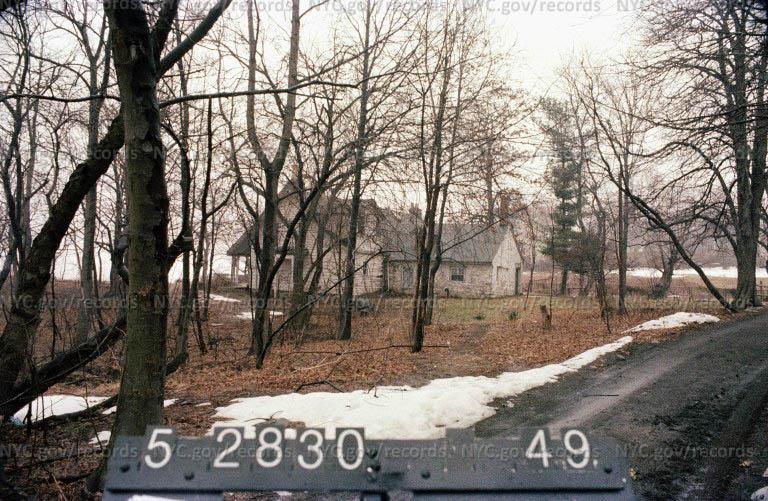
The city photographed every building for its tax records around 1940 and again in the 1980s. NYC Municipal Archives.
Written with AI from the source each entry cites, then fact-checked.
- 1841
Henry and Anne McFarlane buy the site and build an Italian-Swiss villa facing the Narrows
Soon after buying the land in 1841, Henry and Anne McFarlane built a long, low two-story wooden cottage with brick-filled walls modeled on an Italian-Swiss villa. A map from January 1846 shows the house with a wide veranda toward the Narrows, plus outbuildings including stables, greenhouses, an ice-house and a fish pond. McFarlane was an early Staten Island developer; any architect is unknown.
- 1865
Almira Wolfe pays $25,000 for the villa
Dry-goods merchant Henry Dibblee lived here from 1850 to 1865 and probably built the west addition that nearly doubled the house, copying its original details. In 1865 he sold the property to Almira Wolfe, wife of Nathaniel Wolfe, for $25,000, a very large price at the time.
- 1868
The New York Yacht Club buys the house for its clubhouse
The Richmond County Gazette reported on May 27, 1868, that the Wolfe house and three acres at Clifton had gone to the New York Yacht Club for a price of $25,000. The club then had 450 members. The purchase was made in the name of club officer James Gordon Bennett Jr., who handed it over to the club two months later.
“The sale was formally made to James Gordon Bennett, Jr., an officer of the New York Yacht Club…”
- 1870
Cannon fire from the clubhouse greets the winner of the first America's Cup defense
On August 8, 1870, the first challenge race for the America's Cup was sailed in New York harbor while the yacht club was based here. About 50,000 people lined the Staten Island and Brooklyn shores to watch the club's Magic beat the English challenger Cambria. Cannon on the clubhouse grounds boomed as Magic came into the Narrows.
“…it was greeted by the thunder of cannon on the Club House grounds…”
- 1871
The yacht club sells its Clifton clubhouse to Frederick Bredt
Members found the Clifton house too small for big parties and the trip to Staten Island a burden, so in 1871 the club sold it to merchant Frederick Bredt for $16,000. Bredt, who had a mansion called Beechwood across the road, probably never lived here and sold in 1874, yet his name stuck to the house.
“…in 1871 it was sold to Frederick Bredt, merchant, for $16,000.”
- 1891
James Thompson buys the house and probably adds its tall west wing
James Thompson bought the property in 1891 and owned it until 1908, and his daughter Jeanette held it until 1948. Thompson probably built the plain, square three-story wing at the far west end, likely meant as servants' quarters.
- 1975
New York City buys the McFarlane-Bredt and Austen properties for a park
Jeanette Thompson sold the house in 1948 to T. Gilbert Brouillette, who stayed until 1961. Developers then bought it along with the neighboring Austen house, and it changed hands several times. In 1975 the City of New York bought both properties, planning a public park on the Narrows.
- 1982
The former yacht clubhouse becomes a city landmark
The Landmarks Preservation Commission designated the McFarlane-Bredt House, the former New York Yacht Club, on October 12, 1982. At its September 1980 hearing five witnesses spoke in favor and none against. The commission called it an early Victorian country villa that had served as the club's second home.
“Five witnesses spoke in favor of designation. There were no speakers in opposition…”
Further reading
- McFarlane–Bredt HouseWikipedia
Nearby
- Alice Austen House (Clear Comfort)43 Maryland Avenue | 1 entry
- Alice Austen House (Clear Comfort)2 Hylan Boulevard | 8 entries
- St. Mary's Church1107 Bay Street | 3 entries
- St. John's Episcopal Church1334 Bay Street | 4 entries
- St. John's P.E. Church Rectory1329 Bay Street | 4 entries
- Woodland Cottage33 Belair Road | 4 entries