Joseph Steele House
200 Lafayette Avenue | also 343 Vanderbilt Avenue | Clinton Hill | built 1845
Open on the map5 entries

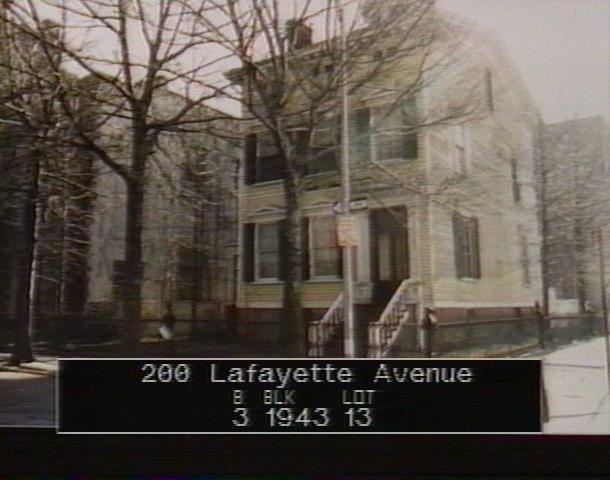
The city photographed every building for its tax records around 1940 and again in the 1980s. NYC Municipal Archives.
Written with AI from the source each entry cites, then fact-checked.
- 1845
Joseph Steele builds a wooden suburban mansion at Lafayette and Vanderbilt Avenues
Around 1845, Joseph Steele, who lived in Brooklyn Heights, built a large clapboard house on land he owned at what is now 200 Lafayette Avenue. At the time the neighborhood was still being turned into a suburb well away from the city. The Landmarks Preservation Commission later counted the house among Brooklyn's most extraordinary survivors of the mid-1800s.
“…it was he who built the house c. 1845, at the time when this area was being developed as a suburban section some distance from the city…”
- 1845
The house blends Greek Revival and Italianate details, and its small wing may predate it
The two-and-a-half-story frame house combines Greek Revival forms, such as six-over-six windows and pedimented lintels, with early Italianate touches, and has an octagonal cupola on the roof. A small wing on the east side is out of scale with the main house, and the Landmarks Preservation Commission suggested it was an existing building that was joined to the house when the main block went up. The commission said the exterior appears never to have been altered.
“…the small wing to the east of the house was a building, already on the site, which was attached to the house when the latter was built…”
- 1853
Steele's executors sell the house to Joseph K. Brick, first president of Brooklyn Union Gas
In 1853 the executors of Joseph Steele's estate sold the house and its lot to Joseph K. Brick. Brick headed the Brooklyn Union Gas Company as its first president and had built Brooklyn's first gas works in 1848-49. His family kept the house until 1903.
“Steele's executors sold the house and property in 1853 to Joseph K. Brick, who was the first president of the Brooklyn Union Gas Company…”
- 1903
Robert Skinner buys the Steele house from the estate of Julia Brick
Brick family ownership of the house ended on November 1, 1903, when Robert Skinner bought the property out of the estate of Julia Brick, who had been Joseph Brick's widow. Skinner's family still owned it when the Clinton Hill Historic District was designated in 1981.
- 1968
The Landmarks Preservation Commission designates the Steele House a city landmark
The commission held a hearing on February 8, 1966, at which four witnesses spoke for designation, among them the owner's daughter, and nobody spoke against. When it designated the house on March 19, 1968, it described it as unequaled among Kings County examples of clapboard Greek Revival architecture. It also noted that the house had not been modernized.
Nearby
- Queen of All Saints Church300 Vanderbilt Avenue | 5 entries
- Apostolic Faith Mission (former Orthodox Friends Meeting House)265 Lafayette Avenue | 4 entries
- Paul Robeson Theatre (former St. Casimir's Church)40 Greene Avenue | 8 entries
- Emmanuel Baptist Church279 Lafayette Avenue | 5 entries
- Caroline Ladd Pratt House229 Clinton Avenue | 6 entries
- Royal Castle Apartments20 Gates Avenue | 5 entries