Queen of All Saints Church
300 Vanderbilt Avenue | also 296 Vanderbilt Avenue, 201 Lafayette Avenue, 306 Vanderbilt Avenue | Clinton Hill | built 1911
Open on the map5 entries

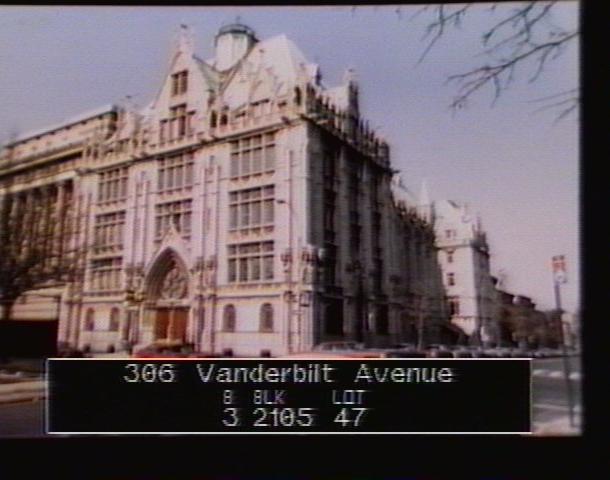
The city photographed every building for its tax records around 1940 and again in the 1980s. NYC Municipal Archives.
Written with AI from the source each entry cites, then fact-checked.
- 1910
Construction begins on Queen of All Saints church and school, designed by Reiley & Steinback
The parish began as St. John's, whose chapel, dedicated in 1878, soon proved too small for its growing congregation. Work on a new church and school at Lafayette and Vanderbilt Avenues began in 1910, to designs by the Catholic church architects Reiley & Steinback. The apse of the church and the rectory on Vanderbilt Avenue were not built until 1915.
- 1910
The school facing Lafayette Avenue gets a Gothic portal, saint statues and gargoyles
The complex's school building faces Lafayette Avenue as a symmetrical five-story block under a tall hipped roof. Its Gothic entry portal sits between paired buttresses, each carrying a column that supports a statue of a saint in a canopied niche. A cornice of foliate ornament supports projecting gargoyles, and a traceried parapet runs in front of the gabled dormers.
“The school is basically a symmetrical, five-story rectangular building surmounted by a tall hipped roof and clad in Gothic facing.”
- 1913
Queen of All Saints is dedicated as the Cathedral Chapel, hailed as Brooklyn's most beautiful church
The new Cathedral Chapel Queen of All Saints was dedicated on November 27, 1913. The Landmarks Preservation Commission's report quotes a contemporary view that there was unusual agreement that it was the most beautiful ecclesiastical structure in Brooklyn and one of the most important additions to the country's architecture.
- 1913
A Wirsching organ is built for the church and later earns a Historical Citation
Philipp Wirsching of Salem, Ohio, built the church's organ in 1913, and it was electrified in 1925. The Organ Historical Society regards it as an outstanding example of Wirsching's artistry and has given it Historical Citation number 66.
Source: Wikipedia
- 2019
The Queen of All Saints school closes after enrollment falls
The parish school, built together with the church in the 1910s, closed in August 2019 because enrollment had fallen by 30 percent. Wikipedia notes it was not yet known what the school building would be used for next. Faith formation classes were no longer offered at the church once the school had shut.
“The school closed in August 2019 because of a 30% decline in the number of students enrolling in the school.”
Source: Wikipedia
Further reading
Nearby
- Joseph Steele House200 Lafayette Avenue | 5 entries
- Paul Robeson Theatre (former St. Casimir's Church)40 Greene Avenue | 8 entries
- Apostolic Faith Mission (former Orthodox Friends Meeting House)265 Lafayette Avenue | 4 entries
- Emmanuel Baptist Church279 Lafayette Avenue | 5 entries
- Caroline Ladd Pratt House229 Clinton Avenue | 6 entries
- Pratt Institute Library261 Hall Street | 4 entries