Paul Robeson Theatre (former St. Casimir's Church)
40 Greene Avenue | Fort Greene | built 1864
Open on the map8 entries

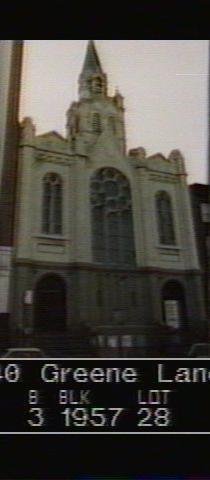
The city photographed every building for its tax records around 1940 and again in the 1980s. NYC Municipal Archives.
Written with AI from the source each entry cites, then fact-checked.
- 1864
The Fourth Universalist Society moves into its new Church of the Redeemer on Greene Avenue
The Fourth Universalist Society of Brooklyn formed in April 1860 when Fort Greene members broke away from the First Universalist Society. In 1863 it bought two lots on the south side of Greene Avenue from surveyor Roswell Graves. By the following spring the congregation, which had been meeting in a chapel on Cumberland Street, moved into the Church of the Redeemer.
- 1864
Rembrandt Lockwood, an artist turned church architect, is credited with the design
The design is attributed to Rembrandt Lockwood on the strength of a letter in which he listed eleven churches he had built, including a Universalist church on Greene Avenue in Brooklyn. Born in New York, he studied in Munich and finished a 27- by 17-foot mural of the Last Judgment in 1854 to mixed reviews. He then turned to architecture, moved to New York City in 1863 and practiced until 1876.
- 1870
Temple Israel, a new Reform congregation, buys the church and consecrates it as a synagogue
The Universalists put the church up for sale in 1868, and it passed to the newly formed Temple Israel, founded in November 1869 by members of older congregations drawn to Reform Judaism. The group had about 40 families when it bought the building with its furnishings on April 6, 1870. Little alteration was needed, and it was consecrated as Temple Israel two days later. The congregation worshipped there for 20 years, growing to 465.
- 1890
Bishop Loughlin buys the synagogue and dedicates it as St. Casimir's, a Polish Catholic church
St. Casimir's, Brooklyn's first Polish parish, had been founded in 1875 and by 1888 counted 500 families. In July 1890 Bishop John Loughlin bought the Temple Israel building for it, and an apse and steeple were added. He dedicated the church on November 27, 1890. It served as a national church for Poles across much of Brooklyn.
- 1918
A fire guts St. Casimir's interior, the first of two during Father Kubec's long pastorate
Father Gervase W. Kubec arrived at St. Casimir's in 1913 and remained until 1953, the longest tenure of any of its pastors. Two devastating fires gutted the church interior, altar and gallery included, in his time; the first was in 1918. In 1953 Father William F. Flaskowski oversaw a thorough renovation of the church.
“…two devastating fires gutted the church's interior including the altar and gallery, the first in 1918.”
- 1959
Figurative stained glass by Jacob Renner replaces the church's opalescent windows
The original windows on the main facade and nave had been filled with opalescent glass patterns. In 1959 they were swapped for figurative stained-glass panels of religious scenes, designed by Jacob Renner, an artist trained in Munich who worked with Hiemer & Company of New Jersey. Henry Irwin, who selected the glass, oversaw the critical aspects of the work, and Simon Berasaluce, a Madrid- and Paris-trained artist, did the painted details.
- 1980
Dr. Josephine English buys St. Casimir's and opens the Paul Robeson Theatre
St. Casimir's parish merged with Our Lady of Czestochowa in 1980 and the building was put up for sale. Dr. Josephine English bought it that year; she was the first African-American woman licensed in New York State as an obstetrician/gynecologist. She converted it into the Paul Robeson Theatre, intended to enrich and strengthen the community through art, culture and education, which has offered works by and for the African-American community.
- 2011
The Landmarks Preservation Commission designates the former church an individual landmark
The Landmarks Preservation Commission held a public hearing on June 28, 2011, with the Historic Districts Council, the New York Landmarks Conservancy and the Victorian Society New York speaking in favor. Its designation report, dated October 25, 2011, called the building a significant example of the Rundbogenstil and a reflection of Brooklyn's religious and cultural history.
Nearby
- Hanson Place Seventh-day Adventist Church88 Hanson Place | 6 entries
- Joseph Steele House200 Lafayette Avenue | 5 entries
- Queen of All Saints Church300 Vanderbilt Avenue | 5 entries
- James E. Davis 80 Arts Building80 Hanson Place | 2 entries
- Moe's80 Lafayette Avenue | 3 entries
- Royal Castle Apartments20 Gates Avenue | 5 entries