Lunt-Fontanne Theatre
205 West 46th Street | Times Square | built 1910
Open on the map15 entries

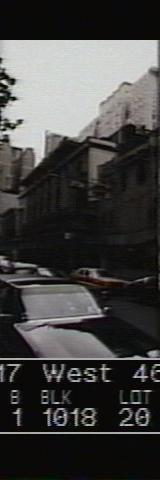
The city photographed every building for its tax records around 1940 and again in the 1980s. NYC Municipal Archives.
Written with AI from the source each entry cites, then fact-checked.
- 1910
Dillingham gives his Globe a ceiling that slides open to the sky
Charles Dillingham named his new theater for Shakespeare's open-air playhouse and tried to echo it with a sliding roof. The large oval panel in the auditorium ceiling was built to open in good weather so patrons could look up at the sky, a feature the landmark report says had not been tried in an American theater. A foyer on the first balcony level also opened through tall windows onto a balcony over 46th Street.
“The large oval panel of the ceiling is arranged so that it may be opened when the weather permits.”
- 1910
Sarah Bernhardt plays four weeks at the new Globe
The Globe's first year brought one of the most famous actresses of the age. Sarah Bernhardt performed there for four weeks in 1910 and returned briefly in 1911. The rest of the early seasons went to Dillingham's own musical-comedy stars, among them Dave Montgomery and Fred Stone, and to Elsie Janis, who appeared in The Slim Princess in 1911.
“Sarah Bernhardt performed for four weeks that same year and appeared briefly in 1911.”
- 1910
Charles Dillingham opens the Globe Theatre, designed by Carrère and Hastings
Producer Charles Dillingham's company bought land on West 46th Street and at 1555 Broadway in 1907 and engaged Carrère and Hastings as architects. Dillingham first wanted the name Gaiety, but across the street Cohan and Sam H. Harris were planning a Gaiety of their own, so he chose Globe, after Shakespeare's London playhouse. The first show, on January 10, 1910, was the musical The Old Town, with Dave Montgomery and Fred Stone.
Source: Wikipedia
- 1915
Irving Berlin's Stop! Look! Listen! opens at the Globe for Christmas
Dillingham's Christmas attraction in 1915 was Stop! Look! Listen!, with an Irving Berlin score that included the song "I Love a Piano." It followed a series of Dillingham musicals tailored to the comedians Dave Montgomery and Fred Stone, whose Chin-Chin, a fantasy loosely drawn from the Aladdin story, had run for 295 performances at the theater in 1914.
- 1921
Fanny Brice introduces "My Man" and "Second Hand Rose" in the Follies at the Globe
The Ziegfeld Follies of 1921 played the Globe, and Fanny Brice used the revue to introduce two songs, "My Man" and "Second Hand Rose." The theater had been built as the home of Dillingham's own productions, yet in the late 1910s and 1920s it also served as a venue for many lavish revues, the Follies among them.
- 1922
George White's Scandals brings Gershwin's 25-minute Blue Monday Blues to the Globe
George Gershwin wrote the music for the Scandals of 1920, 1922 and 1923 at the Globe, and the 1922 edition is the one the landmark report singles out. It featured "I'll Build a Stairway to Paradise" and Blue Monday Blues, a 25-minute opera that is often seen as a forerunner of Porgy and Bess.
“Blue Monday Blues," a 25-minute opera widely regarded as a precursor to Porgy and Bess…”
- 1925
No, No, Nanette opens at the Globe and makes Louise Groody the first musical-comedy star to earn $1 million
The Globe, which mostly staged revues and musicals, many of them Dillingham's own, had a major hit in 1925 with No, No, Nanette. Its featured performer Louise Groody went on to earn more than $1 million, a first for a musical-comedy performer. The theater's other attractions in these years included the Ziegfeld Follies, George White's Scandals, and, in 1910 and 1911, limited engagements by Sarah Bernhardt.
Source: Wikipedia
- 1932
Spear Securities buys the Globe at a foreclosure auction as Dillingham goes under
In October 1932 Spear Securities won the Globe at a foreclosure sale, paying $1.125 million. Charles Dillingham, who had built the theater, went bankrupt in 1933 with debts of more than $7 million, hurt badly by the Depression. Brandt Theatres began leasing the house for films, and by the following year a $1.1 million first mortgage on the house was held by the New York Public Library.
“Spear Securities acquired the theater at a foreclosure auction in October 1932 for $1.125 million.”
Source: Wikipedia
- 1936
Harry Brandt buys the Globe and keeps it as a movie house
The Globe had been leased to RKO as a movie theater in 1930, and The Cat and the Fiddle in 1931 was its last stage show before 25 years as a cinema. Dillingham went bankrupt in 1933, and in February 1936 Harry Brandt, head of Brandt Theatres, said he had purchased the building for $1.15 million. Under Brandt it showed reruns and some vaudeville and hosted film premieres, including The Road Back in 1937.
Source: Wikipedia
- 1958
The renamed Lunt-Fontanne opens with Alfred Lunt and Lynn Fontanne in The Visit
City Playhouses, a partnership that included developer William Zeckendorf, bought the Globe in 1957, and the firm Roche and Roche rebuilt the interior and sealed the Broadway entrance. It was renamed in honor of acting couple Alfred Lunt and Lynn Fontanne, who starred in the opening production, Friedrich Dürrenmatt's The Visit, on May 5, 1958. It was their last Broadway appearance.
Source: Wikipedia
- 1959
The Sound of Music opens at the Lunt-Fontanne and plays 1,443 performances
Rodgers and Hammerstein's The Sound of Music opened at the Lunt-Fontanne in 1959, after a revival of Much Ado About Nothing starring John Gielgud and Margaret Leighton. Over the next three years it played 1,443 performances, a few of them at the Mark Hellinger Theatre. In 1960 the owners leased the house to the producing team of Cy Feuer and Ernest H. Martin.
Source: Wikipedia
- 1967
Marlene Dietrich makes her Broadway singing debut at the Lunt-Fontanne
In 1967 Marlene Dietrich made her Broadway debut as a singer at the Lunt-Fontanne, accompanied by Burt Bacharach and a large orchestra. The theater also housed the musical How Now Dow Jones in 1967 and 1968. Its longest run remained The Sound of Music, with Mary Martin, which held the stage from 1959 through 1962.
- 1987
The Landmarks Commission designates the Lunt-Fontanne's facade but not its remodeled interior
On December 8, 1987, the Landmarks Preservation Commission designated the facade of the Lunt-Fontanne as a landmark. It denied status to the interior, which had been heavily modified in 1958. The Nederlanders, the Shuberts and Jujamcyn sued in 1988 to overturn the designations of 22 theaters, and the courts ultimately upheld them in 1992.
Source: Wikipedia
- 1988
Broadway's theater owners sue to overturn the landmark designations, including this one's
In June 1988 the Nederlanders, the Shuberts and Jujamcyn together sued the Landmarks Preservation Commission to overturn the designations of 22 theaters, the Lunt-Fontanne among them. The owners argued that landmark status severely limited how much they could alter their buildings. The suit went to the New York Supreme Court and on to the U.S. Supreme Court, and the designations were finally upheld in 1992.
Source: Wikipedia
- 1997
The hit musical Titanic pays for the Lunt-Fontanne's renovation
Titanic opened at the Lunt-Fontanne in 1997 and earned enough to pay for renovations of the theater. In 1998 the owners sold air rights to the builders of the Planet Hollywood Hotel next door, and the house closed for much of 1999 while Sachs Morgan Studio changed its lighting and paint scheme. Beauty and the Beast opened there late that year and ran until 2007.
“The musical Titanic opened in 1997 and was a hit, earning enough money to fund renovations of the theater.”
Source: Wikipedia
Further reading
- Lunt-Fontanne TheatreWikipedia
Nearby
- Hotel Edison221 West 46th Street | 7 entries
- Richard Rodgers Theatre226 West 46th Street | 14 entries
- New York Marriott Marquis1535 Broadway | 8 entries
- Paramount Hotel235 West 46th Street | 16 entries
- Morgan Stanley Building1585 Broadway | 12 entries
- Ethel Barrymore Theatre243 West 47th Street | 18 entries