Bank of the Metropolis
21 East 16th Street | also 31 Union Square West, 31 Union Square | Union Square | built 1902
Open on the map8 entries

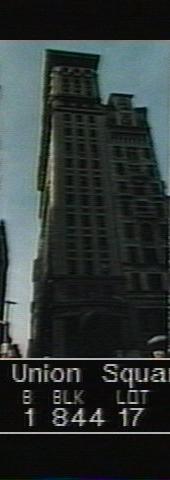
The city photographed every building for its tax records around 1940 and again in the 1980s. NYC Municipal Archives.
Written with AI from the source each entry cites, then fact-checked.
- 1871
Bank of the Metropolis opens at 31 Union Square to serve the square's merchants
The Bank of the Metropolis was founded in 1871 and first did business at 31 Union Square, on the lot where the present tower stands, as commerce moved uptown. It shifted to No. 17 in 1877 and No. 29 in 1888 but never left the square. Its board drew on neighboring businesses, and in 1902 it included the decorator and glassmaker Louis C. Tiffany, the jeweler Charles T. Cook, the publisher Charles Scribner and the lawyer George McNeir.
- 1902
The bank buys the Brentano's lot on Union Square and hires Bruce Price for a skyscraper
The lot at 31 Union Square had long housed Brentano's Bookstore, in the building the bank had left years earlier. In 1902 the bank bought the property and commissioned the architect Bruce Price to put a 16-story tower on the long, thin L-shaped lot. Wanting the prestige of a Union Square address, Price put the entrance on the narrow 32-foot end, beneath a bowed two-story portico carrying the bank's name.
Source: Daytonian in Manhattan
- 1903
Architect Bruce Price dies in Paris before his Union Square bank tower is finished
Bruce Price, who designed the tower, had gone to Europe hoping to recover his health. He died in Paris on May 29, 1903, at age 59, and never saw the finished building. When it opened that year it had cost $500,000 and had five fast elevators, steam heat, electric light and mail chutes. The city's Buildings Department judged it the slimmest tower for its height in New York, possibly anywhere.
Source: Daytonian in Manhattan
- 1903
Price designs the tower as a classical column on a long, thin corner lot
Price treated the skyscraper like a classical column, with a rusticated base, a transitional story, a plain nine-story shaft and a capital under a prominent copper cornice. Behind a face that reads as a slab, the building is actually an L in plan, shaped by its site. He gave it a narrow entrance front to claim the sought-after Union Square West address.
“Price employed his personal approach to the skyscraper as a classical column.”
- 1917
Jewish charities and aid groups begin moving into the Bank of the Metropolis tower in 1917
Besides architects, lithographers and engineers, the building drew Jewish organizations. The Jewish Board for Welfare Work moved in during 1917 and the Young Men's Hebrew and Kindred Association a year later. The American Jewish Committee took offices in 1931, and in 1937 the Jewish Consumptives' Relief Society followed.
Source: Daytonian in Manhattan
- 1918
Bank of the Metropolis is absorbed by the Bank of the Manhattan Company
After operating on Union Square since 1871, the Bank of the Metropolis was taken over in February 1918 by the Bank of the Manhattan Company, which ran it as a branch under the same executive officers. The Manhattan Company later joined the Chase National Bank, and in January 1955 the two became the Chase Manhattan Bank.
“…the bank continued in business until February 1918 when it was absorbed…”
- 1980
The old banking hall becomes a nightclub called Zippers
A 1975 zoning variance let the developer David Teitelbaum convert the office floors into 145 residences. By 1979 the work was done: most of the building held artists' lofts, and four floors served as a Parsons School of Design dormitory. In 1980 the old ground-floor banking room reopened as a club named Zippers, directed by Lynn Barclay. It later turned into a restaurant, Metropolis, whose owners added a small dance club in the basement.
“In 1980 the former banking room at the ground floor became a club called Zippers, under the direction of Lynn Barclay.”
Source: Wikipedia
- 2016
Blue Water Grill reopens with an oyster bar in the old bank vaults
Blue Water Grill had been at 31 Union Square West since 1996 when it closed for a summer renovation costing more than $1 million. It reopened in September 2016 with a new oyster bar, Metropolis, named for the bank and tucked into the former vaults below ground. Metropolis offered live jazz and soul bands five nights a week, while a new chef upstairs drew his menu from the nearby Union Square Greenmarket.
Source: dnainfo.com
Further reading
- Bank of the MetropolisWikipedia
- The Bank of the Metropolis -- No. 31 Union SquareDaytonian in Manhattan
Nearby
- Decker Building33 Union Square | 12 entries
- G. Schirmer Building35 Union Square | 7 entries
- Bank of the Metropolis31 Union Square | 4 entries
- 15 East 16th Street1 entry
- 20 East 17th Street1 entry
- 13 East 16th Street1 entry