Decker Building
33 Union Square | also 33 Union Square West | Union Square | built 1893
Open on the map12 entries

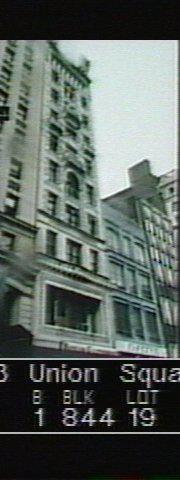
The city photographed every building for its tax records around 1940 and again in the 1980s. NYC Municipal Archives.
Written with AI from the source each entry cites, then fact-checked.
- 1869
The Decker brothers commission Leopold Eidlitz to design an earlier Decker Building on this lot
By the end of the Civil War the Decker Brothers piano firm wanted a building of its own, and in 1869 it hired Leopold Eidlitz to design an elaborate one on Union Square, on the lot where the later Decker Building stands. The four-story building sat among brownstone residences, with a multicolored facade, Venetian arcades and Victorian Gothic detail. Daytonian in Manhattan calls it nonconformist at the very least.
Source: Daytonian in Manhattan
- 1892
John Edelmann's Moorish-style Decker Building rises for a piano maker
The Decker Brothers piano company commissioned this building on Union Square from architect John H. Edelmann, and it was completed in 1892. Its facade draws on Venetian and Islamic design, with abundant terra cotta ornament, and a minaret once crowned the roof before disappearing ahead of World War II. It received landmark designations in 1988 and 2003 and was converted to apartments in 1995.
Source: Wikipedia
- 1894
Critic Barr Ferree likens the new Decker Building to a building afflicted with smallpox
In its April 1894 issue The Engineering Magazine ran Barr Ferree's review of the new building, which he called "a building afflicted with the smallpox." He thought eleven stories were quite enough and mocked the tower. Ferree's view was a minority one: the Real Estate Record and Guide called the facade highly artistic, and Frank Leslie's Popular Monthly had praised it in July 1893.
Source: Daytonian in Manhattan
- 1902
Construction next door threatens the Decker Building's foundation
When the Bank of Metropolis rises on the adjoining lot in 1902, excavation undermines the Decker Building's foundation and lifts its south wall by an eighth of an inch. Engineers respond by driving new foundations down to bedrock to stabilize the eleven-story tower. The repair preserves Alfred Zucker and John Edelmann's Moorish-Venetian design for decades of future use.
Source: Daytonian in Manhattan
- 1913
The Decker piano firm disappears from the building's listings after 1913
Decker Brothers had its showrooms at 33 Union Square West by 1870. City directories cited by the Landmarks Preservation Commission show the firm, which William F. Decker apparently ran by 1896, staying there until 1913. Trow's Directory listed it in liquidation in nearly every year from 1902 on, and it is not listed after 1913.
“The firm (apparently taken over by William F. Decker by May 1, 1896), remained at 33 Union Square West until 1913.”
- 1934
Painter Isabel Bishop takes a studio on the fourth floor
The artist Isabel Bishop set up her studio on the fourth floor in 1934 and stayed until 1978. She drew inspiration for her painting and drawing from Union Square below, which changed a great deal over those decades. Her years there overlapped with Andy Warhol's tenancy on the sixth floor, which began in 1968.
Source: Daytonian in Manhattan
- 1950
A falling cornice block kills a pedestrian below the Decker Building
On November 25, 1950, a one-ton piece of the Decker Building's cornice collapsed onto the sidewalk and killed Abraham Yeager, a 27-year-old man who was walking below. By then the building's rooftop minaret had disappeared, having gone before World War II.
Source: Wikipedia
- 1968
Valerie Solanas shoots Andy Warhol at his Factory on the sixth floor
Andy Warhol moved the Factory into the entire sixth floor of the Decker Building in February 1968, drawn partly by nearby Max's Kansas City. On June 3, 1968, radical feminist Valerie Solanas shot and seriously wounded Warhol here and also injured curator Mario Amaya. Afterward the Factory added security, including a Dutch door and an enclosed elevator. Warhol stayed until 1974.
Source: Wikipedia
- 1968
Andy Warhol moves the Factory to the sixth floor, drawn by nearby Max's Kansas City
In 1968 Warhol moved the Factory from 231 East 47th Street, slated for demolition, to the entire sixth floor of the Decker Building, which included a small balcony over Union Square. His office manager Paul Morrissey found the space, and Warhol liked that it was close to Max's Kansas City, a favorite gathering place. Union Square was then a declining area.
“Warhol was drawn to the building's proximity to Max's Kansas City, a favorite gathering place.”
Source: Wikipedia
- 1968
Messenger Jed Johnson delivers a telegram to the Factory and ends up working for Warhol
During preparations for the move, a young Western Union messenger named Jed Johnson delivered a telegram to the Factory, and Paul Morrissey hired him to help with renovations. Later that year Johnson began living with Warhol and became his longtime partner. After Valerie Solanas shot Warhol in June, Johnson installed a Dutch door and walled in the elevator so visitors had to buzz for entry.
“Jed Johnson, a young Western Union messenger, delivered a telegram to the Factory and was hired by Morrissey to assist with renovations.”
Source: Wikipedia
- 1988
The city designates the Decker Building a landmark
The New York City Landmarks Preservation Commission designates 33 Union Square West a landmark on July 12, 1988, protecting John Edelmann's ornate 1893 facade of Moorish arches and terra-cotta panels. The designation comes decades after the building's rooftop minaret had already vanished, sometime before World War II. The building is later added to the National and New York State Registers of Historic Places in 2003.
Source: Wikipedia
- 1994
A foreclosure buyer hires Joseph Pell Lombardi to restore the Decker Building for apartments
By the time Windsor Construction bought the Decker Building through foreclosure in 1994, its storefront had been obliterated and its balconies stripped away. Planning a residential conversion, the firm hired the preservation architect Joseph Pell Lombardi, who replicated the ground floor where Decker pianos were once displayed and rebuilt the balconies. The minaret was left out, and the building now has 18 apartments above a commercial first floor.
Source: Daytonian in Manhattan
Further reading
- Decker BuildingWikipedia
- The Lush 1893 Decker Building -- 33 Union Square WestDaytonian in Manhattan
- Where Andy Warhol was shot in Union SquareEphemeral New York
Nearby
- G. Schirmer Building35 Union Square | 7 entries
- Bank of the Metropolis21 East 16th Street | 8 entries
- Bank of the Metropolis31 Union Square | 4 entries
- 15 East 16th Street1 entry
- 20 East 17th Street1 entry
- 13 East 16th Street1 entry