G. Schirmer Building
35 Union Square | also 35 Union Square West | Union Square | built 1900
Open on the map7 entries

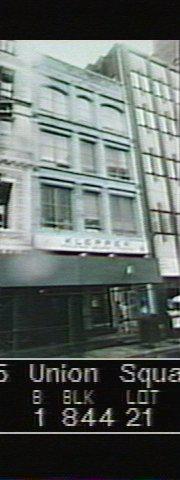
The city photographed every building for its tax records around 1940 and again in the 1980s. NYC Municipal Archives.
Written with AI from the source each entry cites, then fact-checked.
- 1857
The Townsend family takes boarders in their Greek Revival house at 35 Union Square
Samuel Ruggles leased lots on the old Williams farm in 1834 to create Union Square, and No. 35 was a three-and-a-half-story Greek Revival house above an English basement. By 1857 its residents, the Townsends, were taking select boarders, and on February 17 they advertised a second-floor suite with meals for a gentleman, references required. By the end of the Civil War, wealthy families like the Townsends were moving uptown and business was moving in.
Source: Daytonian in Manhattan
- 1867
Bell Brothers opens a clothing emporium in the former Townsend house
In February 1867 the Evening Post carried an ad renting the extra-large house at No. 35, with or without its stable, and it went to the gentlemen's outfitters Bell Brothers. The New York Dispatch called their store one of the largest clothing houses in the city. Upper floors went to other tenants, including the Methodist Missionary Society on the second floor and, by the summer of 1870, the bookseller Brentano's.
Source: Daytonian in Manhattan
- 1870
Painter Charles Caleb Ward works from a top-floor studio at 35 Union Square
Canadian-born Charles Caleb Ward, known for paintings of children, took the top floor around 1868 and remained until 1872. The Evening Post reported on June 24, 1870 that he had just finished a picture of a boy who has wounded his foot with a hatchet while his sister bandages it, with a small dog nearby. The story seemed charming to readers then, though Daytonian in Manhattan calls the subject a bit disturbing today.
Source: Daytonian in Manhattan
- 1873
Music publisher Gustav Schirmer leases the building for G. Schirmer
In 1873 the Townsends leased No. 35 to Gustav Schirmer, a Saxony-born importer and publisher of music who had come to New York with his family at eight. His firm, G. Schirmer, grew from the partnership of Beer & Schirmer. He sublet upper floors, including space for Anna Randall Diehl's teachers' employment bureau from 1876 to 1879. The firm hired an architect in 1891 to design a new headquarters at 108 East 16th Street but kept its Union Square store into the early 1900s.
Source: Daytonian in Manhattan
- 1888
D. & J. Jardine remodel the house with a Victorian Gothic and neo-Grec brick facade
The Record & Guide reported on June 9, 1888, that Gustave Schirmer had hired the firm of D. & J. Jardine to remodel the building. The new red brick front mixed Victorian Gothic touches, such as alternating red and white lintels on the fourth floor, with neo-Grec details, and it had limestone-framed openings on the second and third floors. A cast-metal cornice with a large pediment topped it; both were later lost.
Source: Daytonian in Manhattan
- 1944
Reeds' Cafeteria opens at 35 Union Square West and is picketed on its first day
Alfred Seitz opened Reeds' cafeteria in the ground floor space on February 22, 1944, three years after Stewart Cafeteria had hung a three-story banner on the facade. He had promised the CIO union two cashiers, but the Hotel and Restaurant Workers, Local 448, picketed the opening. He then signed a second contract with that union, and The Sun reported he paid $35 a week for a cashier who had nothing to do.
Source: Daytonian in Manhattan
- 1995
A former kayak store becomes Heartland Brewery after a 2 million dollar renovation
After a few decades of industrial tenants, including Klepper folding boats in the 1980s and early 1990s, the building drew a restaurant instead of the ice cream cafe also considered for it. The New York Times reported on January 1, 1995, that a 2 million dollar renovation would turn it into the Heartland Brewery. Former Wall Street banker Jon Bloostein planned a 250,000 dollar microbrewery making fruit ales.
Source: Daytonian in Manhattan
Further reading
- The 1888 G. Schirmer Building - 35 Union Square WestDaytonian in Manhattan
Nearby
- Decker Building33 Union Square | 12 entries
- Bank of the Metropolis21 East 16th Street | 8 entries
- Bank of the Metropolis31 Union Square | 4 entries
- 20 East 17th Street1 entry
- 15 East 16th Street1 entry
- 18 East 17th Street1 entry