Friends Seminary and Meeting House
222 East 16th Street | also 221 East 15th Street | Gramercy | built 1964
Open on the map15 entries

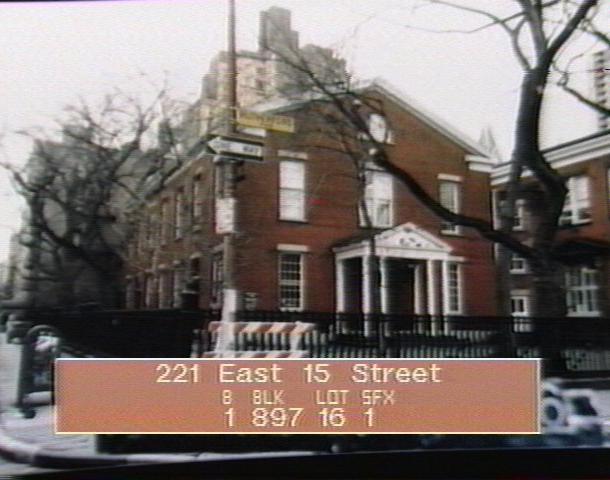
The city photographed every building for its tax records around 1940 and again in the 1980s. NYC Municipal Archives.
Written with AI from the source each entry cites, then fact-checked.
- 1786
Quakers found the Friends' Institute with a $10,000 bequest from merchant Robert Murray
Friends Seminary began in 1786 as the Friends' Institute, funded by a $10,000 bequest from the wealthy New York merchant Robert Murray. It opened on Pearl Street to give Quaker children what it called a guarded education. In 1826 the school moved to a larger campus on Elizabeth Street.
“…founded in 1786 as Friends' Institute through a $10,000 bequest of Robert Murray, a wealthy New York merchant.”
Source: Wikipedia
- 1860
The school moves to Stuyvesant Square and takes the name Friends Seminary
In 1860 the school left its Elizabeth Street campus for its present location near Stuyvesant Square and adopted the name Friends Seminary. It is the only Quaker school in Manhattan and describes itself as the city's oldest continuously operated coeducational day school. Attached to the school is the meetinghouse, a city landmark and the home of the Fifteenth Street Monthly Meeting.
Source: Wikipedia
- 1861
Hicksite Quakers move into the new Rutherford Place meeting house after decades on Hester Street
The Hicksite Quakers had stayed on at their Hester Street meeting house after the 1827 split with the Orthodox Friends, and in 1861 they moved into a new three-story brick meeting house at Rutherford Place and East 15th Street. Charles T. Bunting, a member and builder, constructed it and probably designed it. Its plain pedimented porch looks two decades older than it is.
“In 1861 the "Hicksite" Quakers built a three story brick meeting house at the northwest corner of Rutherford Place and East Fifteenth Street.”
- 1878
Friends Seminary opens a kindergarten, among the earliest in the city's schools
In 1878 Friends Seminary became one of the earliest schools to set up a kindergarten, eighteen years after moving to its Stuyvesant Square site under its present name. The Quaker school, which began in 1786 as the Friends' Institute, taught boys and girls together.
Source: Wikipedia
- 1889
The Universal Peace Union meets here, and President Cleveland declines its invitation
The meeting house hosted the annual conferences of the Universal Peace Union, founded in 1866. Before the two-day gathering on May 13 and 14, 1889, an invitation went to President Grover Cleveland. He turned it down, writing that his engagements were many, but agreed that peace and arbitration in place of war were an object worth the best efforts of civilized nations.
Source: Daytonian in Manhattan
- 1893
A rare Quaker wedding takes place in the meeting house, with no music and no minister
On October 21, 1893, Elizabeth Willetts and Dr. Samuel W. Lambert married in the meeting house, the first wedding there in nearly twenty years, as the New York Herald noted. In the Quaker way the couple declared themselves husband and wife aloud, then signed a certificate that Elder J. Howard Wright read to the congregation. The Herald remarked on the absence of the usual fashionable trappings.
Source: Daytonian in Manhattan
- 1915
The old Friends Meeting House hosts a city suffrage convention
The Sun reported in January 1915 that a Quaker suffrage meeting would be held on February 1, when the city suffrage convention met in the old Friends Meeting House. The hall regularly lent itself to reform causes, and later meetings there took up prison reform and aid for Mexico in 1920 and aid for Russia amid its economic depression in 1922.
Source: Daytonian in Manhattan
- 1925
Friends Seminary hires a full-time psychologist, a first for a private coeducational school
In 1925 Friends Seminary became the first private coeducational school to hire a full-time psychologist. The Quaker school, founded in 1786 as the Friends' Institute, describes itself as the oldest continuously operated coeducational day school in New York City.
Source: Wikipedia
- 1952
Future author M. Scott Peck transfers from Phillips Exeter to Friends Seminary
In late 1952 the future writer M. Scott Peck moved to Friends Seminary from Phillips Exeter Academy. He later praised the school's diversity and nurturing atmosphere, recalling that he woke each morning eager to start the day. At Exeter, by contrast, he said he could barely drag himself out of bed.
Source: Wikipedia
- 1958
The two branches of Manhattan Quakers reunite at Rutherford Place
The 1827 split between Hicksite and Orthodox Friends was healed in 1958, when the two meetings recombined at the Rutherford Place meeting house. The Orthodox had worshipped since 1859 in an Italianate meeting house on Gramercy Park, at 144 East 20th Street. That building stopped serving as a place of worship in 1958 and was sold in 1969 to a group of Gramercy Park residents for community use.
- 1964
Hunter Hall opens as the Seminary's main classroom building next to the meeting house
The school's largest building, Hunter Hall, dates from 1964 and sits beside the meeting house built in 1860. It holds the whole Middle School, most of the Lower School and part of the Upper School. A basement gym and cafeteria, a library and media center, science labs, art studios and computer labs fill the interior.
Source: Wikipedia
- 1969
The Landmarks Commission designates the Friends Meeting House and the old Seminary
On December 9, 1969, the Landmarks Preservation Commission designated the Friends Meeting House at 15 Rutherford Place and the old Friends Seminary at 226 East 16th Street as landmarks. Both buildings were completed in 1861. Two witnesses spoke in favor at the April 1966 hearing and none against, and the designation excluded the 1964 four-story addition to the Seminary.
- 2012
Bo Lauder brings iPads and Arabic to Friends Seminary
By March 2012 Friends Seminary, with about 730 students from kindergarten through twelfth grade, was handing out iPads to kindergartners, fifth graders and ninth graders. Its Arabic program was in its fourth year, and Bo Lauder, who had led the school for about a decade, pointed to a newly built library as the school's intellectual heart. The school also set up a financial aid fund for short-term help after 2008.
Source: dnainfo.com
- 2019
Kliment Halsband finishes a new upper school behind the facades of three 1852 townhouses
In September 2019 Kliment Halsband Architects completed a renovation and expansion that kept the landmarked brick facades of three 1852 townhouses and rebuilt everything behind them as one structure. The 29,000-square-foot upper-school wing rises six stories and is topped by a greenhouse, with the new structure set about five feet behind the old fronts. A columnless ground-floor space reaches nearly 22 feet high, and a 2,000-square-foot garden terrace sits on the roof. At Hunter Hall they also built a rooftop play area and two more floors of classrooms.
Source: architecturalrecord.com
- 2024
James Turrell's Leading Skyspace brings a light-show room to Friends Seminary
In February 2024 Dezeen reported on Leading, a James Turrell Skyspace at Friends Seminary and one of 85 such works worldwide. Visitors sit on wooden seating in a small room beneath a roof opening ringed by color-changing LED lights. During the day the opening stays shut while a light show plays, and a sliding roof opens at sunset to expose the sky. Kliment Halsband Architects was architect of record.
Source: dezeen.com
Further reading
- Friends SeminaryWikipedia
Nearby
- St. George's Episcopal Church211 East 16th Street | 8 entries
- St. George's Episcopal Church209 East 16th Street | 4 entries
- Hotel 17225 East 17th Street | 3 entries
- 226 East 14th Street2 entries
- Scheffel Hall190 3rd Avenue | 4 entries
- Labor Temple223 2nd Avenue | 4 entries