Hubbard House
2138 Mcdonald Avenue | Gravesend | built 1835
Open on the map7 entries

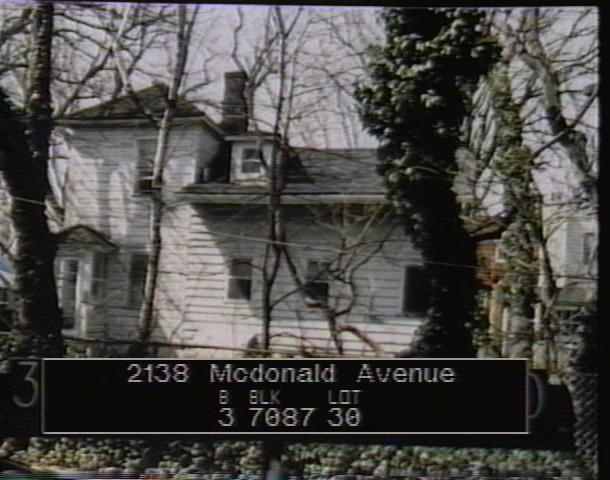
The city photographed every building for its tax records around 1940 and again in the 1980s. NYC Municipal Archives.
Written with AI from the source each entry cites, then fact-checked.
- 1830
Nelly Hubbard has a small Dutch-style farmhouse built on McDonald Avenue
The Hubbard House was built around 1830 to 1835 for Nelly Hubbard, tentatively attributed to Gravesend carpenter-builder Lawrence Ryder. It uses H-bent framing that gives it a one-and-a-half-story form, with sloping eaves and clapboard siding. The Landmarks Preservation Commission later called it the smallest and simplest of the Dutch-American houses surviving in Brooklyn.
- 1860
Carpenter Peter Rumph, a future Gravesend town supervisor, lives in the rented house
From about 1850 the house was rented out to workers and artisans, several of them in Gravesend's building trades. Census records suggest that in 1860 it housed carpenter Peter H. Rumph with his wife Jane and their baby daughter Mary. Rumph later became a prominent Gravesend politician and served as town supervisor in the 1890s.
- 1904
Tailor Vincenzo Lucchelli buys the house for his growing family
Vincenzo Lucchelli, a tailor in the men's garment industry who had emigrated from Ferrandina, Italy, in 1893, bought the house in May 1904 and lived there with his wife, Antoinette. They already had four children, and a fifth was born in the house. The family seems to have quickly converted the entry hall into a bedroom and made the former kitchen the dining room and main entrance.
“The Lucchellis seem to have immediately made alterations to accommodate their growing family.”
- 1923
Tuberculosis in the family leads the Lucchellis to add a sleeping porch wing
Son Vincent died of tuberculosis in 1922, and daughter Angela was also infected, so in 1923 the Lucchellis upgraded the house with a bathroom, electric wiring and a new two-story wing. Brooklyn architects Salvati & Le Quornik designed it with a many-windowed bedroom to serve as a sleeping porch, a setup then thought therapeutic for TB patients.
“…considered therapeutic for TB patients during the 1920s…”
- 1990
John Antonides meets Tess Lucchelli feeding cats in the yard and proposes landmarking
Brooklyn Museum editor John Antonides, researching old Dutch houses in the borough, found the Hubbard House standing and saw Theresa Lucchelli feeding dozens of cats in the yard. She invited him in and later had him to her birthday parties. In 1990 he suggested getting the house landmarked, she agreed, and he filed an application, but little came of it then.
Source: brooklynpaper.com
- 1998
Antonides buys the house after Tess Lucchelli's death and repairs it with Landmarks Conservancy help
Tess Lucchelli, the last family member to live there, died in 1997. In 1998 John Antonides bought the house from Peter Lucchelli's widow and began repairs funded partly by the New York Landmarks Conservancy, to which he granted a permanent facade easement. The work repaired or replaced the clapboards and windows, replaced the shingle roof and parts of the foundation, and added new shutters.
- 2009
The Landmarks Commission designates the Hubbard House after a hearing with thirteen supporters
The Landmarks Preservation Commission held a hearing on June 24, 2008, and continued it to January 13, 2009, when it designated the house. A total of thirteen speakers testified in favor, including the owner, then-Councilman Domenic Recchia, and Borough Historian Ron Schweiger. No one spoke against.
Further reading
- Hubbard House (Brooklyn)Wikipedia
Nearby
- Van Sicklen House27 Gravesend Neck Road | 6 entries
- Congregation Shaare Zion2030 Ocean Parkway | 5 entries
- Old Gravesend Cemetery40 Gravesend Neck Road | 5 entries
- Edmond J. Safra Synagogue2085 Ocean Parkway | 1 entry
- L&B Spumoni Gardens2725 86th Street | 1 entry
- B'nai Yosef Synagogue (The Painted Shul)1616 Ocean Parkway | 3 entries