Old Gravesend Cemetery
40 Gravesend Neck Road | Gravesend | built 1931
Open on the map5 entries

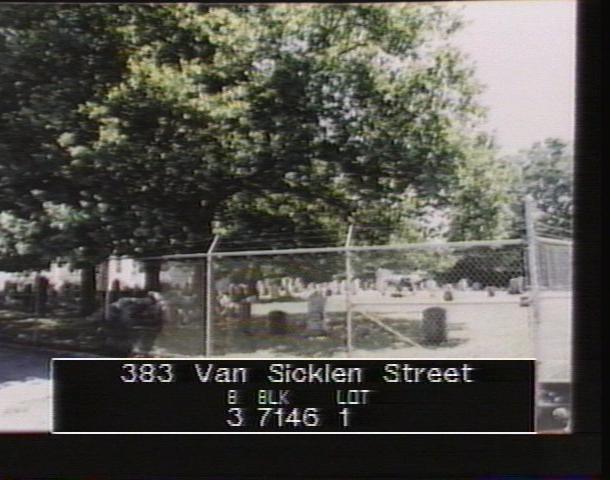
The city photographed every building for its tax records around 1940 and again in the 1980s. NYC Municipal Archives.
Written with AI from the source each entry cites, then fact-checked.
- 1645
Gravesend's 1645 town plan sets aside common ground that later becomes the burial ground
The 1645 drawing of Gravesend shows a walled sixteen-acre center split into four quadrants by two roads, now McDonald Avenue and Gravesend Neck Road. Each quadrant kept a central common square, which in time hosted the burial ground, school, town hall and church. The southwest quadrant's common ground became the cemetery, which the landmark report calls the sole reminder of that pioneer community.
“The burial ground, occupying the original common ground of the south-west quadrant, remains today as Gravesend Cemetery, sole reminder of this pioneer community.”
- 1658
Thomas Spicer's will leaves money to fence in the Gravesend burial ground
The burial ground already existed in 1658, when Thomas Spicer's will left twenty guilders to enclose it with a fence. The report notes that the earliest recorded death in Gravesend was in 1650, though most gravestones from before the eighteenth century have vanished or can no longer be read. In 1687 John Tilton willed his property to the cemetery, one of the gifts that gave it its irregular outline.
“The burial ground existed as early as 1658 when twenty guilders were bequeathed in the will of Thomas Spicer to enclose the cemetery with a fence.”
- 1812
Colonel Rutgert Van Brunt of the Gravesend militia dies and is buried in the cemetery
The landmark report lists Rutgert Van Brunt, who died in 1812, among several graves of men notable in the Revolutionary War. He sat in the Provincial Congress and was a colonel in the Gravesend militia. The others are Captain Rem Williamson, who died in 1825, and Captain Joost Stillwell, who died in 1827, both of the Gravesend militia.
“Rutgert Van Brunt (d. 1812), member of the Provincial Congress and colonel of the Gravesend militia; Rem Williamson (d. 1825), captain…”
- 1863
Tennis G. Berger records the gravestone inscriptions at Gravesend Cemetery
In 1863 Tennis G. Berger compiled a list of the inscriptions in the cemetery. He found the oldest on a broken slab of grey fieldstone, reading "Ida G." with the years 1676 and 1751. Family names he recorded included Van Sicklen, Dyckman, Gerritsen, Van Pelt and Wyckoff, along with Suydam, Van Nuyse, Ryder and Cowenhoven.
- 1976
Old Gravesend Cemetery is designated a New York City landmark
The Landmarks Preservation Commission designated the cemetery, including the Van Sicklen family plot, on March 23, 1976, after a hearing at which eleven witnesses spoke in favor and none against. The Van Sicklen family kept its own burial ground in the northwest corner, still fenced separately. At 1.6 acres, the cemetery is one of the smallest in the city.
“Eleven witnesses spoke in favor of designation. There were no speakers in opposition to designation.”
Nearby
- Van Sicklen House27 Gravesend Neck Road | 6 entries
- Hubbard House2138 Mcdonald Avenue | 7 entries
- Coney Island Yard Electric Motor Repair Shop1 entry
- L&B Spumoni Gardens2725 86th Street | 1 entry
- Congregation Shaare Zion2030 Ocean Parkway | 5 entries
- Edmond J. Safra Synagogue2085 Ocean Parkway | 1 entry