The Bowery House
218 Bowery | also 220 Bowery, 220A Bowery | Nolita | built 1927
Open on the map5 entries

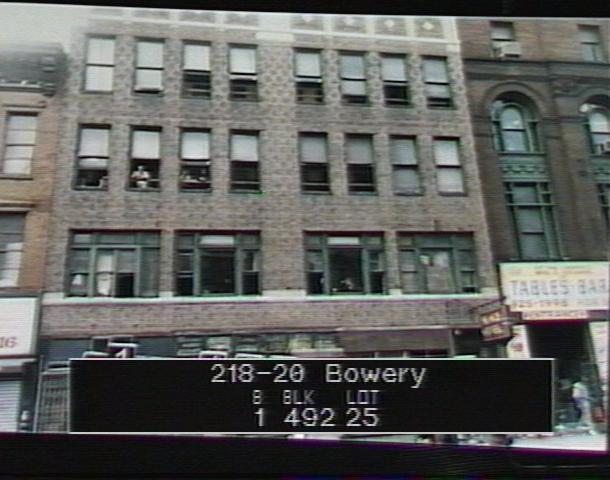
The city photographed every building for its tax records around 1940 and again in the 1980s. NYC Municipal Archives.
Written with AI from the source each entry cites, then fact-checked.
- 1924
L. Cohen & Sons buys the site and builds the Prince Hotel with space for 200 guests
L. Cohen & Sons bought the property in 1924 and put up a four-story brick building with stores on the ground floor and a hotel above, to a design by architect Jacob Fisher. It replaced a three-story building that had stood on the lot. The new Prince Hotel could house 200 people.
Source: Wikipedia
- 1924
The Prince Hotel facade uses a diaper pattern of brown and beige brick
The National Register nomination for the Bowery Historic District describes 218 Bowery as a Colonial Revival store and hotel building by Jacob Fisher. It has four bays on each side of a two-part facade and a decorative diaper pattern in brown and beige brick, with cast-stone diamond panels set in the parapet. The nomination cites it as an example of 1920s buildings that used Colonial Revival details on modern commercial forms.
“Prince Hotel, 1924-1960s+ (218-220). Four-story brick stores & hotel. Bi-partite façade, four bays each side. Decorative diaper pattern brown & beige bricks…”
Source: National Register nomination
- 1940
The Prince Hotel is rebuilt as a flophouse with cabins, bunk rooms and shared baths
By the 1940s, when the Bowery was known as the city's Skid Row, the Prince Hotel was housing returning World War II soldiers and men down on their luck. To fit in as many guests as possible, every floor was rebuilt as cabins for one, bunk rooms and shared bathrooms. Rooms meant for short stays often became long-term homes for their occupants.
“All of the floors were rebuilt with single room cabins, bunk rooms, and communal bathrooms to maximize occupancy.”
Source: Wikipedia
- 2000
Joey Grill buys the building for $2.2 million and leases upper floors to Common Ground
In 2000 Joey Grill, co-owner of the Click modeling agency, bought the building through AHJ Corporation for $2.2 million, planning luxury lofts. The hotel stopped taking new tenants, and its upper floors were leased to Common Ground, now called Breaking Ground, a nonprofit that provides services for homeless New Yorkers. The sale came as the Bowery was gentrifying with condominiums and upscale businesses.
Source: Wikipedia
- 2011
The Bowery House opens as a hotel that recalls the old flophouse
Italian race car driver Alessandro Zampedri and real estate entrepreneur Sanford Kunkel reopened the building in 2011 as The Bowery House. Long-term residents rent tiny stalls six feet long and five feet wide on the second floor, while tourists stay on the third and fourth floors. Critics worry that remaining tenants are being used to manufacture nostalgia for high-end visitors.
“In 2011, The Bowery House opened its doors after its redevelopment by Italian race car driver Alessandro Zampedri…”
Source: Wikipedia
Further reading
- The Bowery HouseWikipedia
Nearby
- Young Men's Institute Building ("The Bunker")222 Bowery | 6 entries
- 206 Bowery5 entries
- Empire Wagon Works Building194 Elizabeth Street | 4 entries
- Alabama House219 Bowery | 3 entries
- Hook & Ladder Company No. 9 firehouse209 Elizabeth Street | 6 entries
- 211 Elizabeth211 Elizabeth Street | 3 entries