Young Men's Institute Building ("The Bunker")
222 Bowery | Nolita | built 1885
Open on the map6 entries

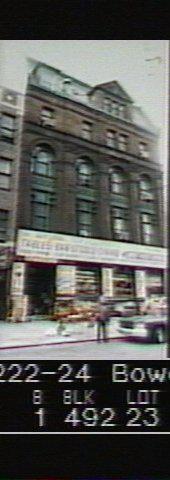
The city photographed every building for its tax records around 1940 and again in the 1980s. NYC Municipal Archives.
Written with AI from the source each entry cites, then fact-checked.
- 1885
The YMCA opens the Young Men's Institute on the Bowery
The YMCA bought the lots at 222 and 224 Bowery in 1882, broke ground on July 1, 1884, and opened the building on October 15, 1885. It was the first branch the YMCA's board had built itself, aimed at hard-working young men rather than the destitute men served by its older Bowery Branch. Cleveland H. Dodge chaired the Institute, and Cornelius Vanderbilt II backed the architect, Bradford L. Gilbert.
- 1886
Beecher and Theodore Roosevelt lecture to members of the Young Men's Institute
Men aged 17 to 35 could join the Institute, which offered a gymnasium, a circulating library of a thousand volumes and weekly lectures, concerts and debates. In 1886 the speakers included the Rev. Henry Ward Beecher, and Theodore Roosevelt spoke twice, on hunting and ranching out West. That fall the National Carriage Builders Association, which paid the teachers, set up a carriage design and drafting class at the Institute.
- 1915
Parish & Schroeder add a big gymnasium and swimming pool at the rear
Membership had fallen from 663 in 1895 to 441 by 1915. To win men back, members and committee backers including Percy and Moses Taylor Pyne and Cleveland Dodge paid for a three-story rear addition by the architects Wainwright Parish and J. Langdon Schroeder. It gave the Institute a large gymnasium with basketball and handball courts, plus a second-floor locker room with showers. A swimming pool of glazed brick and white tile went on the first floor.
- 1940
Fernand Leger, a refugee from the Nazis, lives and works in the empty building
The YMCA closed the Institute in December 1932. In 1940 and 1941 the French painter Fernand Leger, a refugee from the German occupation of his Normandy farm, was allowed to stay and work in the vacant building. In 1942 the YMCA sold it to the X-Ray Manufacturing Corporation of America, which used it for offices and a dental equipment factory.
- 1958
Artists move in, and Mark Rothko paints his Seagram murals in the old gymnasium
By the late 1950s the building was a residence again, and artists began to move in. Mark Rothko, who painted his Seagram murals in the old gymnasium, was one of them. The abstract painters James Brooks and Michael Goldberg followed, and so did the poet John Giorno. Andy Warhol is said to have thrown parties here, and Allen Ginsberg and Roy Lichtenstein were among the visitors.
Source: Ephemeral New York
- 1974
William S. Burroughs moves into the old locker room and names it the Bunker
The poet John Giorno moved into 222 Bowery in 1966 and founded the Dial-a-Poem telephone service the next year. William S. Burroughs, one of the writers who recorded for it, moved into the former locker room in 1974 and kept ownership of that loft until he died in 1997. He called it the Bunker, a nickname the whole building still carries. By the early 1980s he spent most of his time in Kansas, and the space went to a Tibetan Buddhist community for teaching and meditation.
Further reading
- The past lives of the “bunker” on the BoweryEphemeral New York
Nearby
- The Bowery House218 Bowery | 5 entries
- 206 Bowery5 entries
- Empire Wagon Works Building194 Elizabeth Street | 4 entries
- Alabama House219 Bowery | 3 entries
- Hook & Ladder Company No. 9 firehouse209 Elizabeth Street | 6 entries
- 211 Elizabeth211 Elizabeth Street | 3 entries