Shubert Theatre
225 West 44th Street | also 222 West 45th Street | Times Square | built 1913
Open on the map14 entries

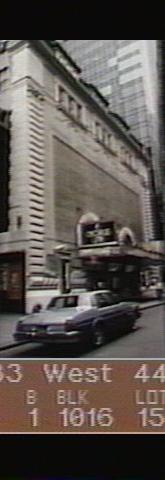
The city photographed every building for its tax records around 1940 and again in the 1980s. NYC Municipal Archives.
Written with AI from the source each entry cites, then fact-checked.
- 1912
Lee Shubert and Winthrop Ames lease an Astor site for two new theaters, with Henry B. Herts as the Shubert's architect
After a planned replacement for the New Theatre was canceled in 1911, Lee Shubert and producer Winthrop Ames agreed in April 1912 to lease the cleared lot from the Astor family. The larger house on 44th Street was named for Sam S. Shubert, Lee's late brother, and the smaller one on 45th Street became the Booth. The Shuberts hired Henry B. Herts, and Fleischmann Bros. began construction in 1912 amid disputes over costs and changes.
Source: Wikipedia
- 1913
The Shubert opens as the family's headquarters and a memorial to Sam S. Shubert
The Landmarks Commission describes the theater, whose full name was the Sam S. Shubert Memorial Theater, as built to serve both as the Shubert empire's headquarters and as a tribute to Sam, who had led the family business until his accidental death. Lee Shubert directed the family's plan for five such memorial theaters, and this was one of them. Two floors of the building held offices for the Shubert organization.
“The Shubert Theater was built in 1912-13 to be both the headquarters of the Shubert theatrical empire, and a memorial to Sam Shubert…”
- 1913
Lee Shubert's rooms above the theater include a room-sized safe for show receipts
The floors above the theater were originally designed as an apartment for Lee Shubert, the brother who took over the company. Among the rooms was a safe the size of a room, where the receipts of dozens of shows in New York and on the road were once kept, back when theater ran strictly on cash. Playbill reported in 2013 that the apartment had long since become offices and that the safe now holds boxes of soft drinks.
Source: playbill.com
- 1913
The Shubert Theatre opens with Johnston Forbes-Robertson's Hamlet, and Shubert Alley is first used at intermission
The Shuberts named the theater for Sam S. Shubert, who died in a railroad accident in 1905 at age 26. Hamlet, with British actor Johnston Forbes-Robertson, opened on October 2, 1913, three days after a reception for the star. Shubert Alley, the private passage beside the theater, was first used during that night's intermission. Forbes-Robertson's repertory season also included Shaw's Caesar and Cleopatra.
Source: Wikipedia
- 1933
Fred Astaire and Claire Luce star in Gay Divorce at the Shubert, Astaire's last Broadway musical
Astaire and Luce appear in the musical Gay Divorce at the Shubert in 1933, Astaire's last appearance in a Broadway musical. Earlier in the decade the theater had staged Everybody's Welcome, which gave Ann Sothern, then known as Harriette Lake, her musical debut, and the revue Americana in 1932.
“Gay Divorce, with Fred Astaire and Claire Luce; this was Astaire's last appearance in a Broadway musical.”
Source: Wikipedia
- 1936
Sherwood's Idiot's Delight opens at the Shubert with the Lunts and wins the Pulitzer Prize
Robert E. Sherwood's play opens with Alfred Lunt and Lynn Fontanne under Bretaigne Windust's direction, with Sydney Greenstreet in the cast. It runs 300 performances, until January 1937, and wins the 1936 Pulitzer Prize for Drama.
Source: playbill.com
- 1939
The Philadelphia Story, starring Katharine Hepburn, opens at the Shubert and rescues the Theatre Guild from bankruptcy
The Theatre Guild staged The Philadelphia Story at the Shubert in 1939, with Katharine Hepburn in the lead. The play ran 417 performances and saved the Guild from bankruptcy. Earlier in the decade the theater had hosted Idiot's Delight, its first Pulitzer Prize winner for drama, and Fred Astaire's last Broadway musical, Gay Divorce.
Source: Wikipedia
- 1943
Paul Robeson plays Othello opposite Uta Hagen and Jose Ferrer at the Shubert
The Theatre Guild's revival of Shakespeare's tragedy opens with Paul Robeson, José Ferrer and Uta Hagen heading the cast. It plays 296 performances, closing on July 1, 1944, so it stays at the Shubert for more than eight months.
Source: playbill.com
- 1962
Barbra Streisand makes her Broadway debut in I Can Get It for You Wholesale at the Shubert
The musical I Can Get It for You Wholesale opened at the Shubert in 1962 and marked Barbra Streisand's first Broadway show. It was also Harold Rome's last large Broadway musical. The same year David Merrick produced Stop the World, I Want to Get Off, staging it here.
Source: Wikipedia
- 1967
The Tony Awards come to the Shubert, and 44th Street is covered in carpet
The Shubert hosts its first Tony Awards ceremony in 1967, and the stretch of 44th Street outside is carpeted for the occasion. The ceremony returns in 1968 and again in 1974. During the run of A Chorus Line, the theater also hosts the 1976 to 1979 ceremonies and the one in 1985.
“The Shubert hosted its first Tony Awards in 1967, an occasion for which the surrounding stretch of 44th Street was covered in carpeting.”
Source: Wikipedia
- 1968
Promises, Promises opens at the Shubert and runs 1,281 performances
The musical by Neil Simon, Burt Bacharach and Hal David opens with Jerry Orbach and Jill O'Hara. It stays more than three years, closing January 1, 1972, after 1,281 performances.
Source: playbill.com
- 1975
A Chorus Line moves to the Shubert from the Public Theater and runs more than a decade
Joseph Papp and the Public Theater moved A Chorus Line from off-Broadway to the Shubert in October 1975. In that year Broadway attendance rose from 6.6 million to 7.3 million. It became Broadway's longest-running show in 1983, reached 5,000 performances in 1987, and closed in April 1990 after 6,137, having won the Pulitzer Prize for Drama.
Source: Wikipedia
- 1987
A Chorus Line passes 5,000 performances, and the Shubert holds a memorial for Michael Bennett
A Chorus Line, which moved to the Shubert in 1975, reaches its 5,000th performance in 1987, the first Broadway show to do so. Soon afterward the theater hosts a memorial service for the show's choreographer, Michael Bennett. The musical had already become Broadway's longest-running production in 1983.
Source: Wikipedia
- 1987
The Landmarks Commission designates the Shubert's facade and interior
The Landmarks Preservation Commission protected the theater's facade and interior on December 15, 1987, part of a sweeping effort to landmark Broadway houses. The Shubert Organization, the Nederlanders and Jujamcyn sued in 1988 to overturn the status of 22 theaters. After appeals reached the U.S. Supreme Court, the designations were upheld in 1992.
Source: Wikipedia
Further reading
- Shubert Theatre (Broadway)Wikipedia
Nearby
- Broadhurst Theatre235 West 44th Street | 12 entries
- Sardi's234 West 44th Street | 13 entries
- Booth Theatre222 West 45th Street | 14 entries
- Gerald Schoenfeld Theatre (Plymouth Theatre)236 West 45th Street | 14 entries
- Hayes Theater240 West 44th Street | 14 entries
- Former New York Times Building229 West 43rd Street | 15 entries