Booth Theatre
222 West 45th Street | Times Square | built 1913
Open on the map14 entries

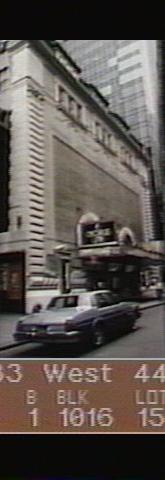
The city photographed every building for its tax records around 1940 and again in the 1980s. NYC Municipal Archives.
Written with AI from the source each entry cites, then fact-checked.
- 1913
The Booth Theatre opens with Arnold Bennett's The Great Adventure
The Booth opened on October 16, 1913, to excellent reviews, with Arnold Bennett's The Great Adventure, adapted from his popular novel Buried Alive. Early runs soon included George Bernard Shaw's Getting Married in 1916 with William Faversham and Henrietta Crosman, Booth Tarkington's Seventeen in 1918 and Somerset Maugham's Too Many Husbands in 1919.
“The Booth opened to excellent reviews on October 16, 1913, with Arnold Bennett's The Great Adventure…”
- 1913
The theater is named for Edwin Booth, brother of John Wilkes Booth, honoring a family's devotion to his legacy
The Booth was named for the actor Edwin Booth (1833-1893), brother of John Wilkes Booth, and Lee Shubert built it with the producer Winthrop Ames. It was the second New York theatre to bear the name, since Booth had built his own in 1869 at 23rd Street and Sixth Avenue. Ames's father had worked to preserve the actor's memory, so the name honored Booth and tied the Ames family to his theatrical legacy.
Source: shubert.nyc
- 1913
Henry Herts decorates the Booth's facade with sgraffito scratched into colored plaster
Architect Henry B. Herts gave the Booth an unusual feature: sgraffito decoration on the top panel below the cornice, made by scratching designs into soft plaster. The technique often uses two coats of different colors to heighten the contrast. Remnants of the original work survive, and the landmarks commission says the Booth and the Shubert hold the only known surviving examples in New York City.
“The sgraffito on the Booth and on the Shubert are the only known surviving examples in New York City.”
- 1915
Alice Brown's Children of the Earth, winner of Winthrop Ames's $10,000 prize, opens at the Booth
Winthrop Ames sponsored a $10,000 prize in 1913 for the finest play by an American writer. The winner was Alice Brown, a little-known playwright, and her play Children of the Earth reached the Booth stage in 1915. Ames produced and sometimes directed plays by writers including Maeterlinck, Ibsen, Shaw, A.A. Milne and Edna Ferber at the Booth and his Little Theater.
“He also sponsored a $10,000 prize for the best play by an American author in 1913.”
- 1931
Margaret Sullavan makes her Broadway stage debut at the Booth in a short-lived play
Elmer Harris's A Modern Virgin, which played the Booth in 1931, was a brief run, but it marked the first time Margaret Sullavan appeared on a Broadway stage. The Booth hosted about fifty productions in the 1930s, many of them short-lived or transferred from other venues, yet its central location meant the house was always quickly rebooked.
“One of the more notable short runs was Elmer Harris's A Modern Virgin in 1931, in which Margaret Sullavan performed for the first time on a Broadway stage.”
Source: Wikipedia
- 1936
Kaufman and Hart's You Can't Take It with You opens and runs 837 performances, winning the Pulitzer Prize
On December 14, 1936, George S. Kaufman and Moss Hart's comedy You Can't Take It with You opened at the Booth, starring Josephine Hull, Henry Travers and Oscar Polk. It ran 837 performances, the theater's biggest success to that point, and won the Pulitzer Prize. Another Pulitzer winner, William Saroyan's The Time of Your Life, later opened here with a cast that included Gene Kelly and Celeste Holm.
“Kaufman and Hart's You Can't Take It With You ran 837 times, won the Pulitzer Prize, and starred Josephine Hull, Henry Travers, and Oscar Polk.”
- 1936
Evelyn Laye appears in the songless English drama Sweet Aloes at the Booth
Sweet Aloes, a play from England, settled into the Booth on March 4, 1936, with Evelyn Laye in the cast. Brooks Atkinson of the Times noted that Laye had moved on from Bitter Sweet and that, despite the odd similarity in titles, this was an emotional drama without any songs.
Source: Internet Archive
- 1936
A wrestling-ring comedy, Swing Your Lady, opens at the Booth
Kenyon Nicholson and Charles Robinson's comedy Swing Your Lady! opened at the Booth on October 18, 1936. Brooks Atkinson reviewed it the next day under the headline 'Wrestling Ring Rumpus,' crediting the production with a good deal of comic energy. It was the pair's follow-up to their earlier play Sailor, Beware!
Source: Internet Archive
- 1939
The Theatre Guild opens William Saroyan's The Time of Your Life at the Booth
The Theatre Guild opened its 22nd season on October 25, 1939, with William Saroyan's The Time of Your Life at the Booth. Brooks Atkinson of the Times found something precious in Saroyan and described the play as a reverie in a barroom with little story. The Times headline presented it as the opener of the Guild's twenty-second season.
Source: Internet Archive
- 1953
The Booth hosts its first film premiere, the world premiere of Caesar
In 1953 the Booth Theatre hosted the world premiere of the film Caesar, the first production in the house's history that was not a live stage show. The theater soon returned to plays: in late 1954 Anniversary Waltz, starring Macdonald Carey and Kitty Carlisle, began a ten-month run after transferring from the Broadhurst.
“…the Booth hosted the world premiere of the film Caesar in 1953, the first non-legitimate production in the theater's history…”
Source: Wikipedia
- 1958
Henry Fonda and Anne Bancroft star in Two for the Seesaw, which runs 750 performances
In January 1958 Henry Fonda and Anne Bancroft opened in William Gibson's Two for the Seesaw at the Booth, and the play ran 750 performances. The year before, Cyril Ritchard starred in Gore Vidal's A Visit to a Small Planet for 388 performances. In 1959 Paddy Chayefsky's The Tenth Man, with Lou Jacobi and Jack Gilford, began a 623-performance run.
“…in January 1958, Henry Fonda and Anne Bancroft played in William Gibson's Two for the Seesaw (750 performances)…”
- 1976
Ntozake Shange's For Colored Girls Who Have Considered Suicide opens at the Booth and runs 742 performances
Ntozake Shange's For Colored Girls Who Have Considered Suicide / When the Rainbow Is Enuf began a 742-performance run at the Booth in 1976. The landmarks commission counts it among the theater's significant hits, along with That Championship Season, which won the Tony, the Drama Critics Circle Award and the Pulitzer Prize, and The Elephant Man in 1979.
“Ntozake Shange's For Colored Girls Who Have Considered Suicide/When the Rainbow is Enuf ran 742 times beginning in 1976…”
- 1984
Sondheim and Lapine's Sunday in the Park with George opens at the Booth and wins the Pulitzer Prize for drama
Stephen Sondheim and James Lapine's Sunday in the Park with George opened at the Booth in 1984 and earned the Pulitzer Prize for drama, a rare honor for a musical. Lynn Ahrens and Stephen Flaherty made their Broadway debut here with Once on This Island in 1990, and a two-piano revival of Frank Loesser's The Most Happy Fella opened in 1992.
Source: shubert.nyc
- 1988
Broadway theater owners sue the city to overturn landmark designations, including the Booth's
After the Landmarks Commission designated the Booth's facade and part of its interior on November 4, 1987, and the Board of Estimate ratified it in March 1988, the Shuberts, Nederlanders and Jujamcyn sued in June 1988 to overturn the designations of 22 theaters. They argued the rules severely limited alterations. The case reached the state supreme court and the US Supreme Court, and the designations were finally upheld in 1992.
Source: Wikipedia
Further reading
- Booth TheatreWikipedia
Nearby
- Gerald Schoenfeld Theatre (Plymouth Theatre)236 West 45th Street | 14 entries
- Shubert Theatre225 West 44th Street | 14 entries
- Broadhurst Theatre235 West 44th Street | 12 entries
- Music Box Theatre239 West 45th Street | 14 entries
- One Astor Plaza (1515 Broadway)1515 Broadway | 14 entries
- Bernard B. Jacobs Theatre242 West 45th Street | 14 entries