Broadway Theatre
230 West 53rd Street | also 1681 Broadway | Times Square | built 1924
Open on the map14 entries

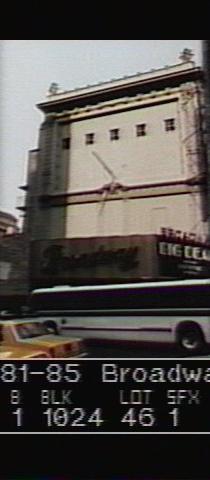
The city photographed every building for its tax records around 1940 and again in the 1980s. NYC Municipal Archives.
Written with AI from the source each entry cites, then fact-checked.
- 1924
B.S. Moss opens the Colony Theatre as a movie palace with The Thief of Bagdad
Designed by Eugene De Rosa for B.S. Moss, the Colony Theatre opened on Christmas Day 1924 on the site of a storage warehouse at Broadway and 53rd Street. It showed Universal Pictures films, beginning with The Thief of Bagdad, and was built for about two million dollars. Moss soon added an automatic air-cooling system.
Source: Wikipedia
- 1928
The Colony screens Steamboat Willie, the first Mickey Mouse cartoon released to the public
In November 1928 the Colony Theatre showed Steamboat Willie, which was the first Mickey Mouse cartoon released to the public. A documentary about the New York Stock Exchange followed the next month. The theater had briefly closed that spring after a film flopped, and Florenz Ziegfeld had considered leasing it for musicals.
Source: Wikipedia
- 1930
The theater reopens as the Broadway with Cole Porter's The New Yorkers
Moss gutted the Colony in 1930 so it could host stage musicals, expanding it into an adjacent lot and raising capacity to 2,000. It took the name Broadway Theatre because the old Broadway Theatre on 41st Street had been torn down. Cole Porter's The New Yorkers opened on December 8, 1930, and the house was then the largest on Broadway.
Source: Wikipedia
- 1940
Disney's Fantasia has its gala premiere at the Broadway Theatre as a British war relief benefit
On the night of November 13, 1940, Walt Disney's Fantasia premiered at the Broadway Theatre as a benefit for the British War Relief Society. The New York Times headline described the proceeds as help for bombed areas. Society leaders and entertainment figures filled the house, debutantes sold programs, and members of a junior committee worked as ushers.
Source: The New York Times
- 1940
The Shubert family takes over the Broadway and fills it with long-running musicals
Lee Shubert and Clifford Fischer took over the theater in December 1939 for the Folies Bergere revue, and the Shubert family bought it in 1940. Its large stage and seating capacity made it a favorite for transfers of hit musicals, the first being Rodgers and Hart's Too Many Girls that April. Walt Disney also showed Fantasia there that November in Fantasound to raise money for British soldiers.
Source: Wikipedia
- 1943
Billy Rose's operetta Carmen Jones opens and runs 503 performances
Producer Billy Rose staged Carmen Jones here in December 1943; the operetta lasted 503 performances. Earlier that year the Shubert family's Trebuhs Realty Company had acquired the theater. The theater also hosted transfers of Up in Central Park in 1945 and of Song of Norway in 1946.
Source: Wikipedia
- 1952
Cinerama is shown to an invited audience at the Broadway Theatre before opening to the public
The Times reported that Cinerama met an audience for the first time on September 30, 1952. Its screen curved through 146 degrees, fed by three projectors, and stereophonic speakers ringed the auditorium. The program, This Is Cinerama, opened with a roller-coaster ride seen from the front seat. The capacity crowd included Governor Dewey, William S. Paley, Richard Rodgers and Louis B. Mayer.
Source: The New York Times
- 1954
South Pacific plays its final performance at the Broadway Theatre
South Pacific gave its last performance at the Broadway Theatre on the night of January 16, 1954. The next morning's New York Times headline reported a farewell "Lang Syne" finale in which the last audience joined the cast in song, and its lead sentence called the closing the end of a long line of enchanted evenings.
Source: The New York Times
- 1970
City planners approve a 43-story tower with an 1,800-seat theater to replace the Broadway Theatre
In late 1969 the Shuberts proposed demolishing the Broadway Theatre for a skyscraper with a theater at its base, using a zoning bonus that traded extra office space for a new theater. The City Planning Commission approved the permit for the 43-story building in May 1970. It was to hold a three-level, 1,800-seat theater and a shopping arcade running between 52nd and 53rd Streets, but the Shuberts shelved the plan in 1971 as demand for office space fell.
Source: Wikipedia
- 1970
Fiddler on the Roof transfers to the Broadway and closes in 1972 as the longest-running show in Broadway history
Fiddler on the Roof moved to the Broadway Theatre in December 1970 and was the longest-running Broadway show when it closed in 1972. The 26th Tony Awards were also presented at the theater, in April 1972. Evita opened there in September 1979 and ran 1,568 performances over four years.
Source: Wikipedia
- 1972
The Tony Awards are televised from the Broadway Theater, where Two Gentlemen of Verona wins a surprise
The Tony Awards ceremony was televised nationally on April 23, 1972 from the Broadway Theater, before a capacity audience of 1,758. Follies had led early with seven awards, but Two Gentlemen of Verona won best musical, drawing audible surprise. With Sticks and Bones named best play, Joseph Papp's two productions swept both categories, which the Times thought a first for any producer.
Source: The New York Times
- 1979
Evita opens at the Broadway Theater with more than $2 million in advance sales and a controversy attached
The London hit Evita, directed by Harold Prince with music by Andrew Lloyd Webber and lyrics by Tim Rice, opened at the Broadway Theater in late September 1979 as the season's first major new musical. It had already taken in over $2 million in advance sales. The Times noted that questions about glamorizing Eva Peron, raised by critics in London, had led Prince to reshape parts of the show.
Source: The New York Times
- 1985
Yul Brynner plays a farewell engagement as the King of Siam at the Broadway Theatre
In January 1985 Yul Brynner returned to The King and I at the Broadway Theatre for what was billed as his farewell engagement, after some thirty years of playing the role on and off. The Times review said actor and part had merged completely. At the critics' preview he had a cold, and his only solo, "A Puzzlement," was cut for the night.
Source: The New York Times
- 1991
Miss Saigon opens at the Broadway Theater amid a casting dispute and a record $100 top ticket
Miss Saigon opened at the Broadway Theater on April 11, 1991, already controversial. Its imported leads, Jonathan Pryce and Lea Salonga, played parts that Asian-American performers felt should be theirs, and its $100 top ticket was a new Broadway high. The Times review nevertheless called it a gripping, old-school entertainment, and noted that the production felt more intimate than its London version despite the theater's size.
Source: The New York Times
Further reading
- Broadway Theatre (53rd Street)Wikipedia
Nearby
- Broadway Theatre1681 Broadway | 5 entries
- Ed Sullivan Theater1697 Broadway | 14 entries
- August Wilson Theatre245 West 52nd Street | 17 entries
- Gallagher's Steakhouse228 West 52nd Street | 8 entries
- Studio 54254 West 54th Street | 16 entries
- Mark Hellinger Theatre (Times Square Church)237 West 51st Street | 14 entries