August Wilson Theatre
245 West 52nd Street | also 257 West 52nd Street, 243 West 52nd Street | Times Square | built 1925
Open on the map17 entries

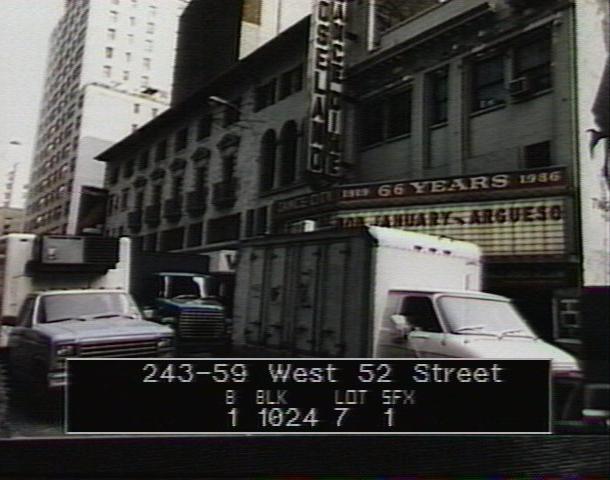
The city photographed every building for its tax records around 1940 and again in the 1980s. NYC Municipal Archives.
Written with AI from the source each entry cites, then fact-checked.
- 1923
The Theater Guild forms a building committee to raise money for its own playhouse
The Theater Guild had outgrown its small Garrick Theater, and its founders feared that leasing houses would mean sharing profits and compromising artistic independence. In 1923 it formed a building committee headed by Walter Prichard Eaton, with members including Mrs. August Belmont, Otto Kahn, Walter Lippmann and Louis Untermeyer. The most eagerly awaited feature of the planned theater was a cyclorama, a backlit painted linen used to show the sky.
“In 1923, therefore, the Theater Guild formed a building committee to raise funds for the construction of a new theater building.”
- 1924
Governor Al Smith attends the cornerstone ceremony for the Guild Theater
The Theater Guild held a cornerstone ceremony for its new playhouse on West 52nd Street on December 2, 1924. Maurice Wertheim, Otto Kahn, Dr. John H. Finley of the New York Times and Governor Alfred E. Smith took leading roles in the event. Four months later, on April 13, 1925, Shaw's Caesar and Cleopatra opened the theater.
- 1925
President Coolidge switches on the Guild Theater's opening night from the White House
The Guild Theater opened on April 13, 1925 with George Bernard Shaw's Caesar and Cleopatra, with Helen Hayes, Lionel Atwill, Henry Travers and Helen Westley in the cast. From the White House, President Calvin Coolidge flipped a switch to mark the start of the performance. The critics panned the play, and one wrote that the Guild had its theater but not yet the company to match it.
- 1925
Alfred Lunt and Lynn Fontanne carry the Guild's early seasons
After the weak opening, another Shaw play, Arms and the Man, ran 180 performances with Alfred Lunt and Lynn Fontanne. The couple returned in At Mrs. Beam's and Pygmalion in 1926, The Brothers Karamazov in 1927, and later Elizabeth the Queen and The Taming of the Shrew, with Sydney Greenstreet. Actors rotated loosely from play to play, and regulars included Claude Rains, Alla Nazimova, Dudley Digges and Leo G. Carroll.
“…another Shaw play following it was more successful: Arms and the Man, starring Alfred Lunt and Lynn Fontanne, ran for 180 performances…”
- 1930
Katharine Hepburn appears with Alla Nazimova in A Month in the Country at the Guild Theatre
Ivan Turgenev's play A Month in the Country was among the Guild Theatre's offerings in 1930, with Dudley Digges, Alla Nazimova, Henry Travers and Katharine Hepburn in the cast. The theater also hosted the revue The Garrick Gaieties that year, and Maxwell Anderson's Elizabeth the Queen with Lunt and Fontanne.
“A Month in the Country with Digges, Alla Nazimova, Henry Travers, and Katharine Hepburn…”
Source: Wikipedia
- 1933
George M. Cohan plays a dramatic role in O'Neill's Ah, Wilderness! at the Guild
Guild audiences were impressed by Eugene O'Neill, first with Mourning Becomes Electra in 1931 and then with Ah, Wilderness! in 1933. In that comedy the musical showman and songwriter George M. Cohan took an unusual dramatic role. A young Humphrey Bogart also appeared on the Guild's stage that year, with Shirley Booth in The Mask and the Face.
- 1933
A young Humphrey Bogart acts at the Guild in The Mask and the Face
In 1933 a young Humphrey Bogart appeared on the Guild Theater stage opposite Shirley Booth in The Mask and the Face. The landmark report notes that the Guild's early casts rotated loosely from play to play, and that regulars of the company included Claude Rains, Alla Nazimova, Dudley Digges, Leo G. Carroll and Gale Sondergaard.
“1933 also saw a young Humphrey Bogart grace the Guild stage with Shirley Booth in The Mask and the Face.”
- 1943
WOR leases the Guild's auditorium and turns it into the WOR Mutual Theatre
In March 1943 the Theatre Guild leased its auditorium for three years to radio station WOR of the Mutual Broadcasting System, which moved over from the New Amsterdam Roof. The hall became a broadcast studio called the WOR Mutual Theatre, and within a month loudspeakers and acoustic changes were added. The Guild kept its offices and rehearsal rooms in the building until 1944.
Source: Wikipedia
- 1950
After six years as a radio studio, the Guild's playhouse becomes ANTA's home
The Theater Guild's last play there was The Russian People in 1943, after which the building served for six years as the WOR Mutual Theater, a studio for radio broadcasts. In 1950 the American National Theater and Academy took over and began experimental subscription performances, opening with Robinson Jeffers's The Tower Beyond Tragedy. One of its most successful and longest-running shows was Paddy Chayefsky's Middle of the Night, which opened in 1956 starring Edward G. Robinson and Gena Rowlands.
“Beginning in 1950, the theater reopened for experimental subscription performances under the new ownership of the American National Theater and Academy…”
- 1951
President Harry Truman dedicates the ANTA Playhouse
In April 1951 President Harry S. Truman dedicated the ANTA Playhouse, the first permanent home of the American National Theater and Academy. The company had begun producing there in November 1950 with Robinson Jeffers's The Tower Beyond Tragedy, starring Judith Anderson, followed by a revival of Twentieth Century with Gloria Swanson and Jose Ferrer. That same year, the American Academy of Dramatic Arts also took space in the building.
Source: Wikipedia
- 1956
Edward G. Robinson stars in Middle of the Night, one of ANTA's longest-running shows
Paddy Chayefsky's Middle of the Night opened at the ANTA Theater in February 1956, with Edward G. Robinson, Gena Rowlands, Ann Jackson and Martin Balsam in the cast. The landmark report counts it among the theater's most successful productions and says it ran for 540 performances. It came shortly after the 1953-54 season, when the building was extensively remodeled inside.
- 1961
Paul Scofield leads A Man for All Seasons, ANTA's biggest hit
Robert Bolt's A Man for All Seasons opened at the ANTA Theater in 1961 and ran for 637 performances, closing in 1963. The landmark report names it the company's most successful production. Paul Scofield played the lead, with Leo McKern, Keith Baxter, William Redfield and George Rose rounding out the cast.
- 1985
The city designates the ANTA Theater a landmark after hearings drew 83 supporters
The Landmarks Preservation Commission designated the ANTA Theater, originally the Guild, a landmark on August 6, 1985. Hearings were held in June and October 1982; eighty-three witnesses spoke in favor and two against, and the owner said he had formed no opinion. The report calls it one of the historic theaters that symbolize American theater and notes that it housed two repertory companies, the Theater Guild and ANTA.
“Eighty-three witnesses spoke in favor of designation. Two witnesses spoke in opposition to designation.”
- 1988
The musical Carrie closes after five performances, a loss of about $7 million
The musical Carrie opened at the Virginia Theatre in May 1988 and shut after just five performances, losing about $7 million, including $500,000 spent renovating the theater. The Times labeled it the costliest fast flop Broadway had seen. The interior had been painted black for the show, and the bare color scheme stayed after the closing.
“Carrie lost about $7 million during its five performances (including $500,000 just on a renovation of the Virginia)…”
Source: Wikipedia
- 2005
Jujamcyn announces the Virginia Theatre will take August Wilson's name, a Broadway first
In 2005 Jujamcyn Theaters president Rocco Landesman said the Virginia Theatre on West 52nd Street, named in 1981 for Virginia Binger, would be renamed for playwright August Wilson on October 17. It would be the first Broadway theater named for an African American. Wilson, 60, had recently announced that he had terminal liver cancer, and the new marquee was to carry his signature in neon.
Source: playbill.com
- 2021
Pass Over reopens the August Wilson as Broadway's first house back after the pandemic
Antoinette Nwandu's play Pass Over raised the curtain at the August Wilson Theatre on August 4, 2021. It was the first Broadway house to open its doors again after the COVID-19 shutdown. The limited run closed in October 2021, and a limited engagement of Slave Play followed from November 2021 to January 2022.
“The theater reopened on August 4, 2021, with Antoinette Nwandu's play Pass Over, making it the first Broadway house to resume performances…”
Source: Wikipedia
- 2024
The theater becomes the in-the-round Kit Kat Club for Cabaret
Before the revival of Cabaret opened in April 2024, the auditorium was rebuilt as a theatre in the round, with new seats around a turntable stage and a mezzanine built into part of the backstage area. The theater took on the look of the Kit Kat Club, and audiences entered through an alleyway. The changes doubled the usual capacity, and the show ran until September 2025.
“…converted into a theatre in the round in advance of Cabaret's opening. A mezzanine seating area was built within part of the backstage area…”
Source: Wikipedia
Further reading
- August Wilson TheatreWikipedia
Nearby
- Neil Simon Theatre250 West 52nd Street | 12 entries
- Broadway Theatre1681 Broadway | 5 entries
- Broadway Theatre230 West 53rd Street | 14 entries
- Gallagher's Steakhouse228 West 52nd Street | 8 entries
- Mark Hellinger Theatre (Times Square Church)237 West 51st Street | 14 entries
- Ed Sullivan Theater1697 Broadway | 14 entries