Phelps-Morgan Mansion
231 Madison Avenue | also 24 East 37th Street, 229 Madison Avenue | Midtown | built 1853
Open on the map15 entries

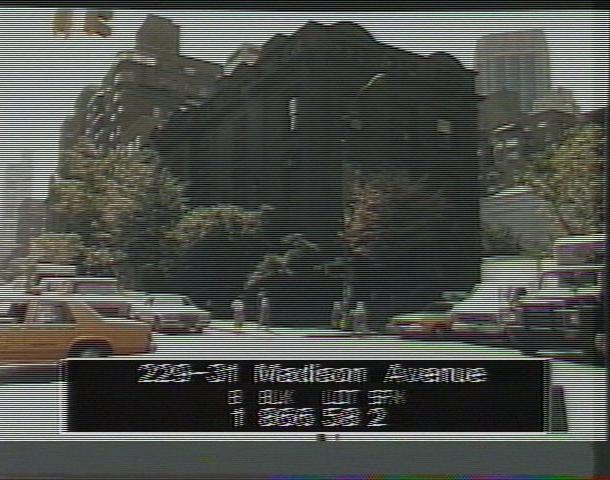
The city photographed every building for its tax records around 1940 and again in the 1980s. NYC Municipal Archives.
Written with AI from the source each entry cites, then fact-checked.
- 1853
Isaac Newton Phelps builds a brownstone mansion on Madison Avenue
Isaac Newton Phelps, whose own fortune came from hardware, banking, and real estate rather than his relatives' copper-trading business, built the Anglo-Italian brownstone as one of three freestanding family mansions he raised with relatives John Jay Phelps and William E. Dodge between 36th and 37th Streets. He was already retired when he moved in with his wife, Sarah Maria Lusk, and their children, on a block the three families shared with gardens and stables.
Source: Daytonian in Manhattan
- 1867
Isaac Newton Phelps Stokes is born in his grandparents' Madison Avenue house
Helen Louisa Phelps married her cousin Anson Phelps Stokes in 1865, and their son Isaac Newton Phelps Stokes arrived two years later in her parents' brownstone, which then carried the number 229 Madison Avenue. A few years before his death, he wrote down his memories of growing up in New York, including the house and its pleasant conservatory.
- 1888
Helen Phelps Stokes doubles the size of her father's mansion
After Isaac Newton Phelps's death, his daughter Helen inherited the house and hired architect R. H. Robertson to roughly double it in size and add an attic story. The wrought-iron window balustrades seen on the building today date from either this renovation or the modest exterior work J. P. Morgan Jr. later commissioned.
Source: Wikipedia
- 1892
A maid and her boyfriend quietly empty the Stokes mansion of china, jewelry and rugs
Mabel Youngson worked as a maid in the Stokes house in 1892 and, together with Arthur Morley, a servant at a house a block away, carried valuables out over several months. By the time Helen Stokes noticed, more than $2,000 worth of china, jewelry and rugs was gone. Police recovered much of it, but Youngson slipped away to England.
Source: Daytonian in Manhattan
- 1904
J. P. Morgan buys the house as a gift for his son Jack
J. Pierpont Morgan purchased the mansion, next door to his own Madison Avenue library, and gave it to his son J. P. Morgan Jr. and daughter-in-law Jane Norton Grew, who moved in the following year. Jack renumbered the house 231 Madison Avenue and spent $1,900 renovating its exterior.
Source: Wikipedia
- 1905
Jack Morgan remodels the house into a 45-room home and renumbers it 231
After his father bought the house in late 1904, J. P. Morgan Jr. and his wife Jane spent the following year remodeling it. The finished interior had 45 rooms, 12 bathrooms, 22 fireplaces and a formal ballroom, and the old stable became a squash court. The art dealers Duveen & Co. were the architect of record for a $1,900 round of alterations, and Jack changed the house number from 229 to 231, working the new number into the iron transom over the door.
- 1912
A burglar slips past 18 servants and takes $4,500 in silver and cut glass
John Bernauer entered the younger Morgan's house on January 26, 1912 and left with silver and cut glass valued at $4,500, even though the household employed a staff of eighteen. Police did not catch him right away. He was arrested in October, after a run of similar thefts from wealthy residences around the city.
Source: Daytonian in Manhattan
- 1936
Five hundred guests dance through the Morgan house at a winter ball
From 1934 to 1939 J. P. Morgan Jr. gave debutante dinners and dances in the house for his granddaughters. On December 18, 1936, five hundred guests attended: the Alexander Haas orchestra played while couples danced in the library, and the whole first floor was filled with palm trees, chrysanthemums and roses. The rooms that hosted the party were later turned into the museum's shop and a small cafe.
Source: Daytonian in Manhattan
- 1944
Parke-Bernet auctions the Morgan house's furniture and art in three sales
After J. P. Morgan Jr. died in March 1943, the contents of the mansion went to auction. Parke-Bernet Galleries announced three sales beginning January 6, 1944. Among the lots were an Oriental Lowestoft bowl said to have been used at George Washington's christening in 1732, eighteenth-century gold boxes, two French enamel miniatures of Benjamin Franklin, and French and English furniture.
Source: Daytonian in Manhattan
- 1944
The estate sells the house to the United Lutheran Church for its headquarters
Jack Morgan died of a stroke in Florida in 1943, and early the next year the executors of his estate sold 231 Madison Avenue and the land around it to the United Lutheran Church in America. The denomination wanted it as its national headquarters. The Lutherans owned the house for 44 years before it returned to the Morgan Library.
“Early in 1944, the executors of his estate sold 231 Madison A venue and its surrounding property to the United Lutheran Church in America…”
- 1957
A five-story brick office annex replaces the Morgan stable and squash court
As the Lutheran church expanded its mission in the 1950s, it needed more office space. In 1957 it replaced the old stable, which Jack Morgan had turned into a squash court, and put up a five-story brick office annex on the East 37th Street side. The addition still stands at the eastern end of the house.
- 1965
A landmark fight breaks out over the Lutheran-owned mansion
The United Lutheran Church in America, which had owned the former Morgan house since 1944, sought a zoning change to demolish it, drawing organized opposition from preservationists. The Landmarks Preservation Commission designated the mansion a landmark that year, but a 1974 Court of Appeals ruling reversed the designation before the commission re-designated the building later the same year.
Source: Daytonian in Manhattan
- 1974
New York's highest court strips the Morgan house of its landmark status
The Lutheran Church in America sued over the 1965 designation, and in July 1974 the state Court of Appeals ruled in Lutheran Church in America v. City of New York. It held the landmarks law unconstitutional as applied, because the house did not meet the church's space needs, and removed the designation, though it did not strike down the law itself. The planned office tower was never built, since the zoning was never changed.
- 1988
The Morgan Library buys the mansion and links it with a glass wing
The Pierpont Morgan Library purchased the house from the Lutheran church for $15 million and budgeted $5 million more for restoration. Architects Voorsanger & Mills joined the Victorian mansion to the library complex with a modern glass connector, and the building now holds library offices and a bookstore.
Source: Wikipedia
- 2002
The Landmarks Commission designates the house again, with no one opposed
After the Morgan Library bought the house, the Landmarks Preservation Commission took it up again, holding a hearing on January 8, 2002. Seven witnesses spoke in favor, including representatives of Assemblyman Richard Gottfried and the Historic Districts Council, and nobody spoke against. The commission designated the Phelps Stokes-J. P. Morgan Jr. House a landmark on February 26, 2002, with Community Board 6 also in support.
“Seven witnesses spoke in favor of designation... There were no speakers in opposition to designation.”
Further reading
- Morgan Library & MuseumWikipedia
- The 1854 Phelps-Morgan Mansion No. 231 Madison AvenueDaytonian in Manhattan
- The magnificent iron window railings on an 1850s Murray Hill mansionEphemeral New York
Nearby
- De Lamar Mansion233 Madison Avenue | 12 entries
- Morgans Hotel237 Madison Avenue | 7 entries
- Union League Club48 Park Avenue | 4 entries
- 244 Madison Avenue4 entries
- Henry Randel House38 East 38th Street | 3 entries
- Tiffany and Company Building401 5th Avenue | 11 entries