De Lamar Mansion
233 Madison Avenue | Midtown | built 1905
Open on the map12 entries

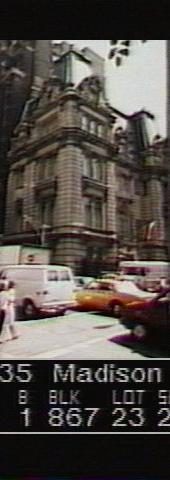
The city photographed every building for its tax records around 1940 and again in the 1980s. NYC Municipal Archives.
Written with AI from the source each entry cites, then fact-checked.
- 1901
J. R. De Lamar buys the Noyes brownstone on the corner where his mansion will rise
On April 17, 1901 the New York Times reported that the Noyes estate had sold J. R. De Lamar the four-story brownstone-front house at 233 Madison Avenue, on the northeast corner of 37th Street. The Real Estate Record and Guide gave the price as $150,000 and said he planned a six-story dwelling. Before building he bought an adjoining plot, widening the site to 50 by 100 feet. The brownstone was the earlier building on the lot.
Source: Daytonian in Manhattan
- 1905
C.P.H. Gilbert completes the De Lamar mansion for a mining magnate
Joseph De Lamar, who made his fortune in mining, bought the corner lot at Madison Avenue and 37th Street in 1901 and hired architect C.P.H. Gilbert to design a French Beaux-Arts mansion. Finished in 1905, the house held its own electric plant, refrigerating plant, and five Otis elevators, including one built to lift automobiles and another for trash removal.
Source: Daytonian in Manhattan
- 1915
De Lamar, an accomplished organist, has a pipe organ installed in the mansion
Joseph De Lamar was an accomplished organist. His Long Island estate, Pembroke, had a large pipe organ made by the Aeolian Company, and in 1915 he had a similar instrument put into the Madison Avenue mansion. He was also a steady buyer at auctions, once paying $3,400 in 1909 for a set of four 17th-century Brussels tapestries.
Source: Daytonian in Manhattan
- 1915
Alice De Lamar makes her society debut in the mansion
On February 6, 1915, Joseph De Lamar hosted a debutante ball for his daughter Alice in the Madison Avenue mansion, drawing some 300 guests. The house had gained a pipe organ that year, adding music to its roster of cutting-edge amenities.
Source: Daytonian in Manhattan
- 1918
Joseph De Lamar dies and his mansion's contents are auctioned
De Lamar died in the mansion on December 1, 1918, and his funeral was held there before his $32.3 million estate was distributed, with roughly $20 million going to medical and educational institutions and $10 million placed in trust for Alice. The house's contents, including the Ardebil Mosque Carpet, were sold at a November 1919 auction.
Source: Daytonian in Manhattan
- 1922
The American Bible Society's contract to buy the mansion collapses in court
In May 1921 the American Bible Society signed a contract to buy the vacant mansion for $275,000, put down $5,000, and planned to use it as a Bible store. The executors of the De Lamar estate refused to go ahead, citing the cost of renovation and the Murray Hill Restrictive Agreement, an 1847 covenant against non-residential buildings on Madison Avenue. In July 1922 a Supreme Court judge ordered the down payment refunded but held that the covenant barred the sale. The house had already been sold to Ella M. O'Kane in September 1921.
“The American Bible Society signed a contract in May 1921 to buy the house for $275,000, and it made a down payment of $5,000.”
Source: Wikipedia
- 1923
The National Democratic Club buys the mansion as its headquarters
In January 1923 the National Democratic Club bought the house for $287,000, selling its Fifth Avenue clubhouse, which was then demolished for the Saks Fifth Avenue flagship, to pay for it. Leaders put in a presidential suite and a governor's room but kept the murals. The club opened in the house in December 1923 and soon began publishing the National Democratic Magazine from there.
Source: Wikipedia
- 1960
John F. Kennedy climbs onto a Steinway at the Democratic Club the day before the election and sings
On the day before the 1960 presidential election, candidate John F. Kennedy stopped at the National Democratic Club. Joe O'Connor recalled a mob scene as people tried to see him, so Kennedy pulled himself onto a Steinway grand and, hoarse, sang while someone played. Others remembered Harry Truman playing the same piano before the 1948 election. O'Connor bought it for $1,300 at the club's 1973 auction.
Source: Daytonian in Manhattan
- 1973
Poland turns the former mansion into its New York consulate
After the National Democratic Club used the mansion as its headquarters for about fifty years, hosting Democratic presidents including Truman, Kennedy, and Johnson, Poland's government bought the building in 1972 for $940,000. The Consulate General of Poland has occupied it since 1973.
Source: Wikipedia
- 1975
The Landmarks Commission designates the De Lamar Mansion
The Landmarks Preservation Commission designated the De Lamar Mansion a city landmark on March 25, 1975, after a January 28 hearing at which one witness spoke in favor and none opposed. Its report called the 1902-05 house by C. P. H. Gilbert an imposing Beaux-Arts mansion, comparable in grandeur to the limestone houses that once stood along upper Fifth Avenue.
“This imposing Beaux-Arts style mansion, designed by the noted New York architect, C. P. H. Gilbert…”
- 1976
A pipe bomb explodes in front of the Polish consulate's entrance
On January 17, 1976, three years after the Polish government took the house, a pipe bomb exploded in front of its entrance. A man then telephoned two wire services and the New York Post to claim responsibility, calling himself 'The voice of Jewish Armed Resistance'.
Source: Daytonian in Manhattan
- 2007
A statue of Jan Karski playing chess is installed outside the Polish consulate
In November 2007 the Polish Consulate set a life-size statue of Jan Karski outside its entrance, showing him on a bench at a chess game, after three years of effort by Chet Szarejko of the Polish American Congress and Consul General Krzysztof Kasprzyk. Karski had entered the Warsaw Ghetto at the Polish government-in-exile's direction and later urged Britain and the United States to act. He died in 2000 while playing chess, and the street corner was renamed for him two years after the statue.
Source: Wikipedia
Further reading
- Joseph Raphael De Lamar HouseWikipedia
- The Joseph R. De Lamar Mansion - 233 Madison AvenueDaytonian in Manhattan
Nearby
- Morgans Hotel237 Madison Avenue | 7 entries
- Phelps-Morgan Mansion231 Madison Avenue | 15 entries
- 244 Madison Avenue4 entries
- Henry Randel House38 East 38th Street | 3 entries
- Union League Club48 Park Avenue | 4 entries
- Tiffany and Company Building401 5th Avenue | 11 entries