John H. Heller House
247 Grand Street | Chinatown | built 1900
Open on the map5 entries

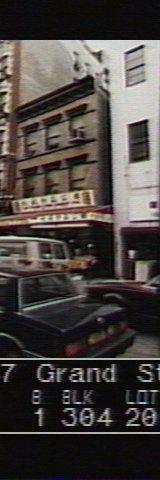
The city photographed every building for its tax records around 1940 and again in the 1980s. NYC Municipal Archives.
Written with AI from the source each entry cites, then fact-checked.
- 1850
Jeweler John H. Heller moves his watch shop into 247 Grand Street after splitting with his partner
Heller and Anthony Imberry had run a watch and jewelry store at 231 Grand since 1837. When they dissolved the partnership on October 1, 1850, a notice in the New-York Tribune said Heller would carry on at 247, the Federal-style brick house where his family already lived upstairs. The shop sold watches and jewelry on the ground floor for roughly a century.
Source: Daytonian in Manhattan
- 1866
Heller's jewelry income doubles to more than $10,000 in 1866
According to the District Assessor, John H. Heller earned $5,272 from his shop in 1865 and $10,468 the next year. His son William appears to have been learning the trade, and Heller rented part of the ground floor to a silver plater, Isaac D. Noe, who was working there by 1873. By 1879, after the elder Heller's death, the business carried the name of his son, John H. Heller Jr.
Source: Daytonian in Manhattan
- 1889
The attic is raised to a full story, with new brownstone and pressed-metal trim
Around the time the Heller family moved to Brooklyn in 1889, the attic of the old house was raised into a full floor and given updated brownstone trim and a pressed-metal cornice. A brownstone band course hides the addition, but close inspection of the brickwork still shows the change. The house stands free of its neighbors, an unusual feature on this stretch of Grand Street.
Source: Daytonian in Manhattan
- 1901
A tailor at 247 Grand claims to make half of the police uniforms in the city
The Tammany Times reported that H. Levy, a tailor working from the ground floor, had arranged with a large cloth firm for an unfadable indigo blue. He pointed out that he had long supplied half of the uniforms worn by New York's police. In the same building H. B. Lubbert's silver-plating shop employed 19 people, most of them women.
Source: Daytonian in Manhattan
- 1939
The old jeweler's house sells for $35,000 as Italian Grand Street gives way to Chinatown
The house was renovated in 1912 for the estate of Mary A. Astor Woodcock, by which time the neighborhood had filled with Italian immigrants. When it sold in 1939 for $35,000, the New York Times described it as a three-story tenement. A restaurant run by the Marin family occupied the ground floor then; later in the century the street signs were in Chinese, and a Chinese market operates there now.
Source: Daytonian in Manhattan
Further reading
- The John H. Heller House -- No. 247 Grand StreetDaytonian in Manhattan
Nearby
- Owney Geoghegan's Bowery dive103 Bowery | 3 entries
- 101 Bowery (New World Hotel)101 Bowery | 5 entries
- 97 Bowery3 entries
- U.S. Pacific Hotel104 Bowery | 4 entries
- Chatham Phoenix Bank116 Bowery | 2 entries
- Bernard Flynn Lodging House100 Bowery | 2 entries