Thomas S. Jaycox House
284 Hudson Street | Hudson Square | built 1901
Open on the map5 entries

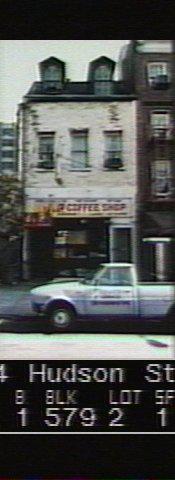
The city photographed every building for its tax records around 1940 and again in the 1980s. NYC Municipal Archives.
Written with AI from the source each entry cites, then fact-checked.
- 1820
A modest Federal brick house rises on the filled-in Lispenard Meadows
Around 1820 a plain Federal house of brick goes up at 284 Hudson Street, one of hundreds like it built for working- and middle-class families on Lispenard Meadows, a marsh that an 1817 ordinance ordered filled and that gained a sewer along Canal Street in 1819. It stands two and a half stories tall with two prominent dormers, and its brickwork skips the costlier Flemish bond used on grander homes. The wooden dormers and upper floors were still largely intact when the house was written up in 2015.
Source: Daytonian in Manhattan
- 1841
Dry-goods merchant Thomas S. Jaycox joins New York tradesmen petitioning Congress for a bankruptcy law
Thomas S. Jaycox, a federal clerk in the 1830s who had gone into the dry goods business by 1841, signs a petition on January 20, 1841, asking Congress for a uniform bankruptcy law. At the time there was no standard regulation, which hurt merchants who extended credit and then fought local laws to recover losses. Fellow signers included fishmongers, auctioneers, grocers, butchers, oystermen, painters and gun manufacturers.
Source: Daytonian in Manhattan
- 1864
Actor and lyricist James Seymour of Niblo's Garden dies at 41 and is mourned at a funeral in the house
James Seymour, an actor, producer and lyricist who lived here and was a favorite at Niblo's Garden, wrote the words to a song for the play The Duke's Motto and took the part of Carrickfergus when the original actor switched roles; the Era Almanack blamed the play's short run on that casting. His seven-year-old son Willie played a female part in Edwin Booth's Hamlet. Seymour died on September 22, 1864, at 41, and mourners gathered at the house the next day for the funeral before burial at Greenwood Cemetery.
Source: Daytonian in Manhattan
- 1876
Saloon keeper Adolph Midler is arrested for violating the Excise law, then again the next year
By 1876 the ground floor is a saloon, and on the evening of March 12 its keeper, who gave his name as Adolph Midler, is arrested for violating the Excise law, which required a costly license. On August 7, 1877, a New York Times reporter at the Excise Commissioners' office found crowds of recently arrested saloon keepers applying for licenses, among them Adolph Miller, arrested again and put under $100 bail. He paid $75 for his license in 1882, by then spelling his surname Muller.
Source: Daytonian in Manhattan
- 1913
As Hudson Street turns industrial, the old house hosts a barber-supply shop, a felt dealer and an air-cooling firm
By 1900 the saloon has been replaced by C & G Fina's barber-fixtures store, while patrolman James J. Lockhart, appointed in 1897, lives upstairs with his wife Adelphia and son Harry. Villone & Co. sells felt roundings from the address in 1909, and by 1913 L. Thomas runs the New York branch of the Chicago firm Thomas & Smith, maker of the Acme air-purifying and cooling system. That firm stays for several years, adding related products such as power pumps.
Source: Daytonian in Manhattan
Further reading
- The Thomas S. Jaycox House -- No. 284 Hudson St.Daytonian in Manhattan
Nearby
- 290 Hudson Street3 entries
- New York City Fire Museum278 Spring Street | 5 entries
- Former Half Note jazz club289 Hudson Street | 8 entries
- Abraham B. Vanderpoel House38 Dominick Street | 7 entries
- 36 Dominick Street House36 Dominick Street | 4 entries
- 34 Dominick Street House34 Dominick Street | 5 entries