Former Half Note jazz club
289 Hudson Street | also 292 Spring Street | Hudson Square | built 1910
Open on the map8 entries

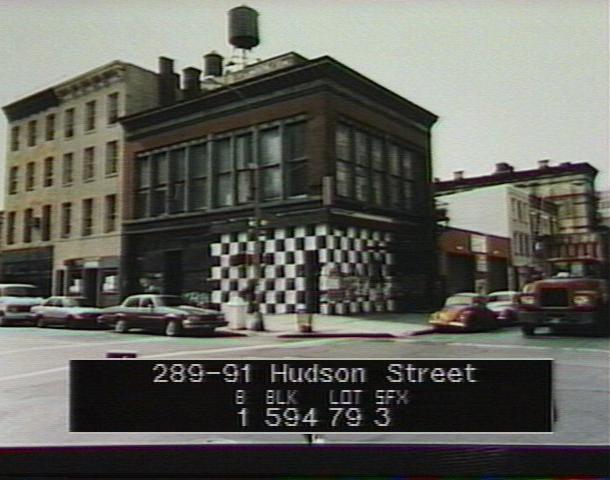
The city photographed every building for its tax records around 1940 and again in the 1980s. NYC Municipal Archives.
Written with AI from the source each entry cites, then fact-checked.
- 1957
The Canterino family opens the Half Note jazz club at Hudson and Spring Streets
The Half Note was a family business: brothers Mike and Sonny Canterino, their sister Rosemarie and their parents, Frank and Jean, owned the club, which operated here from 1957 to 1972. It became known for showcasing up-and-coming jazz musicians, who could play as long as they liked rather than keeping set times. A live Friday-night radio show on WABC, Portraits in Jazz, hosted by Alan Grant, helped cover the costs.
“…defraying costs with a Friday night live WABC radio show called Portraits in Jazz, hosted by Alan Grant…”
Source: Wikipedia
- 1957
The club is a former Zombie Bar with the bandstand behind the bar and record covers for wallpaper
The Canterino family had owned the Half Note since 1942, when it was the Zombie Bar. Its two plain rooms seated 130, divided by the bar, and the bandstand was a narrow platform raised five feet behind it. Record covers unrelated to jazz papered the walls, the owners' parents cooked simple Italian food, and the club sat among cobblestones and warehouses in a part of town then largely deserted.
Source: westviewnews.org
- 1958
Lennie Tristano begins long engagements after the owners replace the club's Steinway with a Bechstein he chose
The Canterinos persuaded Lennie Tristano to play the club in 1958, partly by replacing its Steinway with a new Bechstein that he picked. It was the first of several sometimes lengthy engagements there. A saying later went around that Coltrane brought in the masses, Zoot Sims the musicians and Tristano the intellectuals.
Source: Wikipedia
- 1964
CBS broadcasts the Lennie Tristano quintet from the club as "Jazz at the Half Note"
On June 6, 1964, the Lennie Tristano quintet was recorded at the Half Note and shown on CBS in the series Look Up and Live under the title "Jazz at the Half Note." The group also included Lee Konitz, Warne Marsh, Sonny Dallas and Nick Stabulas. William Hamilton of the Colgate Rochester Divinity School narrated the episode.
“…the Lennie Tristano quintet – with Lee Konitz, Warne Marsh, Sonny Dallas, and Nick Stabulas – was recorded and broadcast on television…”
Source: Wikipedia
- 1965
John Coltrane's quartet plays two long runs at the club in spring 1965
John Coltrane's quartet, with McCoy Tyner, Jimmy Garrison and Elvin Jones, played the club from March 19 to April 4, 1965, and again from May 4 to 9. Archie Shepp and Dave Liebman later recalled the experience vividly: Shepp compared the room to being in church, and Liebman remembered an audience that stood up as one.
“Coltrane's group played at the Half Note from March 19–April 4…”
Source: Wikipedia
- 1965
Elvin Jones's bass-drum pedal breaks during Coltrane's 27-minute "One Down, One Up" on the radio
WABC-FM taped the quartet's Friday sets on March 26 and May 7, 1965, for Alan Grant's radio show Portraits in Jazz. In the March 26 performance of "One Down, One Up," Elvin Jones broke his bass-drum pedal and played on without it for several minutes, and about 13 minutes of the 27-minute piece are a duet between Coltrane and Jones. Ravi Coltrane, who found the tapes in the 1990s, produced their 2005 release as a double CD.
“A recording of "One Down, One Up," during which Elvin Jones breaks his bass pedal and plays without a bass drum for several minutes…”
Source: Wikipedia
- 1965
Wes Montgomery and the Wynton Kelly Trio record part of "Smokin' at the Half Note" at the club
In June 1965 guitarist Wes Montgomery and the Wynton Kelly Trio, with bassist Paul Chambers and drummer Jimmy Cobb, recorded live at the club. Only two of the album's five tracks, "No Blues" and "If You Could See Me Now," came from the club; at producer Creed Taylor's urging, the others were redone in September at Rudy Van Gelder's studio in New Jersey. Pat Metheny later told the New York Times it was the greatest jazz-guitar album ever made and the record that taught him to play.
“Only two of the original LP's five tracks were recorded at the Half Note: "No Blues" and "If You Could See Me Now.”
Source: Wikipedia
- 1972
Mike and Sonny Canterino leave Hudson Street and reopen the Half Note in a Midtown carriage house
In 1972 the brothers Mike and Sonny Canterino moved the Half Note to a former carriage house at 149 West 54th Street, just a block from the Museum of Modern Art. A Connecticut record distributor, Roger Brousso, put $240,000 into the new room. The Midtown club closed on January 1, 1975, and a hotel, The London NYC, now stands on its site.
Source: Wikipedia
Further reading
- Half Note ClubWikipedia
Nearby
- Thomas S. Jaycox House284 Hudson Street | 5 entries
- 290 Hudson Street3 entries
- Dennison and Lydia Wood House310 Spring Street | 5 entries
- New York City Fire Museum278 Spring Street | 5 entries
- 7 Hudson Square (Robert A. Iger Building)310 Hudson Street | 12 entries
- Abraham B. Vanderpoel House38 Dominick Street | 7 entries