St. Barbara's Roman Catholic Church
299 Central Avenue | also 138 Bleecker Street, 309 Central Avenue | Bushwick | built 1910
Open on the map6 entries

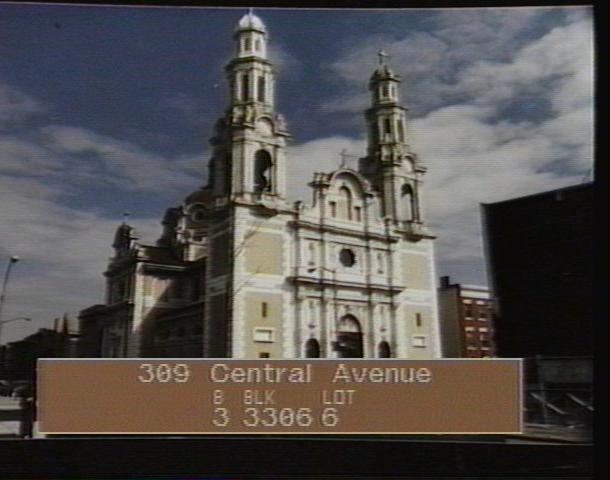
The city photographed every building for its tax records around 1940 and again in the 1980s. NYC Municipal Archives.
Written with AI from the source each entry cites, then fact-checked.
- 1893
German-descended Bushwick residents found St. Barbara's parish, run by the Redemptorists
The parish is founded in 1893 by Bushwick residents of German extraction, and the Redemptorist order of priests establishes it. Many early parishioners work in the neighborhood's breweries. The Diocese of Brooklyn approves the new parish to relieve crowding at the nearby German-speaking church of St. Leonard's.
“Established in 1893, St. Barbara's parish was founded by residents of Bushwick who were of German extraction. Many of the church's early parishioners worked nearby in Bushwick's many breweries.”
- 1900
The congregation, outgrowing its first church beside a brewery, starts raising money for a larger one
Earlier on this site, the parish's first church stood on Bleecker Street next to the Eppig & Ibert Brewery, whose brewer Joseph Eppig was a founding member of the congregation. By 1900 the parish has outgrown it and begins raising funds for a bigger building. The original church and its rectory are later torn down to make room for the present church.
- 1907
Helmle & Huberty file plans for a Spanish Colonial Revival church after the pastor studies church design in Europe
The architects Helmle & Huberty file plans for the new church in August 1907. According to a newspaper account, the pastor, James F. Hanselmann, travels to Europe beforehand to study church architecture. The Spanish Colonial Revival style they settle on is fairly uncommon in the northeastern United States, and the Landmarks Preservation Commission writes that the architects appear to have worked closely with the pastor on the choice.
“Plans for the new church were filed in August 1907 by the architects Helmle & Huberty. The architects appear to have worked closely with the church's pastor…”
- 1910
The new St. Barbara's is dedicated after the P.J. Carlin company builds it with terra cotta from South Amboy
The church is dedicated in December 1910, when it goes into full use. Its basement was already serving for services when the cornerstone was laid in 1909. The P.J. Carlin Construction Company builds it, the South Amboy Terra Cotta Company makes the terra cotta, and Carter, Black & Ayers supplies the face brick.
- 1977
After the 1977 blackout, St. Barbara's is left among the few buildings standing around it
A power blackout in 1977 brings widespread looting and fires to the area, and housing abandonment follows. The neighborhood and the congregation shrink sharply, and the church remains for a time one of the few buildings left standing nearby. By the early 1980s the Hope Gardens housing project begins the recovery, and the parish later regains its pre-riot number of parishioners.
“The population of the neighborhood and the parish's congregation shrunk significantly after a power blackout in 1977 resulted in widespread lootings and fires…”
- 2016
The city designates St. Barbara's a landmark after the Diocese of Brooklyn opposes it at a 2015 hearing
The Landmarks Preservation Commission designates the church on December 13, 2016. It first held a hearing in July 1980, where a representative of the owner spoke against designation. At an October 2015 hearing on a backlog of Brooklyn buildings, preservation groups testified in favor, while a representative of the Diocese of Brooklyn opposed it and Councilmember Rafael Espinal sent a written submission against it.
Further reading
- St. Barbara's Church (Brooklyn)Wikipedia
Nearby
- Public School 116 (Elizabeth Farrell School)515 Knickerbocker Avenue | 6 entries
- Peter P. and Rosa M. Huberty House1019 Bushwick Avenue | 7 entries
- South Bushwick Reformed Church855 Bushwick Avenue | 8 entries
- 83rd Precinct Police Station and Stable179 Wilson Avenue | 6 entries
- Doering-Bohack House1090 Greene Avenue | 8 entries
- Ridgewood Masonic Temple1054 Bushwick Avenue | 4 entries