Public School 116 (Elizabeth Farrell School)
515 Knickerbocker Avenue | also 501 Knickerbocker Avenue | Bushwick | built 1899
Open on the map6 entries

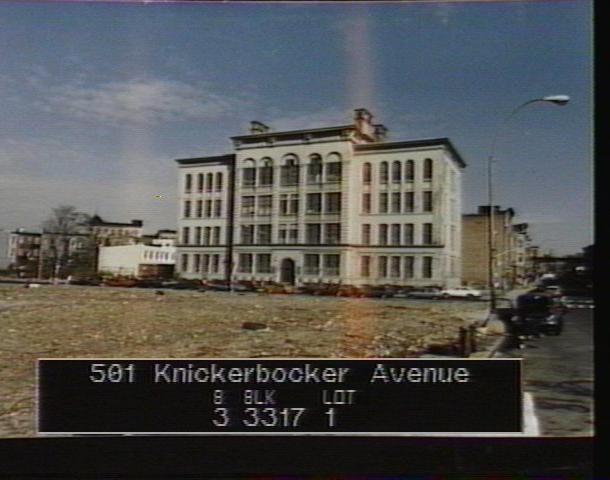
The city photographed every building for its tax records around 1940 and again in the 1980s. NYC Municipal Archives.
Written with AI from the source each entry cites, then fact-checked.
- 1897
Board of Education buys a Knickerbocker Avenue plot for a school to relieve crowded Public School 86
In April 1897 the Brooklyn Board of Education bought a plot 200 feet wide along Knickerbocker Avenue and 100 feet deep along Grove and Ralph (now Menahan) Streets for $17,500. Overcrowding at nearby Public School 86 on Irving Avenue had made a new school necessary. The land was assembled from three lots owned by A. Frank Wilson, Mary E. and Oliver L. Jones, and Jacob Manneschmidt.
- 1897
Andrew P. Blixt wins the contract to build Public School 116
On November 9, 1897, the Board of Education's Committee on School Houses awarded the building contract to Andrew P. Blixt of Brooklyn. Plans were filed soon after for a four-story brick schoolhouse of 150.8 by 78 feet, projected to cost $93,800. The architect was James W. Naughton.
“On November 9, 1897, the Committee on School Houses of the Board of Education awarded the contract for construction of the school to Andrew P. Blixt of Brooklyn…”
- 1899
Naughton's plain late design drops the ornament of his earlier schools
Public School 116 was one of the last designs of James W. Naughton, and was completed a year after his death. Drawn up as Brooklyn's consolidation with New York neared and the need to build cheaply grew, it has a simple plan, a flat roof, cornices of galvanized iron and ornament of stock terra-cotta. The commission contrasts it with his earlier Public School 86 and Public School 108, which have picturesque rooflines and elaborate dormers.
“Gone are the picturesque rooflines, elaborate dormers, detailed wall ornamentation, and complex massing of Public School 86 (1892-93) and Public School 108 (1895).”
- 1899
Public School 116 finally opens after more than a year of budget troubles
Construction lasted over a year because the newly consolidated city had continuing budget problems and the merged school board had administrative difficulties. The school was completed and occupied in 1899 at a total cost of $123,500, a price that included the land, the building and its furnishings.
- 1916
Public School 116 is given the name Plymouth School
In 1916 the Board of Education was handing out vanity names to all the city's public schools, and this one became the Plymouth School. The commission notes that the building opened in January 1899 and has served as a public school without interruption since.
“The school was given the title "Plymouth School" in 1916, when the Board of Education was assigning vanity names to all the city's public schools.”
- 2002
Landmarks Preservation Commission designates Public School 116 a landmark
The commission designated the school, then called the Elizabeth Farrell School, on June 25, 2002. At its public hearing on October 21, 1997, a teacher at the school and a representative of the Historic Districts Council testified in favor. The Victorian Society in America also sent a letter of support, and no one spoke against.
Nearby
- Public School 86 (Irvington School)220 Irving Avenue | 4 entries
- St. Barbara's Roman Catholic Church299 Central Avenue | 6 entries
- Bushwick Campus400 Irving Avenue | 1 entry
- 83rd Precinct Police Station and Stable179 Wilson Avenue | 6 entries
- Wyckoff Heights Medical Center374 Stockholm Street | 2 entries
- Doering-Bohack House1090 Greene Avenue | 8 entries