Beekman Tower (Panhellenic Tower)
3 Mitchell Place | also 1 Mitchell Place | Turtle Bay | built 1929
Open on the map9 entries

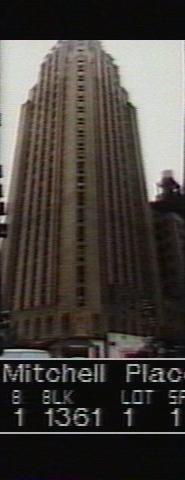
The city photographed every building for its tax records around 1940 and again in the 1980s. NYC Municipal Archives.
Written with AI from the source each entry cites, then fact-checked.
- 1921
The New York chapter of the Panhellenic Association proposes a clubhouse for students and working women
In 1921 the New York chapter of the Panhellenic Association, a year old and 3,000 members strong, proposed a clubhouse with both permanent and temporary rooms for students and working women. A committee found that the Bryn Mawr Club and the Smith Club, along with two YWCAs, all kept long waiting lists, so it urged building large rather than small. The plan grew into a fourteen-story building for 400 to 500 guests, and Donn Barber was selected as architect in October 1922.
- 1926
Emily Eaton Hepburn buys the First Avenue and Mitchell Place corner in her own name
Fearing she might lose the site, Hepburn, the philanthropist who had taken over the Panhellenic project, bought the lot herself in the spring of 1926. She was drawn to the far East Side after Anne Morgan, Elsie DeWolfe and Elisabeth Marbury redeveloped Sutton Place. She handed the property to the Association in 1928, once she had persuaded the president of Metropolitan Life, who lived in her building, to give a mortgage.
“Concerned that she might lose the site, Hepburn bought the property in her own name in the spring of 1926.”
- 1928
The Panhellenic Tower opens as a residence for sorority women
Designed by John Mead Howells, the 26-story Art Deco tower at First Avenue and East 49th Street opened in October 1928 as housing for women who belonged to Greek-letter sororities. With too little demand during the Depression, it admitted other women in 1931 and men in 1934, when it was renamed Beekman Tower.
Source: Wikipedia
- 1929
The First Avenue Association honors the Panhellenic Tower for architectural merit
In 1929 the First Avenue Association gave John Mead Howells's design an award for outstanding architectural merit. The tower was widely published in the American architectural press and in French periodicals, and The New Yorker called it a glorious building on a glorious site. It soon served as a model for the R.J. Reynolds Tobacco Company Building in Winston-Salem, finished in April 1929.
“Howells's design received an award for outstanding architectural merit from the First Avenue Association in 1929…”
- 1934
The tower opens its doors to men and is renamed Beekman Tower
Depression-era finances had already forced the sorority residence to admit non-member guests in 1931. In 1934 it drops the women-only rule entirely, opening to male guests and adopting the name Beekman Tower (Panhellenic). Thirty years later, in 1964, the sorority federation sells the building to outside investors.
Source: Wikipedia
- 1940
The rooftop solarium becomes the Top of the Tower bar
In 1940 the building's rooftop solarium was turned into the Top of the Tower bar. The sorority group sold the building in 1964, and it became a hotel used by United Nations delegates and business travelers. The city designated it a landmark in 1998.
Source: Wikipedia
- 1964
The tower is sold and architect Sidney Goldhammer converts it to an apartment hotel
The building was sold in 1964 to 3 Mitchell Place, Inc., a company led by Benjamin J. Denihan and Arthur W. Bresciani Sr., which hired Sidney Goldhammer to convert it to an apartment hotel. He put bathrooms and kitchenettes into the tower, turned the auditorium into apartments and added marble facing to the ground story. Most guests came from the nearby United Nations and from large corporations, and famous guests included Geraldine Chaplin, Pearl Bailey and Frank Zappa.
“In 1964, the building was sold to 3 Mitchell Place, Inc., headed by Benjamin J. Denihan and Arthur W. Bresciani, Sr.”
- 1991
A refurbishment strips the marble from the base and uncovers original Greek-letter tiles
Between 1989 and 1991 the hotel's guest rooms and lobby were refurbished and the ground-floor corner restaurant was redone. Taking off the marble that had been added to the ground story in the 1964 conversion exposed original details, including tiles with Greek lettering and a pierced sandstone panel designed by Rene Chambellan. New windows, doors, lighting and canopies went in on Mitchell Place, and etched-glass lunettes over the entrance carry a palmette motif copied from the original metal ones.
“The marble facings were removed from the ground story revealing many original details including decorative tiles ornamented with Greek lettering…”
- 1998
The city designates Beekman Tower a landmark
New York's Landmarks Preservation Commission designates the former Panhellenic Tower an individual city landmark, protecting John Mead Howells's Art Deco design. Fifteen years later, in 2013, Silverstein Properties buys the building and converts its hotel rooms into corporate apartments.
Source: Wikipedia
Further reading
- Beekman TowerWikipedia
Nearby
- Luxembourg House17 Beekman Place | 4 entries
- Paul Rudolph House23 Beekman Place | 10 entries
- Trump World Tower845 United Nations Plaza | 8 entries
- P.S. 135 (The Beekman Regent)351 East 51st Street | 3 entries
- Japan Society333 East 47th Street | 8 entries
- 434 East 52nd Street2 entries