Sohmer & Company Piano Factory
31-01 Vernon Boulevard | Old Astoria | built 1886
Open on the map8 entries

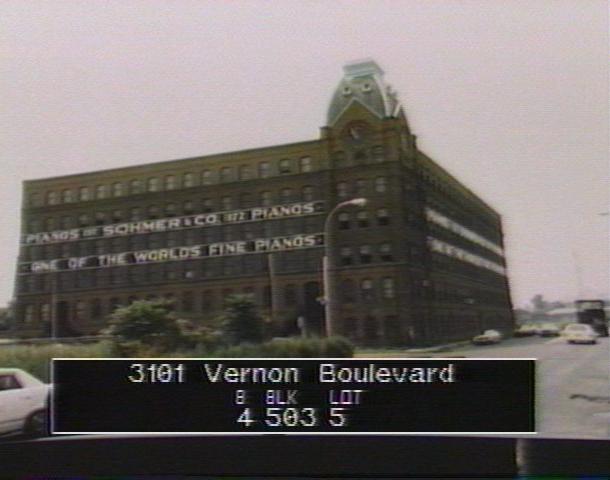
The city photographed every building for its tax records around 1940 and again in the 1980s. NYC Municipal Archives.
Written with AI from the source each entry cites, then fact-checked.
- 1886
Piano maker Hugo Sohmer moves his growing company to the Astoria waterfront
German immigrant Hugo Sohmer (1845-1931) founded Sohmer & Co. in Manhattan in 1872, and by the 1880s output had risen from four pianos a week to 46. After moving from East 14th Street to larger quarters on East 23rd Street, the firm acquired a big waterfront tract close to the Astoria ferry in 1886 and built a six-story factory crowned by a clock tower there.
“Sohmer bought a large tract of waterfront land near the Astoria ferry in Queens, where a new six-story factory with a prominent clock tower would be built.”
- 1886
Berger & Baylies give the Sohmer factory a mansard-topped corner clock tower
The firm of Bruno W. Berger and Franklin Baylies, whose other work was mostly neo-Grec, including warehouses in Tribeca, designed the factory in the German Romanesque Revival style, or Rundbogenstil, in red brick with segmental-arched windows. Its narrow L-shaped plan let daylight reach the workrooms before electric lighting. The corner clock tower, the most ornamented part, was meant to catch the eye of Manhattan residents and East River boat passengers.
“It is built in red bricks and designed in German Romanesque Revival Style or Rundbogenstil.”
Source: Wikipedia
- 1906
Sohmer adds a six-story south wing along Vernon Boulevard to keep up with demand
With business still growing, Sohmer & Co. built a six-story addition in 1906-07 matching the original brick block. Building records for the wing have been lost, but the commission attributes it to Franklin Baylies, a Queens resident who kept designing warehouses and lofts after the original partnership ended in 1890. By 1915 the company employed 250 people.
“Sohmer & Co. continued to thrive in the early twentieth century; by 1915, it was employing 250 people.”
- 1924
A 1924 account calls the pianos made here longtime favorites of New York music lovers
A 1924 account by William Thompson Bonner described the Astoria-made pianos as long-standing favorites of New York music lovers. Composer Victor Herbert owned several, and Irving Berlin wrote songs on three Sohmers fitted with transposing keyboards. The firm also built custom Art Deco and Spanish-style instruments for film stars Ramon Navarro, Jean Harlow and Al Jolson, and Sohmer family members inspected and approved each piano before it left the plant.
- 1925
At its peak the Sohmer factory turns out 2,500 pianos a year with 275 workers
By 1925 the family-run plant covered 210,000 square feet and its 275 employees built about 2,500 pianos a year, including grands in four sizes called Concert, Parlor, Baby and Cupid, plus uprights and a player piano. Cheap radios had already begun wrecking the piano trade. Parts of the building were leased to other manufacturers during the Depression, and by 1960 the workforce had shrunk to 120.
“In 1925, the factory was an impressive 210,000 square feet piece of property and the company employed 275 people…”
Source: Wikipedia
- 1982
Sohmer sells out and pianos leave Astoria after nearly a century of production
In 1982 the Sohmer brothers sold the company to Pratt, Read & Co., the leading American maker of piano keyboards and actions, which moved manufacturing to Ivoryton, Connecticut. The Adirondack Chair Company, an office and institutional furniture firm, took over the Vernon Boulevard building, and the Sohmer archives went to the Smithsonian Institution. Sohmer pianos are now made in Korea.
“Sohmer remained at the Vernon Boulevard plant until 1982, when company was acquired by the Pratt, Read & Co.”
- 2007
After hearings in 1983, 1984 and 1990, the piano factory finally becomes a city landmark
The commission had held hearings on the building in 1983, 1984 and 1990 without designating it. At a March 2005 hearing the owners objected, and Borough President Helen Marshall, Councilmember Peter F. Vallone Jr. and State Senator George Onorato wrote in opposition. New owners then backed designation, Vallone dropped his objection, and the factory was designated on February 27, 2007, as one of the few survivors of New York's piano industry.
“Representatives of the building's owners at that time spoke against designation.”
- 2007
The old piano factory begins its conversion into apartments with penthouses on top
Starting in 2007, the former factory was turned into residences, a project that ran until 2013 and added new penthouse floors above the sixth story. It joined the National Register of Historic Places in 2014, the year after the work finished.
“Between 2007 and 2013, the building was converted for residential use with new penthouse additions above the sixth floor.”
Source: Wikipedia
Further reading
- Sohmer and Company Piano FactoryWikipedia
Nearby
- Noguchi Museum9-01 33rd Road | 6 entries
- Former Barkin, Levin & Company coat factory12-12 33rd Avenue | 4 entries
- The Octagon888 Main Street | 12 entries
- 10 Gracie Square6 entries
- Brearley School610 East 83rd Street | 4 entries
- Gracie Mansion181 East End Avenue | 20 entries