Surrogate's Court
31 Chambers Street | also 23 Chambers Street | Civic Center | built 1911
Open on the map9 entries

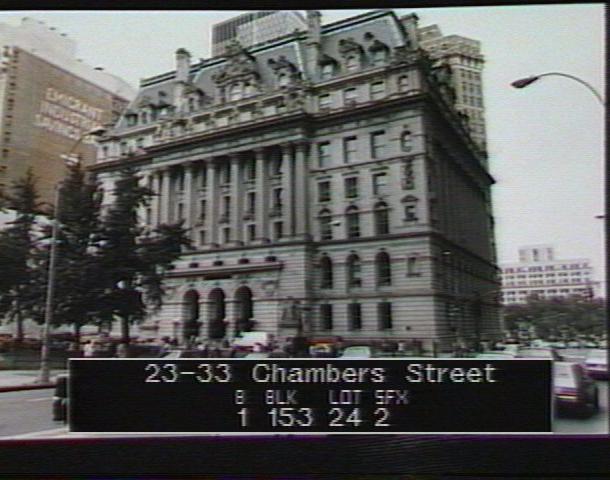
The city photographed every building for its tax records around 1940 and again in the 1980s. NYC Municipal Archives.
Written with AI from the source each entry cites, then fact-checked.
- 1897
The Board of Estimate awards the Hall of Records contract to John Pierce
On December 16, 1897, the Board of Estimate and Apportionment awarded the construction contract for the new Hall of Records to John Pierce on his bid of $1,997,900. The board put the total cost at $2.2 million. Daytonian in Manhattan reports that by the time the building was done, the bill had risen to $8 million.
Source: Daytonian in Manhattan
- 1901
Architect John R. Thomas dies and Tammany-linked Horgan & Slattery take over
John R. Thomas, the Hall of Records' architect, died unexpectedly on August 28, 1901, a few months after the cornerstone was laid on April 13. Mayor Robert A. Van Wyck, backed by Tammany, gave the job of finishing the project to Horgan & Slattery, who were also tied to Tammany Hall. The New York Times grumbled that the firm's changes amounted to a "horganizing and slatterifying" of the design.
Source: Daytonian in Manhattan
- 1902
Workers hoist the first of eight huge granite columns into place
On April 28, 1902, the first of the building's eight massive granite columns was lifted into position. Carved from a single piece, it was 36 feet tall, just over four feet in diameter, and weighed 41 tons. Moving it from Pier 1 took a team of 21 horses.
Source: Daytonian in Manhattan
- 1905
A 12-foot statue of Mayor Hewitt crashes from its rigging and shatters
While sculptors hoist a four-ton, 12-foot statue of former Mayor Abram Hewitt onto the Hall of Records facade in 1905, it falls from the rigging and shatters on the Chambers Street sidewalk. The accident occurs amid an ambitious sculptural program of 54 figures by H. K. Bush-Brown and Philip Martiny covering the building's three tiers. The building does not fully open for another two years.
Source: Daytonian in Manhattan
- 1906
Workers discover the Hall of Records' 'marble' upper floors are plaster
As the Hall of Records nears completion in 1906, workers discover that the gray and white marble specified for the upper floors was substituted with plaster, a mistake architects Horgan & Slattery later acknowledge. The building's cost has already ballooned from an original $2.2 million estimate to about $8 million. The discovery comes after roughly eight years of construction under a project first designed by John R. Thomas.
Source: Daytonian in Manhattan
- 1907
The Hall of Records is completed to keep the city's papers safe from fire
Built from 1899 to 1907 as a fireproof home for city records, the Hall of Records was designed by John Rochester Thomas and finished after his death in 1901 by Arthur J. Horgan and Vincent J. Slattery. Its granite facade carries 54 sculptures by Philip Martiny and Henry Kirke Bush-Brown, and its lobby was inspired by the Paris Opera. It now holds the Surrogate's Court and the Municipal Archives.
Source: Wikipedia
- 1919
The Vehicular Tunnel Commission sets up in the Hall of Records to oversee the Holland Tunnel
The Vehicular Tunnel Commission, charged with overseeing construction of the Holland Tunnel, set up in the building in 1919, and an employment bureau for soldiers began operating there that year. By the mid-1910s the Hall already held 8,000 books of property titles, a million mortgages and more than a million deeds.
“The Vehicular Tunnel Commission was established in the Hall of Records in 1919 to oversee the Holland Tunnel's construction…”
Source: Wikipedia
- 1962
The City Council renames the Hall of Records the Surrogate's Courthouse
In October 1962 the New York City Council adopted a resolution renaming the Hall of Records the Surrogate's Courthouse. The court and related offices occupied most of the building's space by then. The court's own records were spread across four of the building's floors.
Source: Wikipedia
- 1977
The city founds its Department of Records and Information Services on the first floor
The Department of Records and Information Services was founded on the building's first floor in 1977, after a $300,000 renovation of that floor. It replaced two earlier bodies, the Municipal Reference Center and the Municipal Archives and Record Center. The Reference Center had arrived in the courthouse during a 1970s renovation of the Municipal Building.
“Following a $300,000 renovation of the building's first floor, the Department of Records and Information Services (DORIS) was founded in 1977 on the first floor.”
Source: Wikipedia
Further reading
- Surrogate's CourthouseWikipedia
- The Surrogate's Courthouse / Hall of Records -- 31 Chambers StreetDaytonian in Manhattan
- HALL OF RECORDS, CITY HALLForgotten New York
Nearby
- Court Square Building2 Lafayette Street | 4 entries
- Jones Building52 Duane Street | 1 entry
- 49 Chambers (Emigrant Industrial Savings Bank Building)49 Chambers Street | 13 entries
- Municipal Building1 Centre Street | 11 entries
- 22 Reade Street (City Planning Building)22 Reade Street | 4 entries
- Tweed Courthouse52 Chambers Street | 13 entries