Tweed Courthouse
52 Chambers Street | Civic Center | built 1881
Open on the map13 entries

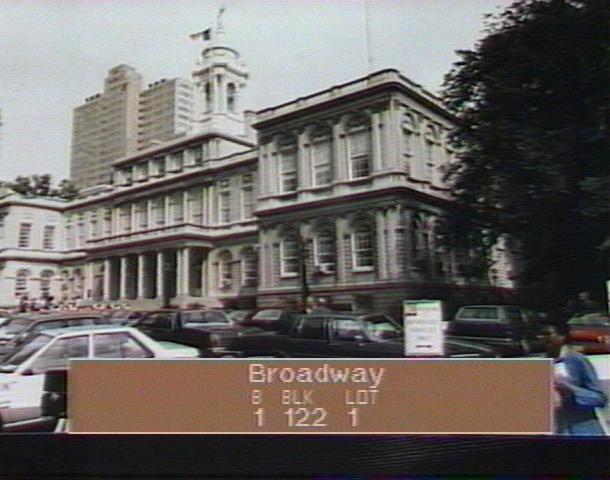
The city photographed every building for its tax records around 1940 and again in the 1980s. NYC Municipal Archives.
Written with AI from the source each entry cites, then fact-checked.
- 1795
The city's second almshouse is built on the ground that later holds Tweed Courthouse
Before the courthouse, the site held the Upper Barracks, built in 1757 and gone by 1790, and then the city's Second Almshouse, built in 1795 and 1796. The almshouse later became the New York Institution and was demolished in 1857. According to the 1984 landmark report, only City Hall and the Tweed Courthouse remain of the many structures built in City Hall Park over two centuries.
- 1861
Construction begins on a lavish new county courthouse
Work starts on September 16, 1861, on a new courthouse for New York County designed by architect John Kellum, with its cornerstone laid that December 26. Land for the project had been appraised at just $450,000 that year, before Tammany Hall supervisors began extracting millions through inflated commissions on the work.
Source: Wikipedia
- 1867
The Court of Appeals moves into a courthouse with a hole in its roof
In March 1867 the Court of Appeals began using the unfinished courthouse, although an open space meant for a dome let rain and snow fall inside and the iron main stair reached only the second floor. The New York Times remarked on March 12 that the building had many holes in its floor and roof in which to bury taxpayers' money. A supervisor had already charged that grossly extravagant spending went on under those in charge of the building in 1866.
- 1871
Work on the courthouse stops as Boss Tweed's ring is exposed
Begun in 1861, the county courthouse became the most notorious project of William M. Tweed's Tammany Hall ring. Bills included $350,000 for carpeting and $179,729.60 for three tables and forty chairs. Construction halted in 1871 after Tweed's arrest and the death of architect John Kellum; Leopold Eidlitz finished the building from 1877 to 1881 at a total cost of roughly $11 to $12 million.
Source: Wikipedia
- 1873
Boss Tweed is tried in the unfinished county courthouse and convicted on 204 counts
William M. Tweed went to trial on November 19, 1873 in the Court of Oyer and Terminer inside the new county courthouse, which was still not complete. He was convicted on 204 counts and sentenced to twelve years in prison and a $12,750 fine. The Court of Appeals later cut this to one year and a $250 fine.
- 1881
Leopold Eidlitz finishes the scandal-plagued courthouse
After Boss Tweed's ring is exposed and construction halts in 1871, architect Leopold Eidlitz completes the building between 1877 and 1881. Total costs by then reach an estimated $11 to $12 million, an enormous sum for the era that permanently attaches the Tweed name to the finished courthouse.
Source: Wikipedia
- 1888
Three courtrooms become a ballroom for the janitor's daughter's wedding
On April 11, 1888 the courthouse hosted a wedding for Julia Clarkson, daughter of the building's janitor Edward Clarkson, and the builder Edward J. Reynolds. The Sun called it an unusual scene in Boss Tweed's twenty-million-dollar courthouse. Three courtrooms were turned into a banquet hall and ballroom, and an orchestra played where the judge's bench stood in the equity division.
Source: Daytonian in Manhattan
- 1904
Rain pours through the cracked walls and worn-out roof of the dilapidated courthouse
By 1904 the courthouse was deteriorating while the city dragged its feet on building a replacement. On September 13 The Sun described the old Tweed courthouse as falling daily into worse condition, with rain pouring through cracked walls and worn-out roofs during every storm, despite constant patching. The New York Times had called for its demolition in 1901 and kept doing so for years.
Source: Daytonian in Manhattan
- 1942
Workers demolish the courthouse's grand entrance stairs to widen Chambers Street
In April 1942 WPA workmen tore down the long-unused flight of steps that led from Chambers Street to the rotunda, as Chambers and Lafayette Streets were widened under a plan for City Hall Park. The New York Times described the steps as imposing, perhaps its first positive word about the building since it was finished. The stairs were rebuilt in the restoration that began in 1999.
Source: Daytonian in Manhattan
- 1974
Mayor Beame decides almost at once to demolish the courthouse
Mayor Abraham Beame, who took office in 1974, soon set out to demolish the Tweed Courthouse. The New York Times reported on July 7 that the decision was early and almost instant, and had never been announced publicly. Critic Ada Louise Huxtable defended the building as substantial and stylish, but wrote that its unsavory associations made it probably "too hot a political potato" for the Landmarks Commission.
Source: Daytonian in Manhattan
- 1984
The Landmarks Commission designates the courthouse after a hearing with no opposition
On October 16, 1984 the Landmarks Preservation Commission designated the Tweed Courthouse a city landmark. At its June 1983 hearing two witnesses spoke in favor and none against, and the commission received a letter of support from Robert Litke, who headed the Department of General Services.
“There were no speakers in opposition to designation.”
- 2001
An $89 million restoration saves the long-neglected courthouse
Mayors from Fiorello La Guardia in 1938 to Abraham Beame in 1974 considered tearing the building down. Instead, a restoration led by John G. Waite Associates began in 1999 and finished in December 2001; workers stripped away as many as 18 layers of paint and rebuilt the grand front steps lost to street widening. Since 2002 the building has housed the city's Department of Education.
Source: Wikipedia
- 2002
The Department of Education moves its headquarters into Tweed
Following the courthouse's restoration, the New York City Department of Education relocates its central headquarters into the old building in 2002. The move gives the long-troubled Tweed name a new civic identity, more than a century after the corruption scandal that built it.
Source: Wikipedia
Further reading
- Tweed CourthouseWikipedia
Nearby
- 49 Chambers (Emigrant Industrial Savings Bank Building)49 Chambers Street | 13 entries
- Sun Building280 Broadway | 11 entries
- City Hall254 Broadway | 16 entries
- Surrogate's Court31 Chambers Street | 9 entries
- 22 Reade Street (City Planning Building)22 Reade Street | 4 entries
- Broadway-Chambers Building277 Broadway | 7 entries