Master Building
310 Riverside Drive | Upper West Side | built 1929
Open on the map13 entries

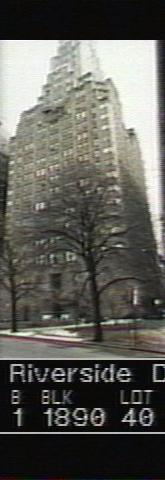
The city photographed every building for its tax records around 1940 and again in the 1980s. NYC Municipal Archives.
Written with AI from the source each entry cites, then fact-checked.
- 1922
Louis Horch buys a mansion on the site and moves the Master School of United Arts into it
In 1922 the financier Louis Horch paid to move the Roeriches' Master School of United Arts from a one-room studio at 314 West 54th Street into a mansion he had bought on the site that the Master Building would later cover. The mansion also held the Roerich Museum, with many of Nicholas Roerich's paintings, and Corona Mundi, which arranged exhibitions of Roerich and international artists. Horch began buying the surrounding lots in 1925.
Source: Wikipedia
- 1929
The Master Building opens as an Art Deco skyscraper for the arts
Financier Louis L. Horch built the 27-story tower, designed by Harvey Wiley Corbett, to house the Master Institute of United Arts founded by the Russian artist Nicholas Roerich and his wife Helena, with a museum, art school and cultural center beneath the apartments. Completed in 1929, it was the first skyscraper in New York City with corner windows, and its entire exterior uses brick in varying colors. The Wall Street Crash came weeks after it opened.
Source: Wikipedia
- 1929
The cornerstone is laid with a letter from Albert Einstein and a Rajput casket inside
The Master Building's cornerstone was laid on March 24, 1929, in a ceremony in which prominent politicians took part. Among the messages read aloud was a letter from Albert Einstein praising the cultural aims of the building's directors. The stepped black stone at ground level carries Roerich's circle-and-three-dots symbol and holds a 400-year-old Rajput casket containing photographs from the Roeriches' Central Asian expedition.
“The cornerstone was laid on March 24, 1929 ... a letter from Albert Einstein in which he praised the cultural goals of the building's directors…”
Source: Wikipedia
- 1938
Louis Horch wins control of the building from the Roerichs
By 1932 the building faced foreclosure, and a rift grew between Horch and the Roerichs. After litigation went Horch's way in 1938, he closed the Roerich Museum and opened the Riverside Museum, focused on contemporary American art. The cultural spaces had closed by 1971, and investor Sol Goldman, who bought the building in 1979, converted it to a cooperative by 1988.
Source: Wikipedia
- 1938
The Riverside Museum opens in the building's lower floors
After the Roerich Museum's eviction from the galleries it had occupied since the tower opened, the Riverside Museum takes over the space with an exhibition of contemporary American art. It operates there for more than three decades before merging with Brandeis University's collection in 1971.
Source: Daytonian in Manhattan
- 1940
A new night clerk uses a master key to empty a resident's safe deposit box
In August 1940 the building's management hired a 26-year-old night clerk. On the night of October 25 he used a master key to open the safe deposit box of a refugee from Germany who lived in the building. He and a friend divided $10,540 in cash and pocketed $11,000 worth of jewelry. After their arrest, police said the two had bought a $150 car and toured nightclubs around the city.
Source: Daytonian in Manhattan
- 1952
A fire in an eleventh-floor apartment sends flames out of the windows
On the night of March 16, 1952, a fire broke out in an eleventh-floor apartment whose tenant was not at home, and for a time flames flashed from the windows, the New York Times reported. Fire Lieutenant Sanford Tice carried a bedridden neighbor with a heart condition down to the lobby. Two other residents were treated for burns and smoke inhalation, and the blaze stayed on the 11th floor and was put out within an hour.
Source: Daytonian in Manhattan
- 1961
The Equity Library Theater begins staging plays in the building
The nonprofit company opens a 274-seat theater on the premises, mounting productions with actors drawn from stage-union membership. Equity Library Theater continues presenting shows in the space for nearly three decades, until 1990.
Source: Daytonian in Manhattan
- 1971
The Riverside Museum announces it is leaving New York to merge into Brandeis University
On June 17, 1971, the New York Times reported that the Riverside Museum would leave the city when June ended, merging with Brandeis University in Waltham, Massachusetts. The paper said the neighborhood's changing makeup had made it impossible to support the staff of 30 the museum needed. Louis and Nettie Horch were by then living in Florida, with their son Frank managing the apartments and their daughter Oriole Farb directing the museum.
Source: Daytonian in Manhattan
- 1975
Manager Frank Horch is found shot to death in the building's basement
At about 6 a.m. on February 21, 1975, Frank Horch, 45, who ran the apartments after his father Louis, was found dead in the basement. The New York Times reported that he had been shot three times, and because his wallet was missing, detectives did not rule out robbery. Horch lived on the 17th floor with Nancy, his wife and a photographer, and their two small sons, among many artists still living in the building.
Source: Daytonian in Manhattan
- 1982
Owners begin converting the Master Building into a cooperative
After decades as a rental building with communal dining for its small artist apartments, the owners start converting the units into a housing cooperative. The conversion, which reshapes many of the original one-to-three-room apartments, is completed by 1988.
Source: Wikipedia
- 1989
The city designates the Master Building a landmark
The Landmarks Preservation Commission designates 310-312 Riverside Drive an individual New York City landmark, citing Harvey Wiley Corbett's Art Deco design and its early use of wraparound corner windows.
Source: Daytonian in Manhattan
- 2016
Resident Peter Glebo turns the lobby into a gallery of his neighbors' portraits
In May 2016 Peter Glebo, an artist, photographer and choreographer who lived in the building, showed portraits of his fellow residents in a lobby gallery space. He photographed the residents inside the building itself, aiming to make the project site-specific. Tommy Tune, whose company Glebo heads, stopped by when the exhibition opened and called the concept a genius idea.
Source: Daytonian in Manhattan
Further reading
- Master ApartmentsWikipedia
- The 1929 Master Building - 310-312 Riverside DriveDaytonian in Manhattan
- ‘Mad Men’ notes: New York becomes an LSD playgroundThe Bowery Boys
Nearby
- George Gershwin House316 West 103rd Street | 4 entries
- Charles de Cordova House312 West 105th Street | 6 entries
- Canavan Mansion333 Riverside Drive | 4 entries
- Humphrey Bogart House245 West 103rd Street | 3 entries
- Hotel Marseilles2689 Broadway | 5 entries
- Schinasi House351 Riverside Drive | 11 entries