Schinasi House
351 Riverside Drive | Upper West Side | built 1909
Open on the map11 entries

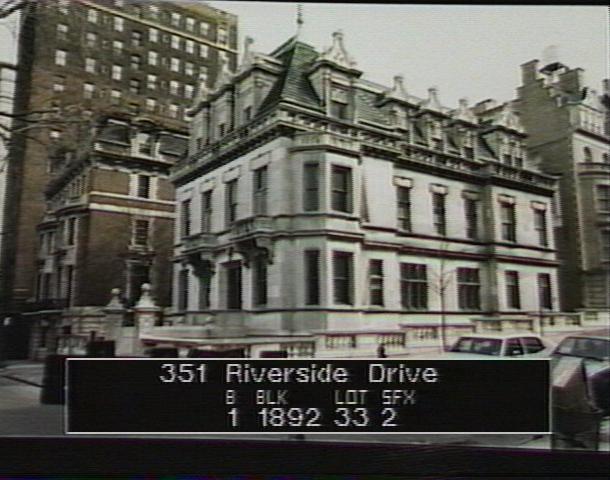
The city photographed every building for its tax records around 1940 and again in the 1980s. NYC Municipal Archives.
Written with AI from the source each entry cites, then fact-checked.
- 1909
The Schinasi household blends Turkish and American tastes, down to a jazz-playing Victrola
Morris Schinasi and his wife Laurette drew on both their homeland and their adopted country when they furnished the new mansion. A friend of the family later described a large sitting room with weighty carved furniture, thick wall hangings, a deep oriental rug, a piano and a Victrola that played jazz. The library was adorned with carved teak panels brought from India by Associated Artists, a decorating firm co-founded by Louis Comfort Tiffany.
Source: Daytonian in Manhattan
- 1909
Architect William Tuthill completes the marble Schinasi mansion
Tobacco importer Morris Schinasi hires architect William Tuthill to design a free-standing neo-French Renaissance mansion clad in white Vermont marble. Built by contractor Charles T. Wills for about $180,000, the two-and-a-half-story house features a mansard roof, carved oak newels with pineapple and tobacco-leaf motifs, and a library paneled in teak imported from India.
Source: Daytonian in Manhattan
- 1909
A sealed tunnel to the Hudson River fuels a lasting legend
A persistent legend holds that a tunnel once ran from the mansion's basement toward the Hudson River, though it has long since been sealed and its original purpose is unknown. Theories range from a private boat landing to smuggling contraband, but the house sits roughly 120 feet above the river, leaving the story unverified.
Source: Ephemeral New York
- 1928
Morris Schinasi dies, leaving an $8.5 million estate and a hospital for his Turkish hometown
Schinasi died on September 10, 1928. He had arrived in New York in 1891 with his brother Solomon, and their firm Schinasi Brothers sold cigarettes made from imported Turkish tobacco under the brand name Natural. His estate was about $8.5 million, and his will provided for building the International Morris Schinasi Hospital in Manisa, the town the brothers came from.
Source: Daytonian in Manhattan
- 1930
The mansion becomes the Semple School for Girls
Two years after Morris Schinasi's 1928 death, his heirs sell the mansion to the Semple Realty Corporation in 1930 for $200,000. Rosa Gunter Semple runs it as a finishing school, the Semple School for Girls, until her death there in 1956 at age 93.
Source: Daytonian in Manhattan
- 1956
Rosa Gunter Semple, who ran the girls' school in the mansion, dies there at 93
Mrs. Semple moved into the Schinasi mansion after the family sold it in 1930 and opened the Semple School for Girls, a finishing school for well-bred young ladies. She died in her rooms in the house on October 10, 1956, at the age of 93. Four years later the building passed to Columbia University.
Source: Daytonian in Manhattan
- 1960
Columbia University turns the mansion into a day care center
Columbia University purchases the former Schinasi mansion in 1960 and operates it as a day care center known as the Children's Mansion. The university sells the house in 1979 to law professor Hans Smit and his wife, Beverly, for a reported $325,000.
Source: Daytonian in Manhattan
- 1968
Columbia's mansion houses the offices of the Current Digest of the Soviet Press
Between 1968 and 1969, while Columbia University owned the house, it held the offices of the Current Digest of the Soviet Press. The mansion had already served as a temporary classroom building in the mid-1960s, when high school students from St. Hilda's & St. Hugh's School attended classes there while their own new building was under construction.
“Between 1968 and 1969, when Columbia owned the building, it hosted the Current Digest of the Soviet Press offices.”
Source: Wikipedia
- 1974
The Landmarks Commission designates the Schinasi Residence after a hearing with no opposition
The Landmarks Preservation Commission held its public hearing on the house on November 27, 1973. Two witnesses spoke in favor and nobody spoke against, and the commission designated the Schinasi Residence a landmark in 1974. Its report calls the house a fine example of neo-French Renaissance style and notes that its architect, William B. Tuthill, trained under Richard Morris Hunt and is best known for Carnegie Hall.
“Two witnesses spoke in favor of designation. There were no speakers in opposition to designation.”
- 1979
Columbia law professor Hans Smit buys the mansion and starts a two-decade restoration
When Columbia decided to sell in 1979, law professor Hans Smit and his wife Beverly bought the house for a reported $325,000. Smit began an interior restoration that ran about two decades. It returned the oak newels carved with pineapples and tobacco leaves, the wall mosaics and the parquet floors to their original 1909 look.
Source: Daytonian in Manhattan
- 2013
Goldman Sachs executive Mark Schwartz buys the mansion for $14 million
Smit first offered the house for sale in 2006 at $30 or $31 million, then cut his price to $29 million, and it stayed unsold for years and was relisted in late 2011. In 2013 Mark Schwartz, a vice chairman at Goldman Sachs, bought it for $14 million. By then it was among the last freestanding single-family houses in Manhattan that were still a home.
“Mark Schwartz, a vice chairman at the Goldman Sachs investment bank, bought the Schinasi House in 2013, paying $14 million.”
Source: Wikipedia
Further reading
- Schinasi HouseWikipedia
- The 1909 Morris Schinasi Mansion - No. 351 Riverside DriveDaytonian in Manhattan
- Does this Riverside Drive mansion really have a tunnel to the Hudson River?Ephemeral New York
Nearby
- Nicholas Roerich Museum319 West 107th Street | 9 entries
- The Manhasset301 West 108th Street | 8 entries
- Canavan Mansion333 Riverside Drive | 4 entries
- Charles de Cordova House312 West 105th Street | 6 entries
- Harmony Hall544 Cathedral Parkway | 6 entries
- Master Building310 Riverside Drive | 13 entries