Charles de Cordova House
312 West 105th Street | Upper West Side | built 1900
Open on the map6 entries

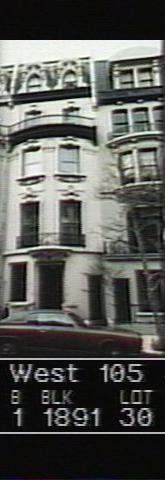
The city photographed every building for its tax records around 1940 and again in the 1980s. NYC Municipal Archives.
Written with AI from the source each entry cites, then fact-checked.
- 1900
Developer John C. Umberfield has Janes & Leo build a row of French-style mansions on West 105th Street
John C. Umberfield bought the block front of West 105th Street between the newly finished Riverside Drive and West End Avenue and hired Janes & Leo to design a row of high-end houses, numbers 302 to 320. Construction began in 1899 and took a year. The firm chose a French Beaux-Arts look closer to the Upper East Side's mansions than to the brick-and-stone houses typical of the West Side, and the homes went on sale in 1900.
Source: Daytonian in Manhattan
- 1901
Tea importer Charles de Cordova buys No. 312
Umberfield sold No. 312 to Charles de Cordova that April. De Cordova, born in London in 1854, ran De Cordova & Co., a tea brokerage described as a leader in the American tea trade. He pushed for a tea law in 1895 and is credited with helping pass the 1897 Tea Importation Act, which barred tea contaminated with pesticides or metals.
Source: Daytonian in Manhattan
- 1906
The de Cordovas' only child, Fanny, marries a Boston doctor in the house
The mansion hosted the wedding of Charles and Ella de Cordova's daughter and only child, Fanny, to a Boston physician, Dr. John W. Sanborn, on April 18, 1906. The family summered in Stockbridge, Massachusetts, or Lakewood, New Jersey. Ella was active in St. Luke's Church's Women's Guild and served as treasurer of the School of Domestic Art and Sciences.
Source: Daytonian in Manhattan
- 1925
Robert Davison Petty, the new dean of New York Law School, buys the house for $31,000
In 1925 Robert Davison Petty paid $31,000 to the de Cordovas for No. 312. The year before, he had become dean of the New York Law School, which led him to resign as assistant district attorney. A farm accident, a scythe cutting his knee while he cut corn, had ended his hopes of manual work and set him on the road to law. He and his wife, Florence, raised seven children, four of them in the house.
Source: Daytonian in Manhattan
- 1932
Dean Petty dies in his sleep hours after handing diplomas to 124 law graduates
On the night of June 2, 1932, Petty presented degrees to 124 New York Law School graduates. Back home he told his son-in-law he would like to return to the farm someday. When he did not come down for breakfast the family assumed he was tired, and at noon his daughter Elizabeth found that he had died in his sleep. The funeral took place in the house the next Monday.
Source: Daytonian in Manhattan
- 1945
A Hungarian refugee doctor, Laci Klein, makes the house a haven for relatives escaping the Nazis
After No. 312 was sold on August 20, 1945, the house became home to Dr. Laci Klein and his wife Ancsi, Jewish refugees who had recently escaped Hungary. According to Judy Cohen's book Song of the Silent Bell, Klein gave his siblings a place to live as they fled the Nazi regime, while Ancsi's family died in the Holocaust. The couple took the name Kay when they became citizens in 1952 and stayed until early 1956.
Source: Daytonian in Manhattan
Further reading
- Riverside–West 105th Street Historic DistrictWikipedia
- The 1900 Charles de Cordova House - 312 West 105th StreetDaytonian in Manhattan
Nearby
- Canavan Mansion333 Riverside Drive | 4 entries
- Master Building310 Riverside Drive | 13 entries
- George Gershwin House316 West 103rd Street | 4 entries
- Humphrey Bogart House245 West 103rd Street | 3 entries
- Nicholas Roerich Museum319 West 107th Street | 9 entries
- Schinasi House351 Riverside Drive | 11 entries