317 West 4th Street
West Village | built 1836
Open on the map4 entries

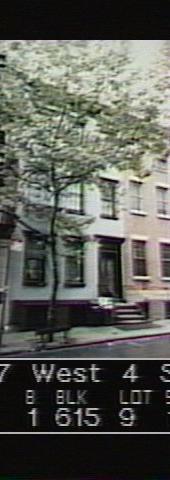
The city photographed every building for its tax records around 1940 and again in the 1980s. NYC Municipal Archives.
Written with AI from the source each entry cites, then fact-checked.
- 1868
Storage-warehouse owner and Seventh Regiment captain Augustine Pressinger buys the house
In June 1868 real estate operator Cyrus W. Price sold No. 317 for $8,500 to his son-in-law, Augustine E. Pressinger. Born in London in 1824, Pressinger ran a storage business with warehouses on Washington Street and had been made a captain in the Seventh Regiment in 1851. His wife Mary also traded Manhattan properties, and the attic was apparently raised to a full floor in their time. Pressinger died in 1877; Mary sold the house in 1885.
Source: Daytonian in Manhattan
- 1923
Boarder Captain Edwin A. Quinn of the fire department wins the Bennett Medal for a rescue
In 1923 Edwin A. Quinn, a captain in the fire department, was a boarder in the house. On May 24 that year he received the Bennett Medal for bravery in a deadly fire of November 3, 1922, at a factory on East 13th Street that made nitro-cellulose novelties. Five young women died, but Quinn climbed a ladder to a third-floor window, advanced with a hose line and crawled along the floor to rescue three others.
Source: Daytonian in Manhattan
- 1926
Retzker Realty turns the house into a rooming house with a front fire escape
The Retzker Realty Company bought No. 317 from Georgine E. E. Poppe in October 1926 and ran it as a rooming house. A fire escape was attached across the front, and the 19th-century stoop ironwork gave way to solid masonry wing walls. A renovation completed in 1968 divided the building into three apartments, and the wing walls were probably replaced then with iron railings more suited to the house.
Source: Daytonian in Manhattan
- 1945
A resident draws scrutiny from Congress for serving as the Joint Anti-Fascist Refugee Committee's executive secretary
In 1945 and 1946 Helen R. Bryan, who lived in the house, attracted the suspicion of the congressional committee on un-American activities because she served as the Joint Anti-Fascist Refugee Committee's executive secretary. That group raised money for relief organizations abroad, among them a Cuban association aiding victims of the war in Spain.
Source: Daytonian in Manhattan
Further reading
- The 1836 Augustine E. Pressinger House - 317 West Fourth StreetDaytonian in Manhattan
- Then & Now photos: 317 West 4th StreetVillage Preservation: Greenwich Village Then & Now
Nearby
- 319 West 4th Street2 entries
- 315 West 4th Street5 entries
- 313 West 4th Street5 entries
- 284 West 12th Street2 entries
- 37 Bank Street1 entry
- 33 Bank Street1 entry